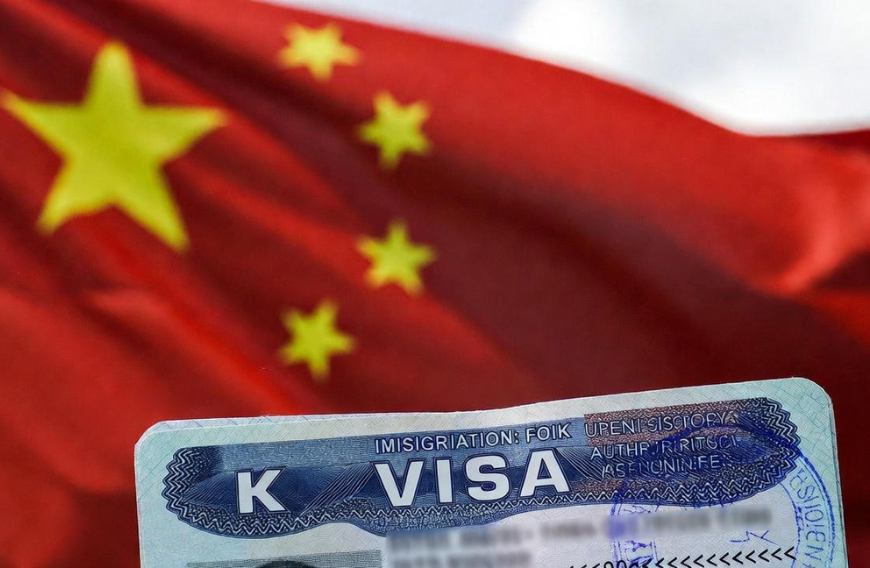
Vaishnavi Srinivasagopalan, an experienced Indian IT professional with a background spanning role in India and the United States, is now exploring opportunities in China. Her prospects have brightened with Beijing’s introduction of the new K-visa program, a policy specifically designed to attract skilled science and technology professionals from around the world.
Beijing appears to be capitalizing on growing uncertainty in the U.S. immigration landscape. Its recently launched K-visa program, introduced last month is part of a broader push to attract top global talent and narrow the gap with America in advanced technology fields. The move comes as many skilled professionals face increasing hurdles under President Donald Trump’s stricter H-1B visa policies, giving China an opening to lure talent that once saw the U.S. as its primary destination.
For Srinivasagopalan, the growing uncertainty around U.S. work visas has prompted her to look eastward. Drawn by China’s newly launched K-visa program, she sees an emerging opportunity in the country’s expanding tech landscape. “(The) K-visa for China (is) an equivalent to the H-1B for the U.S.,” said Srinivasagopalan, who became interested in China’s work culture after her father spent time teaching at a Chinese university. “It is a good option for people like me to work abroad.”
Building on China’s existing R-visa for foreign professionals, the new K-visa goes a step further by easing entry barriers for global talent. Unlike previous programs, applicants are not required to secure a job offer before applying, a move seen as part of Beijing’s broader effort to make China a more accessible destination for skilled workers.
Tougher U.S. immigration rules under President Trump, including steep hikes in H-1B visa fees, now set at $100,000 for new applicants are pushing many skilled professionals and students to look beyond America’s borders. For some, China’s more open approach through initiatives like the K-visa is emerging as an appealing alternative.
READ: US cracks down on H-1B visa ‘potential abuse’ with 175 investigations (
Bikash Kali Das, an Indian master’s student of international relations at Sichuan University in China, said, “Students studying in the U.S. hoped for an (H-1B) visa, but currently this is an issue.”
China is using the uncertainty surrounding U.S. visa rules to its advantage. As more skilled professionals struggle with stricter American immigration policies, Beijing is presenting itself as a practical alternative. Its new K-visa program, aimed at science and technology workers, lowers entry barriers and makes it easier for foreign experts to relocate. The move reflects China’s effort to fill talent gaps and strengthen its position in global innovation while the U.S. continues to tighten access for foreign professionals.
“Beijing perceives the tightening of immigration policies in the U.S. as an opportunity to position itself globally as welcoming foreign talent and investment more broadly,” as per Barbara Kelemen, associate director and head of Asia at security intelligence firm Dragonfly.
Despite a large pool of university graduates, China faces high unemployment and a shortage of specialized skills in science and technology. The government sees this gap as a weakness it needs to close. For years, many of China’s brightest students have built their careers in the U.S. and Europe after studying abroad. Now, with programs like the K-visa, Beijing is trying to reverse that trend by attracting both returning Chinese professionals and foreign experts to strengthen its domestic talent base.
Alfred Wu, an associate professor at the National University of Singapore, noted that many Chinese families still regard Western education as superior and continue sending their children abroad for studies. Yet, a quiet shift is underway.
READ: DHS to end automatic extension policy for immigrant work permits (EADs) (
In recent years, a number of professionals, including AI researchers, scientists, and engineers have begun returning to or relocating to China, among them several Chinese-Americans. Notably, Fei Su, a chip architect formerly at Intel, and Ming Zhou, a senior engineer from U.S.-based Altair, both accepted teaching positions in China this year. The appeal is not limited to Chinese nationals; according to Edward Hu, a Shanghai-based immigration director at Newland Chase, interest in the new K-visa has also grown among skilled workers from India and Southeast Asia.
“The job market is already extremely competitive,” said Zhou Xinying, a 24-year-old behavioral science postgraduate at Zhejiang University in eastern China. Zhou acknowledged that the arrival of foreign professionals could “bring about new technologies” and expose local industries to broader global perspectives. Still, she added, “some Chinese young job seekers may feel pressure due to the introduction of the K-visa policy.”
Nikhil Swaminathan, an Indian professional on an H-1B visa who works with a U.S. nonprofit after completing his graduate studies, says he’s curious about China’s K-visa program, though he remains cautious about its promises. “I would’ve considered it. China’s a great place to work in tech, if not for the difficult relationship between India and China,” Swaminathan said.
“The U.S. is probably more at risk of losing would-be H-1B applicants to other Western economies, including the UK and European Union, than to China,” said Feller at Geopolitical Strategy.
“The U.S. may be sabotaging itself, but it’s doing so from a far more competitive position in terms of its attractiveness to talent,” Feller said. “China will need to do far more than offer convenient visa pathways to attract the best.”
