
Listen to this article
Estimated 4 minutes
The audio version of this article is generated by AI-based technology. Mispronunciations can occur. We are working with our partners to continually review and improve the results.
It was a day of congratulating the winners and perhaps consoling the loser at the NATO summit for Canada’s prime minister.
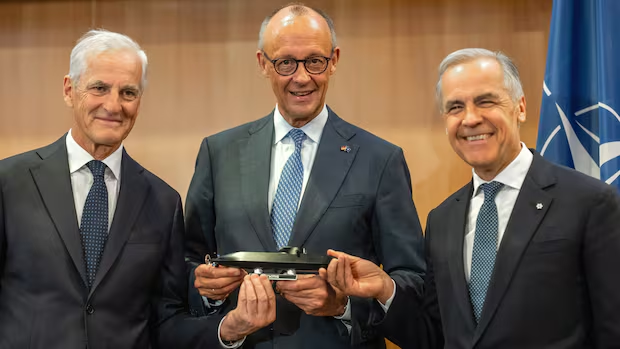
Mark Carney met with the leaders of Germany and Norway on Tuesday in a trilateral meeting where they thanked each over Canada’s decision to accept German shipyard ThyssenKrupp Marine Systems (TKMS)’s bid to build 12 submarines for the navy.
Carney also briefly met face-to-face with South Korea’s president on the margins of the Ankara gathering.
Both encounters came less than 24 hours after Carney announced the winning bidder, leaving South Korea’s Hanwha Ocean as the runner-up supplier in the multibillion-dollar program.

Prime Minister Mark Carney says Canada is negotiating to procure ‘up to 12’ submarines from German shipbuilder ThyssenKrupp Marine Systems. Speaking to reporters in Halifax, Carney says the reported $24-billion procurement is the ‘largest in Canadian history.’
In one instance, it was evidently smoothing the diplomatic waters with South Korean President Lee Jae Myung, whom Carney informed of the decision over the weekend by phone.
Going into the summit, Canadian officials had indicated that Carney would hold a formal bilateral meeting with Lee. But it was removed from the schedule abruptly and the Prime Minister’s Office said there was a more casual encounter on the sidelines.
Lee was present at NATO because South Korea is fast becoming a major arms supplier to many nations in the 32-member alliance.
Carney’s meeting with German Chancellor Friedrich Merz and Norwegian Prime Minister Jonas Gahr Støre had the air of a celebration.
“We made the right decision for Canada. We made the right decision for NATO,” Carney said at the opening of the trilateral gathering.
Merz says the decision was important for both Canada and Europe.
“This something which is bringing the people together, which is bringing our countries together, and which is not just a military procurement,” Merz said.
“This is something, which is, really, a new era of co-operation between this part of the world.”
Earlier in the day, Merz told European media that the Canadian submarine decision was a major boost to the German economy.
The Current18:24Can Canada become a NATO leader as US support wanes?
NATO members are gathering in Ankara, Turkey at a fraught time. The wars in Ukraine and Iran are ongoing and there are questions about how the alliance will reimagine itself as the US reduces support. Guest host Catherin Cullen speaks with Kerry Buck, Canada’s ambassador to NATO from 2015 to 2019, Gönül Tol, the founding director of the Middle East Institute’s Turkish Program, and Oana Lungescu, NATO’s principal spokesperson from 2010 to 2023 about the future of NATO and Canada’s role in the alliance.
Defence Minister David McGuinty said he understood the disappointment of the South Koreans and described Carney’s encounter with Lee “as a very good exchange and very encouraging.”
He also insisted the Canada-South Korea relationship remains strong.
“It’s obvious when you have two bidders, one bidder is going to be chosen, the other will not,” McGuinty said, reiterating that if contract talks with TKMS fail, Ottawa will turn to Hanwha Ocean.
“Look, there’s a lot of co-operation possibilities here between Canada and Korea.”
One of the areas of co-operation he referenced could still involve military equipment.
South Korea equips many of Canada’s closest allies with armoured vehicles and mobile artillery — two commodities the Canadian Army is looking for.
Progress for defence bank
At the same time, Canada announced that it and eight other mostly small European nations will be joining Carney’s push to create a Defence, Security and Resilience Bank.
The concept is best described as a World Bank for defence where countries can access private capital to make critical security investments at a much lower cost.
With so much money now begging to slosh around in the defence sector, some experts are growing concerned.
“It doesn’t matter how much you spend if you don’t spend it in the right way and that has been a problem that NATO has had over the years,” said Rachel Ellehuus, director general of the U.K.-based Royal United Services Institute.
As money pours into the sector, she said NATO countries need to set clear, collective spending priorities that will benefit the alliance as a whole, not just individual nations.
That money would be well spent on “critical enablers, not long-term developmental programs,” Ellehuus said.
“I get it. Everybody wants to be the first to create a next-generation fighter. But there are real gaps now, today.”
One of the most critical gaps NATO faces is in drone production and employment. Most countries are also short on air defence equipment.
Although it’ll take several years, Canada’s purchase of submarines fills an important gap since the United States has signalled it will no longer provide certain capabilities to NATO in the event of war.
Although the list hasn’t been published, reports suggest U.S. submarines are one of the items the Pentagon intends to withhold.