TL;DR: USD/CAD has stabilized after absorbing the initial tariff shock, but Friday brings two catalysts operating on completely different axes — Canadian GDP tests whether the BoC can mainatin patience, while Warsh’s Jackson Hole speech tests whether the Dollar deserves a smaller or larger credibility discount.
CAD Moves Beyond First Tariff Repricing
A week that began with renewed fears over US-Canada trade relations is ending with Canadian Dollar surprisingly steady. Breakdown in talks late Aug. 21 brought 50% US tariffs on roughly C$28bn of Canadian exports, followed by Canada’s announcement of counter-tariffs covering around C$27.6bn of US goods from Sept. 8.
Initial CAD selling confirmed tariffs mattered, but scale of move suggested markets had already discounted substantial risk of negotiations failing. With no further escalation since, pressure has faded and CAD has stabilized. Trade dispute nevertheless remains unresolved, and Sept. 8 is still an important risk date. Stabilization means first shock has been absorbed; it does not mean tariff premium has disappeared.
Canada Could Print Strong Growth at an Awkward Moment
Friday’s Q2 GDP could give CAD its next independent catalyst. Consensus points to around 3.3% annualized growth, reversing two consecutive contracting quarters. But expected rebound is unusually dependent on trade: exports are seen rising roughly 18.3%, imports 6.3%, while domestic demand grows only around 1.2%.
That makes headline simultaneously encouraging and backward-looking. Q2 ended in June, nearly two months before trade talks collapsed. A strong report would show Canada had more economic momentum entering tariff escalation, but its main source of strength—exports—is now precisely where outlook has become less secure.
For BoC, that distinction matters. Rate remains at 2.25%, bottom of its estimated neutral range. With inflation around 3%, case for cutting is already weak; fragile growth and trade uncertainty are what argue against tightening. An upside GDP surprise would chip away at that second constraint and could encourage markets to bring eventual normalization toward 2.75% forward from current early-2027 timetable.
But it would not make September hike automatic. BoC would still have reason to wait for evidence that activity remained resilient after August tariff escalation. Strong Q2 GDP can remove a reason for delay without confirming that Q3 has remained strong enough to justify action.
ActionForex’s Technical View on USD/CAD: 1.3730 Returns to Focus as Rebound Fades
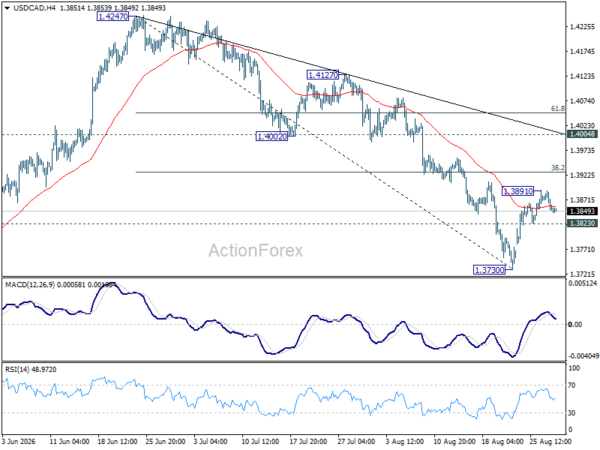
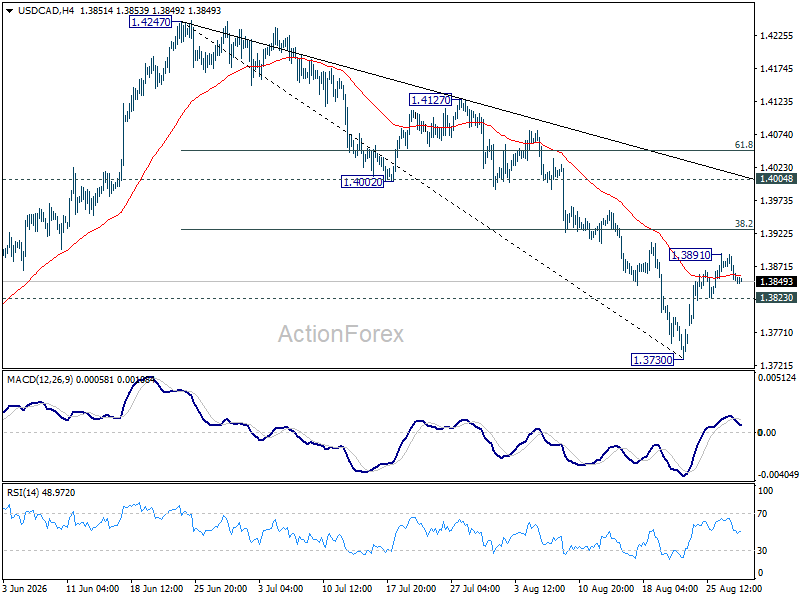
GDP lands against a technical backdrop that has become increasingly favorable to CAD. USD/CAD rebounded from 1.3730 to 1.3891, but recovery remains comfortably below 1.3927, 38.2% retracement of decline from 1.4247 to 1.3730. That keeps fall from 1.4247 intact and leaves rebound looking corrective rather than start of a fresh uptrend.
Momentum is also fading on 4H chart. MACD has crossed back below its signal line and RSI has retreated toward neutral around 49. Break below 1.3823 minor support would argue recovery from 1.3730 completed at 1.3891 and bring 1.3730 back into focus.
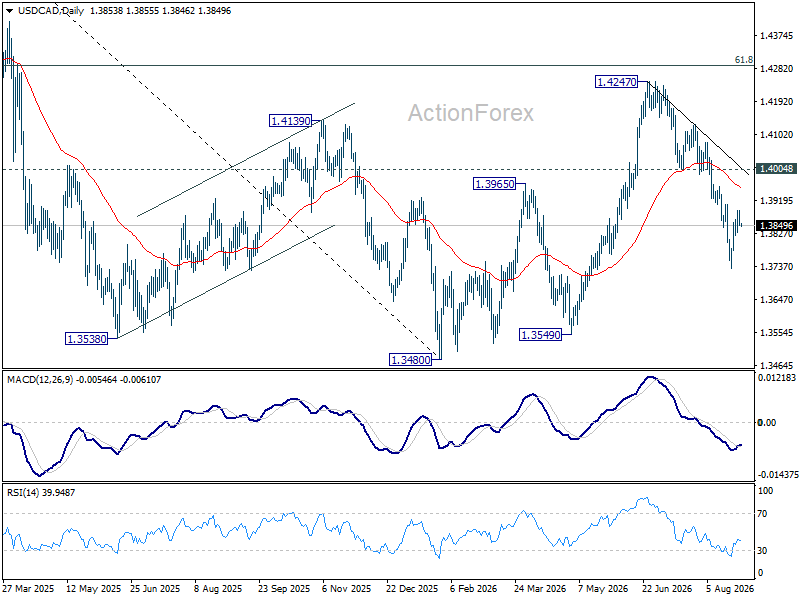
Firm break of 1.3730 would carry bigger implications. Decline from 1.4247 is viewed as reversing entire three-wave corrective advance from 1.3480, making that February low next major downside reference. Daily momentum is not yet accelerating sharply lower, however, so 1.3823 remains important confirmation rather than treating another downside leg as already underway.
Warsh Tests Dollar Credibility, Not Just Rate Expectations
Canada GDP controls only one side of USD/CAD. Later, Fed Chair Kevin Warsh can determine whether Dollar reinforces or overwhelms whatever Canadian data deliver.
Warsh has already indicated his Jackson Hole address will focus on longer-term structural questions rather than conventional near-term rate guidance. That makes simple hawkish-versus-dovish interpretation less useful. More important is whether he clearly defends Fed independence as Treasury becomes increasingly active in long-end bond market, or leaves room for markets to infer closer Treasury-Fed coordination.
A market-discipline message that firmly separates Fed from Treasury’s yield-management efforts could strengthen Dollar by reducing institutional-credibility discount, potentially overwhelming even a strong Canadian GDP reaction. A fiscal-dominance interpretation would do opposite, weakening Dollar if investors see monetary policy becoming more accommodating toward government financing pressures. An ambiguous speech may leave existing credibility concerns largely intact rather than actively reversing them.
Two Catalysts, Two Different Axes
Friday therefore gives USD/CAD two catalysts operating through completely different channels. GDP is rate-adjacent: it tests whether Canadian growth is strong enough to reduce BoC’s need for patience. Warsh is credibility-adjacent: he tests whether Dollar deserves a smaller or larger institutional discount.
For USD/CAD to break decisively below 1.3730, cleanest combination would be stronger Canadian data followed by a Warsh message that fails to restore Dollar credibility—or actively reinforces concerns over fiscal dominance. A strong market-discipline speech could instead neutralize CAD-positive GDP and revive rebound.
CAD has already shown it can survive first tariff shock. Friday will show whether that resilience is strong enough to become a renewed advance.
Key Takeaways
- CAD has stabilized after absorbing the initial 50% tariff shock, but the dispute remains unresolved with Canada’s Sept. 8 counter-tariffs still a live risk date.
- Q2 GDP consensus of 3.3% annualized growth is unusually export-dependent, meaning a strong print reflects pre-tariff momentum rather than resilience to the current trade escalation.
- A GDP beat would remove one BoC constraint against cutting but wouldn’t confirm Q3 activity has held up, so it doesn’t make a September hike automatic.
- Warsh’s Jackson Hole speech operates on a separate axis from GDP: it tests Dollar credibility and Fed independence, not near-term rate expectations.
- USD/CAD needs both a stronger Canadian GDP print and a Warsh speech that fails to restore Dollar credibility to break decisively below 1.3730 support.