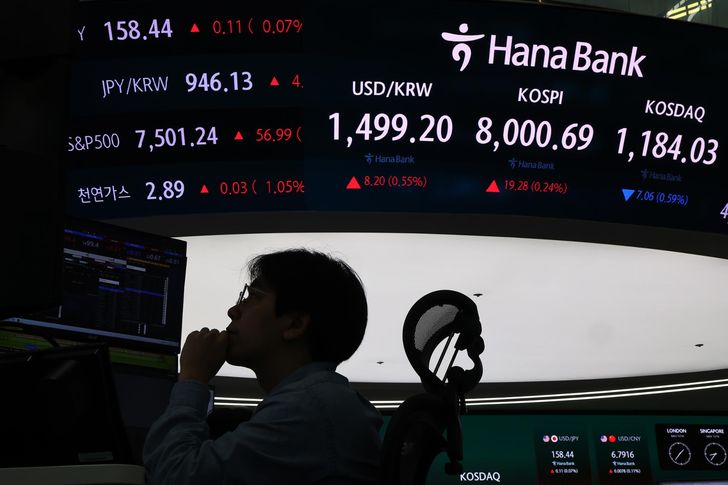
A stock ticker at Hana Bank headquarters in central Seoul shows the benchmark KOSPI crossing the 8,000 mark for the first time during intraday trading, Friday. Yonhap
A single post uploaded May 8 by a Korean civil servant on Blind, the anonymous workplace community app, quickly set off a frenzy online.
The post included a screenshot of his brokerage account showing he had poured a staggering 2.3 billion won ($1.7 million) into shares of semiconductor giant SK hynix, one of the key driving forces behind Korea’s roaring stock market.
Even more striking, 1.7 billion won of that investment was financed through margin loans borrowed from his brokerage.
“I believe the semiconductor market will continue its upward climb through 2028, but I’m taking a more aggressive approach to grow my assets faster,” he wrote. Four days later, on May 12, he returned with an update claiming he had already locked in 267 million won in profits.
That same day, another Blind post surfaced — this time from a Seoul Metro employee in her 20s, who wrote that rather than missing out on the rally, she would “risk complete collapse,” adding that she had used 150 percent margin financing to fully leverage into stocks.
As Korea’s bull market barrels ahead, more retail investors are turning to borrowed money to magnify returns, despite associated risks. As of Friday, outstanding margin loans used for stock purchases had ballooned to a record 36.47 trillion won, according to the Korea Financial Investment Association.
For Korea’s securities firms, the recent retail borrowing boom has become a lucrative windfall.
According to recent industry data, the nation’s 10 largest brokerages — Korea Investment & Securities, Mirae Asset, Samsung, Kiwoom, NH, KB, Shinhan, Hana, Meritz and Daishin — generated a combined 600 billion won in interest income from margin lending in the first quarter of this year, up 55.9 percent from a year earlier.
Margin loans allow investors to borrow money from brokerages to buy stocks by pledging existing assets as collateral. While this can amplify gains, it also comes with annual interest rates ranging from 7 to 9 percent, and if share prices fall too sharply, brokerages can force-sell holdings to recover their loans.
For now, bullish sentiment shows few signs of cooling.
With the benchmark KOSPI climbing from the 4,000 range late last year to surpass the historic 8,000 mark in less than half a year, many retail investors appear willing to embrace higher-risk strategies in pursuit of faster gains.
In a May 10 report, J.P. Morgan raised its base-case KOSPI target to 9,000, with a bull-case projection of 10,000, arguing that investors should “stay positioned for further upside and not preemptively anticipate a cycle-end.”
The investment bank pointed to a “higher for longer” memory chip upcycle, fueled in large part by sustained artificial intelligence-driven demand, while also identifying brokers, insurers, holding companies and dividend-heavy sectors as major beneficiaries of the country’s broader market transformation.