If there is indeed an AI bubble, it may be quietly deflating before our eyes thanks to rising bond yields.
Rates on 10-year Treasurys have climbed recently as investors sweat higher oil prices, sticky inflation, and snowballing government debt. Those higher yields have helped to put downward pressure on stock valuations.
Usually, such a derating results in a more dramatic decline in stock prices, but valuations have seen a more orderly pullback, with some individual names struggling but the indexes still not far from highs reached this summer.
It’s a “rare” scenario, according to Jeff Blazek, the co-head of multi-asset strategies at Neuberger, which manages $613 billion in assets.
In a note on Tuesday, he said that the S&P 500’s forward price-to-earnings ratio has dropped from 22.9 last October — which had been the highest level since 2000 — to 19.09 currently.
That’s fairly middle-of-the-road for the valuation gauge over the last six years, and almost as low as valuations got around the bottom of the sell-off that followed the “Liberation Day” announcement in April 2025. The Magnificent Seven stocks have seen their collective forward PE ratio drop from about 33 to 23, he pointed out.
Meanwhile, the S&P 500 is still up 12.8% since its forward PE peak last October.
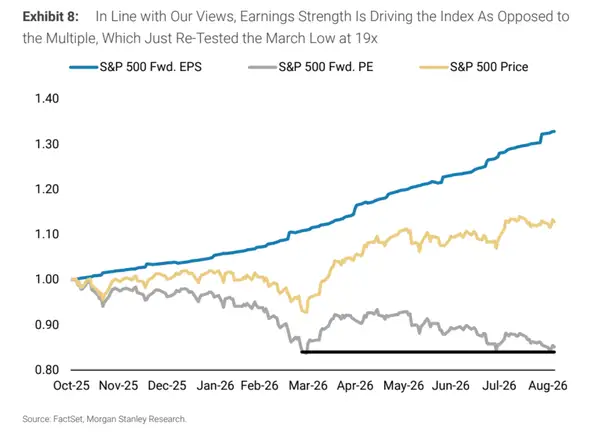
A chart from Morgan Stanley in a September 8 client note illustrates this dynamic:
Morgan Stanley
The forward PE ratio accounts for two components: today’s stock price and expected earnings over the next 12 months. It essentially allows investors to measure how expensive the market is — what the dollar price is you’re paying for the profits you expect to generate over the next year.
Recent stellar earnings have bolstered the “E” portion of the ratio and essentially forced stock prices to rise. But macro pressures have also created some headwinds for stocks, allowing earnings growth to outpace stock price growth.
This has brought down valuations in a way that’s more palatable to investors, as opposed to stock prices falling while earnings stagnate.
Government bond yields have been a major pressure point recently. Investors measure risk-free Treasury rates against the future return potential they see in stocks. When Treasury yields rise — yields on the 10-year touched 19-year highs this week — investors historically have been less willing to pay for stocks at high valuations, since they can find substantial guaranteed returns elsewhere.
“The bar for taking risk is rising as rates reset higher, making the durability of earnings more important,” said Wei Li, the global chief investment strategist at the BlackRock Investment Institute, in a September 14 note.
Li added that “exceptional earnings growth, attractive valuations and a cleaner tactical backdrop” support the firm’s overweight rating for US and AI stocks.