Bangladesh is exploring the possibility of joining the newly signed military agreement between Pakistan, Saudi Arabia and Turkey, which has been termed as an “Islamic NATO”.
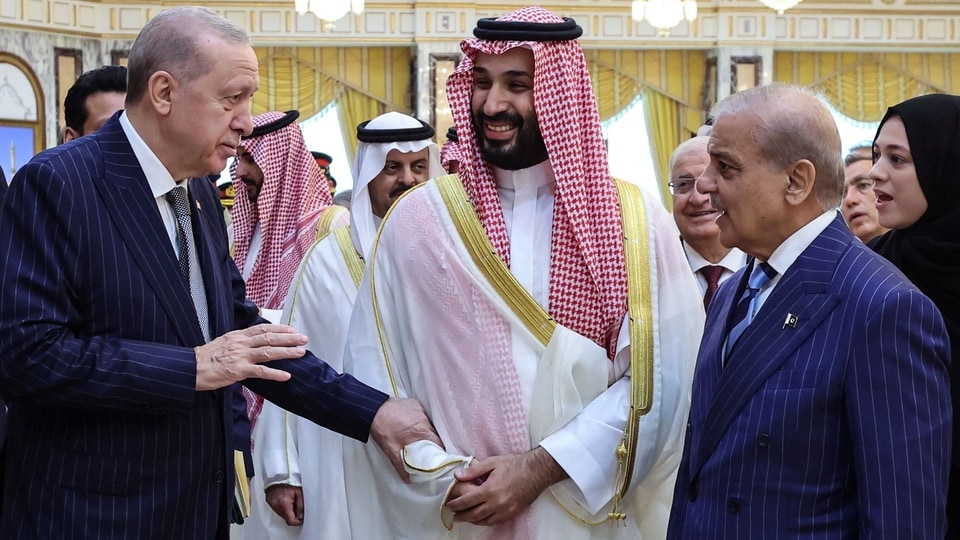
Officially called the Mecca Joint Defence Agreement, the military pact was signed by the three countries on August 7. Pakistan’s defence minister Khawaja Asif said at the time that he wanted the pact to expand and become something like “an Islamic NATO”, and not remain an “exclusive club”, He had called on the Islamic nations to bury their differences and come together.
The pact, according to media reports, has drawn attention in Dhaka as Bangladesh looks to strengthen its defence capabilities and secure key economic interests.
Officials in Dhaka maintain that their willingness to evaluate the Mecca pact is guided strictly by national interest and a desire to diversify geopolitical ties amid regional uncertainty and domestic political transition.
What is ‘Islamic NATO’?
The Mecca Joint Defence Agreement was signed in Saudi Arabia’s Mecca by Saudi Crown Prince Mohammed bin Salman, Turkish President Tayyip Erdogan and Pakistani Prime Minister Shehbaz Sharif on August 7.
The agreement includes a collective defence provision under which an armed attack on one of the three countries would be treated as an attack on all. This is akin to Article 5 of the NATO charter, hence the name “Islamic NATO”.
The pact also provides for greater cooperation in defence production, technology transfer and joint military exercises.
Pakistan’s deputy Prime Minister Ishaq Dar, who also oversees the foreign ministry, described the agreement as “purely defensive” and said it remains open to other countries in the region.
The pact came amid heightened regional tensions and concerns over Iran’s military posture, which has affected Saudi Arabia following the US-Israel war on Tehran.
Interest from Bangladesh
Bangladesh has historically been closer to India while also trying to balance its relations with China. However, recent strains with New Delhi over issues including borders and water-sharing have prompted Dhaka to consider broader security partnerships. Another strain has been the extradition of former prime minister Sheikh Hasina, who has been living in India since her ouster in August 2024 due to a student-led uprising.
Her Awami League, seen as closer to India, remains banned in Bangladesh, and the Bangladesh Nationalist Party (BNP) came to power earlier this year with Tarique Rahman becoming the Prime Minister. Since coming to power, Rahman has advocated for a “Bangladesh First” policy and has had somewhat cold ties with India. Dhaka’s interest in the so-called Islamic NATO stems from there.
Bangladesh’s Foreign Affairs Adviser Humayun Kabir said in mid-August that Dhaka had a “positive approach” towards a possible economic or defence framework involving the three countries, guided by its “Bangladesh First” policy, according to a Reuters report.
A close aide to Bangladesh PM Tarique Rahman also told Bangladesh Sangbad Sanstha that Bangladesh was keen on joining a formation like the Mecca Pact.
Why joining the Mecca Pact may make sense to Dhaka?
For Bangladesh, closer ties with Saudi Arabia could help protect a vital source of remittances coming into the country. Saudi Arabia was Bangladesh’s biggest remittance source in the 2025-26 financial year, contributing about $5.28 billion in the first 11 months. It is roughly 16 per cent of total inflows, a big chunk for the country. Saudi investment potential might also be lucrative.
Turkey and Pakistan are already important suppliers of military equipment to Bangladesh. Turkey provides drones, frigates and armoured vehicles, while Pakistan supplies fighter jets such as the JF-17 Thunder and naval vessels.
Closer cooperation under the pact could open opportunities for technology transfer, joint production, training and access to defence equipment.
Energy security is another factor for Dhaka, which may drive it towards the pact. Bangladesh depends heavily on imports for its energy needs, relying on shipping routes through the Red Sea and Bab el-Mandeb Strait for supplies from West Asia.
The pact could be seen as helping to protect oil and LNG shipments, supporting more stable energy prices, and safeguarding shipping routes used by Bangladesh’s garment exports to Europe.
What are the challenges?
Getting into any pact with Pakistan as a proponent could be a challenge for the Bangladesh government, as it will face backlash from the secular forces in the country. Memories of the 1971 war of independence with Pakistan are still fresh in the minds of a section of the society.
Dhaka would also have to balance its relations with India and China.
The exact operational mechanisms and membership criteria of the Mecca Agreement also remain unclear.
As of now, Bangladesh has not formally announced a decision to join. However, its interest signals a possible shift in Dhaka’s foreign policy, with security, remittances, energy and investment all forming part of the calculation.
(With Reuters inputs)