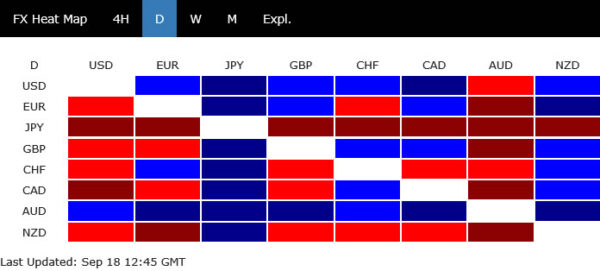
What’s happening: AUD led the major currencies Friday while Yen was weakest. The BoJ hiked its policy rate 25bp to 1.25%, its highest since 1995, on a 7–2 vote, yet Yen weakened past 157 against Dollar, JGB yields fell and Nikkei rose. The RBA made no rate decision, but Governor Michele Bullock testified that “inflation is too high” and that August’s identified upside risks “appear to be materialising” ahead of the September 29 meeting.
Why it matters: This isn’t two unrelated domestic stories. Bullock and BoJ Governor Kazuo Ueda independently cited the same combination, the Middle East energy shock and the global AI investment boom, as inflation drivers, a framing the ECB and BoE have also used this week. What separated AUD and Yen was the policy surprise relative to expectations: the RBA sounded more hawkish than markets expected, while the BoJ’s hike came with more resistance, two dovish dissents and no updated forecasts, than Yen bulls wanted to see.
Energy and AI Emerge as a Synchronized Global Shock
At his post-meeting press conference, Ueda said global central banks were responding to “similar factors.” He identified inflation pressure from the Middle East conflict and strong AI expenditure, which was simultaneously supporting economic growth and lifting prices. The BoJ’s statement also cited AI-related demand, higher oil prices and Yen depreciation as forces expected to push Japanese core inflation clearly above 2% from the second half of fiscal 2026.
Bullock used a similar framework during testimony to the House of Representatives Standing Committee on Economics in Canberra. She said the prolonged Middle East conflict, global AI boom and extreme weather were lifting energy, agricultural and technology costs. The BoE had already highlighted AI-related demand as a source of global price pressure in its minutes earlier this week. Three major central banks have therefore begun describing the same combination of supply pressure and investment demand.
The common shock explains why central banks are leaning toward tighter policy. It does not explain the currency rankings by itself. For that, markets focused on whether each central bank delivered more or less tightening than expected.
Central Banks Citing the Same Shock
- BoJ Governor Ueda: central banks are responding to “similar factors,” Middle East conflict inflation pressure plus strong AI expenditure.
- BoJ statement: AI-related demand, higher oil prices and Yen depreciation expected to push core inflation clearly above 2% from H2 fiscal 2026.
- RBA Governor Bullock (Canberra testimony): prolonged Middle East conflict, global AI boom and extreme weather lifting energy, agricultural and technology costs.
- BoE: already flagged AI-related demand as a global price-pressure source in this week’s minutes.
Yen Falls Despite the BoJ Hike
The BoJ raised its policy rate by 25bp to 1.25%, its highest since 1995. Yet Yen weakened beyond 157 against Dollar, the 10-year JGB yield fell 4.9bp to 2.947%, and Nikkei 225 gained 1.38%. The usual cross-asset response to a rate increase was reversed because investors treated the composition and communication of the decision as more important than the widely anticipated hike.
The decision passed by a 7–2 vote, with Policy Board members Toichiro Asada and Ayano Sato preferring to leave the rate at 1.00%. Asada pointed to core inflation slowing from 1.8% to 1.7% and questioned whether the economy was sufficiently strong. Sato argued that economic activity and prices had not accelerated enough to justify another increase. The two hold votes surprised markets and reduced confidence in an immediate follow-up move.
The meeting also came without an updated quarterly outlook. That limited the BoJ’s ability to reinforce the rate increase with higher inflation forecasts or a revised assessment of the policy path. The statement remained close to the language used in July, disappointing investors positioned for a clearer signal of accelerated normalization.
There was also a political dimension. Both dissenters were appointed under Prime Minister Sanae Takaichi, whose administration has favored accommodative monetary conditions and expansionary fiscal policy. Their votes suggested that faster normalization could face more resistance, notwithstanding US pressure on Japan to address Yen weakness.
Friday’s BoJ Decision
- Policy rate: raised 25bp to 1.25%, highest since 1995.
- Vote: 7–2, Asada and Sato dissented, preferred holding at 1.00%.
- Market reaction: Yen weakened past 157/USD, 10-year JGB yield fell 4.9bp to 2.947%, Nikkei 225 gained 1.38%.
- No updated quarterly outlook accompanied the decision; statement language stayed close to July’s.
- Political dimension: both dissenters were appointed under PM Takaichi, whose administration favors accommodative policy.
Ueda Keeps October Open
The market’s initial interpretation should not be confused with the BoJ closing the door on consecutive tightening. Asked about a 50bp move or back-to-back increases, Ueda said policymakers “shouldn’t rule anything out.” He cited the Fed and ECB as examples of central banks acting pre-emptively to avoid being forced into sharper increases later.
Ueda also said the BoJ would quantify the economic and inflation impact of Friday’s hike in its next quarterly report in October. The October 30 meeting will therefore carry something Friday’s decision lacked: fresh forecasts capable of supporting a firmer policy signal. The two dissents reduced the perceived probability of another immediate hike, but Ueda preserved the option if incoming evidence warrants faster action.
Hawkish RBA Testimony Lifts AUD
Australia produced the opposite policy surprise. The RBA made no rate decision on Friday, but Bullock delivered a hawkish assessment ahead of the September 29 meeting. She said “inflation is too high” and that upside risks identified in August “appear to be materialising.”
Australia also entered the global energy and AI shock with less spare capacity than many peers. Bullock emphasized that the economy began with excess demand, leaving less room to absorb another inflationary impulse. RBA liaison indicated that businesses were already passing higher input costs to customers, and she warned that persistent transmission into broader price and wage decisions could require a stronger policy response.
There were counterweights. Household spending growth was moderating, housing prices and new lending had declined, and the full impact of this year’s rate increases had yet to reach the economy. But these developments had not generated substantial spare capacity. Labour conditions remained slightly tighter than full employment, while forward-looking employment indicators were stable rather than signaling an imminent downturn.
Business investment was another source of resilience. Spending on data centres and renewable-energy projects had accelerated, supporting demand even as weak productivity limited how rapidly the economy could grow without generating inflation. The AI boom was therefore operating in Australia as both a growth engine and a near-term inflation risk.
RBA Deputy Governor Andrew Hauser reinforced the message by saying the Bank would “persevere.” He also described the exchange rate as the “biggest single channel” through which higher interest rates affect the economy. A stronger Australian Dollar reduces import costs and contributes directly to the RBA’s effort to contain inflation, making AUD appreciation part of the policy transmission mechanism rather than merely a market side effect.
The RBA has already delivered 75bp of tightening this year, lifting the cash rate to 4.35%. Bullock did not pre-commit to another increase on September 29, but the collective message was difficult to interpret as neutral.
Bullock’s Hawkish Case
- “Inflation is too high,” and August’s identified upside risks “appear to be materialising.”
- Australia entered the shock with less spare capacity, existing excess demand.
- RBA liaison: businesses already passing higher input costs to customers.
- Counterweights present (moderating household spending, softer housing/lending, past hikes not fully felt) but insufficient to generate substantial spare capacity.
- Business investment in data centres and renewable energy accelerating, AI as both growth engine and inflation risk.
- Deputy Governor Hauser: RBA will “persevere”; exchange rate is the “biggest single channel” of policy transmission.
- 2026 tightening so far: 75bp, cash rate at 4.35%.
One Shock, Two Policy Surprises
| BoJ (Japan) | RBA (Australia) | |
|---|---|---|
| Today’s action | Hiked 25bp to 1.25%, 7–2 vote | No rate decision; hawkish testimony ahead of Sept 29 |
| Market reaction | Yen weakened, JGB yields fell, Nikkei rose | AUD strengthened |
| Surprise | More resistance than expected, two dissents, no new forecasts | More hawkish than expected |
| Next test | October 30 meeting, with fresh quarterly forecasts | September 29 meeting |
One Shock, Two Policy Surprises
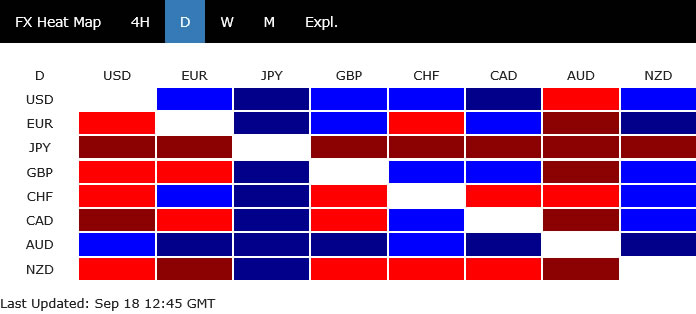
Friday’s heatmap reflected relative expectations rather than opposing inflation fundamentals. Japan raised rates, but unexpected dissents and cautious communication weakened confidence in an immediate follow-up move. Australia made no decision, but its officials strengthened the case that more tightening could be required.
The Middle East energy shock and AI investment boom are reaching every major economy at once. AUD and Yen diverged because Australia appeared closer to its next hike, while Japan’s latest increase exposed more resistance to the one after it.
Related Coverage
BoJ & Yen Deep Dive
USD/JPY Jumps as Back-to-Back BoJ Hike Risk Fades—Can Momentum Carry It Back to 160? — the technical picture behind today’s Yen move, with 157.11 the first test and 160 the bigger one.
BoJ Raises Rate to 1.25%, Yet Dovish Dissents Cloud Next Move — more on the political dimension behind Friday’s two dissents.
Japan Core CPI Slips to 1.7%, but Underlying Inflation Holds at 1.9% — the inflation data Asada cited in his dissent, and why the underlying picture looks firmer than the headline.
RBA & AUD Deep Dive
RBA Turns More Hawkish as Excess Demand Meets Global Inflation Shock — the fuller case for why the Board is questioning whether 75bp of tightening is enough.
Global Central Bank & Data Watch
ECB’s Lagarde Says Rates Will Not Move in Lockstep With Energy Prices — how the ECB is balancing the same energy shock against growth risks.
UK Retail Sales Rise 0.5% as Non-Food Stores Recover — a rebound that beat expectations even as higher prices weighed on fuel volumes.
Silver Correction Ends at 62.27—Can 68.32 Unlock the Path to 80.32? — the technical setup for Silver’s next leg if 68.32 breaks.
FAQ
Why did Yen weaken even though the BoJ hiked rates?
Two dovish dissents (Asada and Sato) and the absence of updated quarterly forecasts left markets doubting an immediate follow-up hike. Investors reacted more to the decision’s composition and communication than to the rate increase itself.
Does the BoJ still plan to hike again soon?
Governor Ueda said policymakers “shouldn’t rule anything out,” including a 50bp move or back-to-back hikes. The October 30 meeting will bring the BoJ’s next quarterly report with fresh forecasts that could support a firmer signal.
What made the RBA’s message more hawkish than expected if it didn’t move rates?
Governor Bullock said inflation is “too high” and that August’s identified upside risks “appear to be materialising,” while Deputy Governor Hauser said the Bank would “persevere” and called the exchange rate the “biggest single channel” of policy transmission, making AUD strength itself part of the RBA’s inflation-fighting toolkit ahead of the September 29 decision.
Key Takeaways
- AUD led major currencies Friday and Yen was weakest, driven by a shared Middle East energy shock and AI investment boom that both RBA Governor Bullock and BoJ Governor Ueda cited independently.
- The BoJ hiked its policy rate 25bp to 1.25%, its highest since 1995, but Yen weakened past 157 because a 7–2 vote with two dovish dissents and no updated forecasts left markets doubting an immediate follow-up move.
- Ueda said the BoJ “shouldn’t rule anything out” on a 50bp move or back-to-back hikes, and the October 30 meeting will bring fresh quarterly forecasts that could support faster normalization.
- The RBA made no rate decision, but Bullock’s hawkish testimony and Hauser’s comments on the exchange rate as the “biggest single channel” of transmission strengthened the case for more tightening ahead of the September 29 meeting.
- The divergence reflected relative policy surprise rather than opposing inflation fundamentals: Australia appeared closer to its next hike, while Japan’s hike exposed more resistance to the one after it.
What to Watch Next
The RBA’s September 29 meeting for whether Friday’s hawkish testimony converts into an actual hike, and the BoJ’s October 30 meeting, its first with updated quarterly forecasts since Friday’s decision, for evidence of whether faster normalization is back on the table despite this week’s dissents.