Aston Villa know that to remain competitive and in line with manager Unai Emery’s demands that they push the elite clubs, they need to sell well.
However much they rail against football’s various financial regulations and to whatever extent they believe the rules are in place to impede aspirational sides and enable the traditional bigger ones, Villa have plotted a route to the top.
And across Emery’s three full seasons as their manager, they have been incredibly successful: two Champions League qualifications (cruelly missing out in the other campaign only on goal difference) and, of course, winning the Europa League.
Villa supporters are tired of their club being obstructed by what they see as the Premier League’s closed shop because, regrettably, the remedy to all of this is to sell players.
And Villa do that well. Better than anyone, in fact.
With over a month of this summer’s transfer window still to go, two marquee assets have already gone from Villa Park.
Youri Tielemans joined Manchester United, who activated the midfielder’s £35million release clause, and forward Morgan Rogers moved to Chelsea for £117m — a record for a British player. The next biggest asset, Ezri Konsa, could leave too, but Villa and Arsenal are currently some way apart on their respective valuations for the England international defender.
Villa’s upward mobility has been built on robust foundations and consistency throughout the team, even if they have regularly sold players.
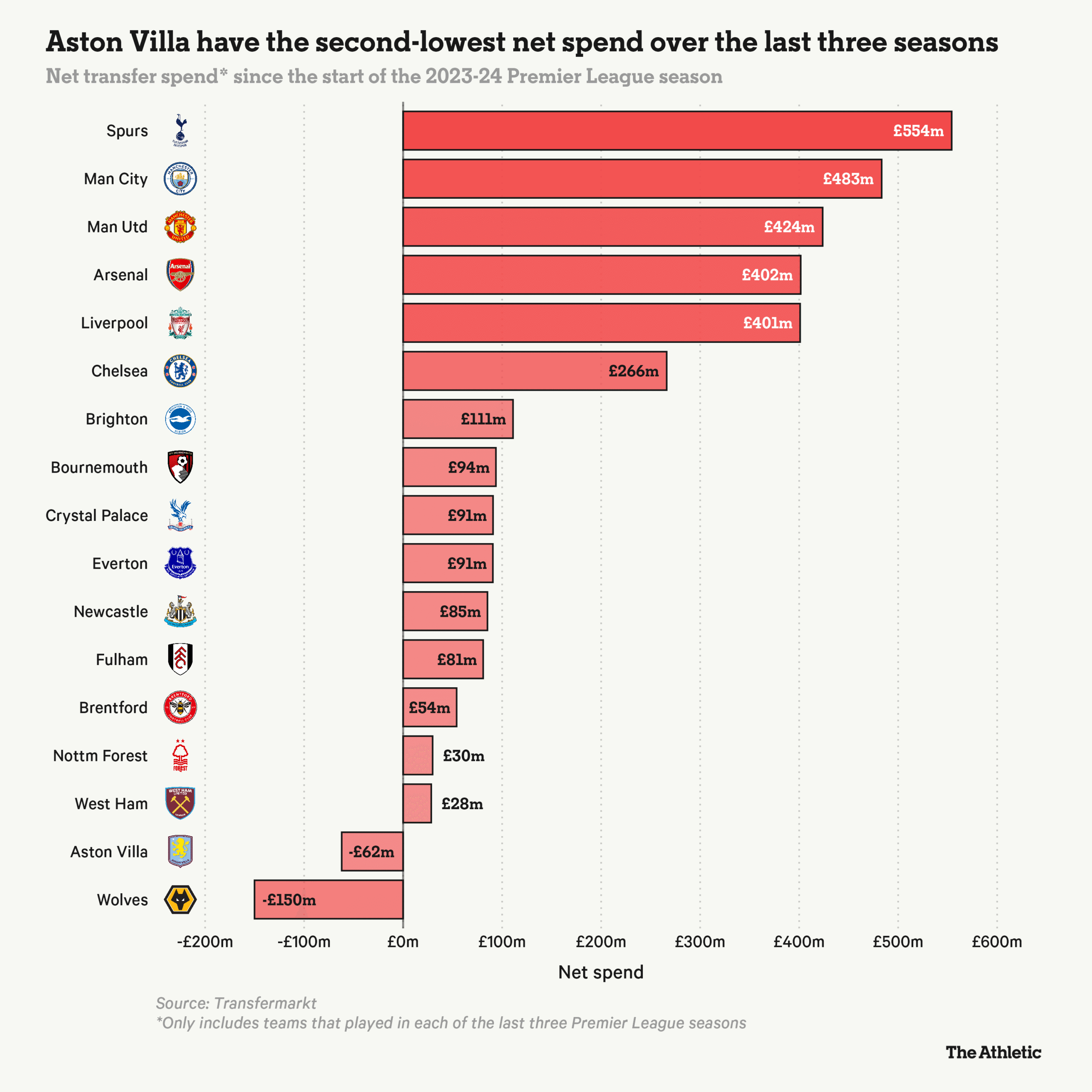
Of all Premier League clubs to have featured in all three of Emery’s full seasons, only Wolverhampton Wanderers (who got relegated in May) had a lower net spend than Villa. In that period, Emery’s men have earned the fourth-most points of any team, only behind Liverpool, Manchester City and Arsenal, all of whom rank within the top four for net spend.
With Wolves now in the Championship, Villa have the lowest net spend in the Premier League.
Selling to buy is Villa’s primary method for competing sustainably and, according to club sources speaking anonymously to protect relationships, this was again discussed with Emery heading into the summer.
Even if Rogers and Tielemans are key departures, with the former generating the club’s greatest-ever windfall, there have been multiple examples of big-money outgoings during the Spaniard’s tenure.
Moussa Diaby left for Al Ittihad in a package that totalled about £50million, Douglas Luiz joined Juventus for £42.5m, Jacob Ramsey moved to Newcastle United for a similar amount and Jhon Duran, who Villa adored but accepted that no more rope could be afforded to his eccentricities, departed for Al Nassr in a deal worth close to £65m.
In Tielemans’ case, Villa would have wanted more than the £35million stated in his release clause. But there was a shared belief from sources close to both player and club that, all in all, considering they had signed him as a free agent three years ago and he is now 29, that was close to a fair price.
From the aforementioned players, Villa generated around £235million, having signed them — Ramsey came through their academy — for close to £65m combined, giving them a significant profit.
Although academy staff would love to see their young talents on a pathway into the club’s first team, the nature of profitability and sustainability rules (PSR) encourages homegrown sales because they deliver pure bookable profit. In turn, there is satisfaction that the academy has been instrumental in Villa navigating the threat of PSR.
Jack Grealish’s £100million switch to Manchester City in 2021 helped considerably, but Villa have continued to sell effectively. In the past five years, their academy has raised more than £200m via sales.
In summer 2023, Villa avoided PSR’s imminent danger by selling Aaron Ramsey, Cameron Archer and Jaden Philogene, while inserting buy-back options and other controlling mechanisms in the agreements. Include Aaron’s older brother, Jacob, and those four had been worth more than £100million, with Philogene bringing in more money 18 months later with a move to Ipswich Town, having been bought back after a year at Hull City.

Jaden Philogene has been sold twice by Villa over the past three years (Aston Villa/Aston Villa FC via Getty Images)
A similar pattern of thinking has been repeated in this window, with The Athletic revealing earlier this month that Villa are increasingly receptive to selling previously loaned-out players and many of their academy talents.
Rather than send them on loan and paying a percentage of their salary, Villa seek a flexible approach, looking to sell youngsters in deals including certain mechanisms that allow them to retain a level of control.
To comply with the UEFA Settlement Agreement this year, Villa have to balance the squad in relation to costs.
The club will be assessed by UEFA, European football’s governing body, over a three-year period, from the 2024-25 season to 2026-27. Considering the losses of the previous two years, Villa will, most likely, require a football earnings profit in 2026-27 to ensure their losses are below the UEFA threshold of €60million (£51.2m/$68.2m at the current rates).
Villa have scope for those combined losses to reach €80million — they’ll be hit with a proportional fine for any breach over €60m — but beyond that, unless they show good financial health to qualify for a slightly higher loss-limit (which English clubs rarely do), there is no leeway: they would be banned from European competition for one season.
Rogers’ sale was crucial to complying with UEFA rules. Chelsea were keen on the player before he joined Villa for an initial £8million (plus £7m in potential add-ons) from Middlesbrough in January 2024. Middlesbrough will take some of the fee Chelsea are paying, in light of their sell-on clause, but Villa will still bank a profit of more than £90m.
Villa have a close relationship with Chelsea. Alejandro Garnacho’s move in the opposite direction, on an initial season-long loan with a conditional obligation to buy, stemmed from talks between the two clubs, with Emery a long-standing admirer of the Argentine forward.
There is a track record of both teams displaying an openness to discuss buying and selling.
In summer 2024, Ian Maatsen came to Villa Park from Chelsea for £37.5million, with academy graduate Omari Kellyman moving from the second city to west London for £19m. The Premier League, having initially asked for proof of the justification in paying that amount for Maatsen, approved the transaction.
Not discounting the sales of Lucas Digne to Paris Saint-Germain (£8million), Lewis Dobbin to Southampton (£9m), and Donyell Malen to Roma for £23m, which, on reflection, looks cheap considering the player they signed as his replacement in January, Tammy Abraham, is now available to leave, Villa have been proactive in banking money already for those regarded as expendable.
Continuing to move on unwanted squad members would assist with having the scope to bring in recruits.
Even if this summer will show the largest transformation of Emery’s squad since he was appointed in October 2022, selling is nothing new for Villa.
In the past, they have not only found a solution for departures, but have ended up improving on the pitch.
Fundamentally, the coming season’s level of success will hinge on whether they are able to rise to such a challenge once more.