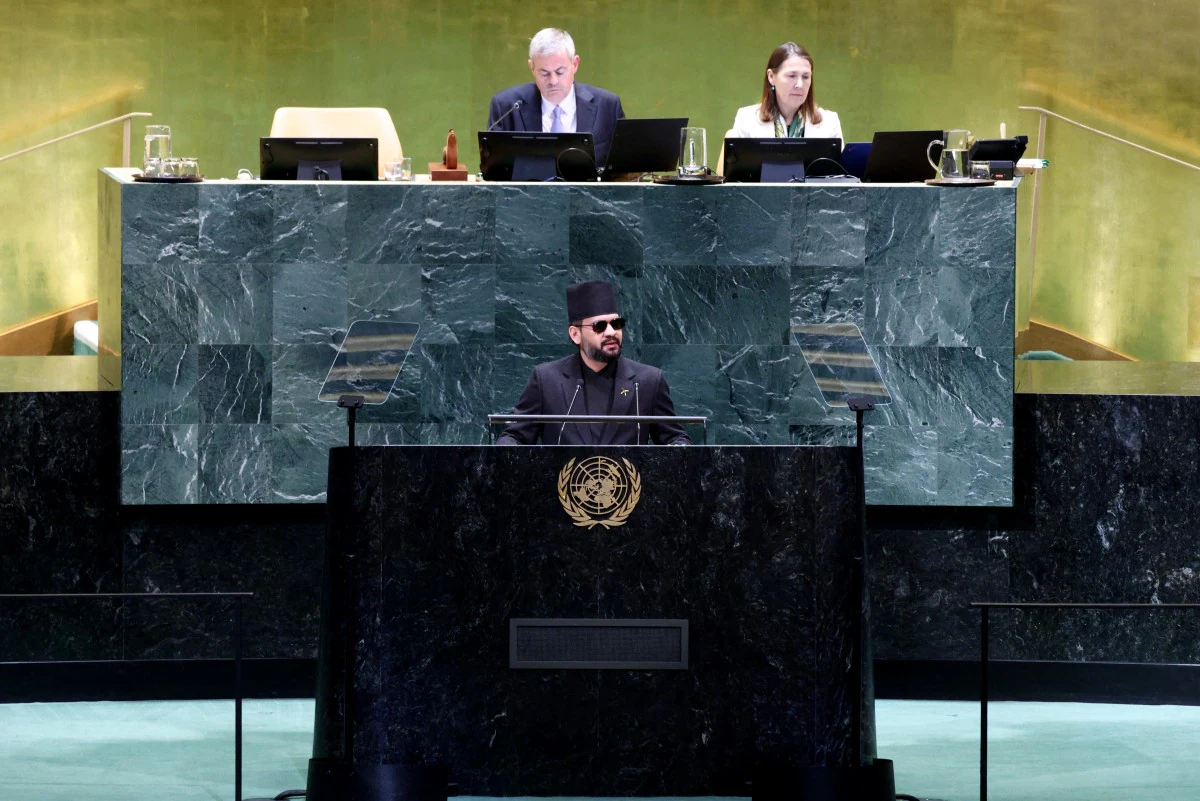
While delivering his maiden speech at the 81st session of the United Nations General Assembly on Thursday, Nepal’s Prime Minister Balendra Shah questioned a global system where weapons cross borders rapidly while farmers struggle to access fuel and fertilizer.
“Inter-continental missiles arrive on time. Rifles and ammunition cross borders, clear every bottleneck, meet each deadline. But a peasant in Nepal cannot procure his fertilizer or fuel at market price at a time of need”, he said.
In his speech, Shah strongly criticised the current global order, stating, “We have built a world with flawless logistics for war and broken logistics for food.”
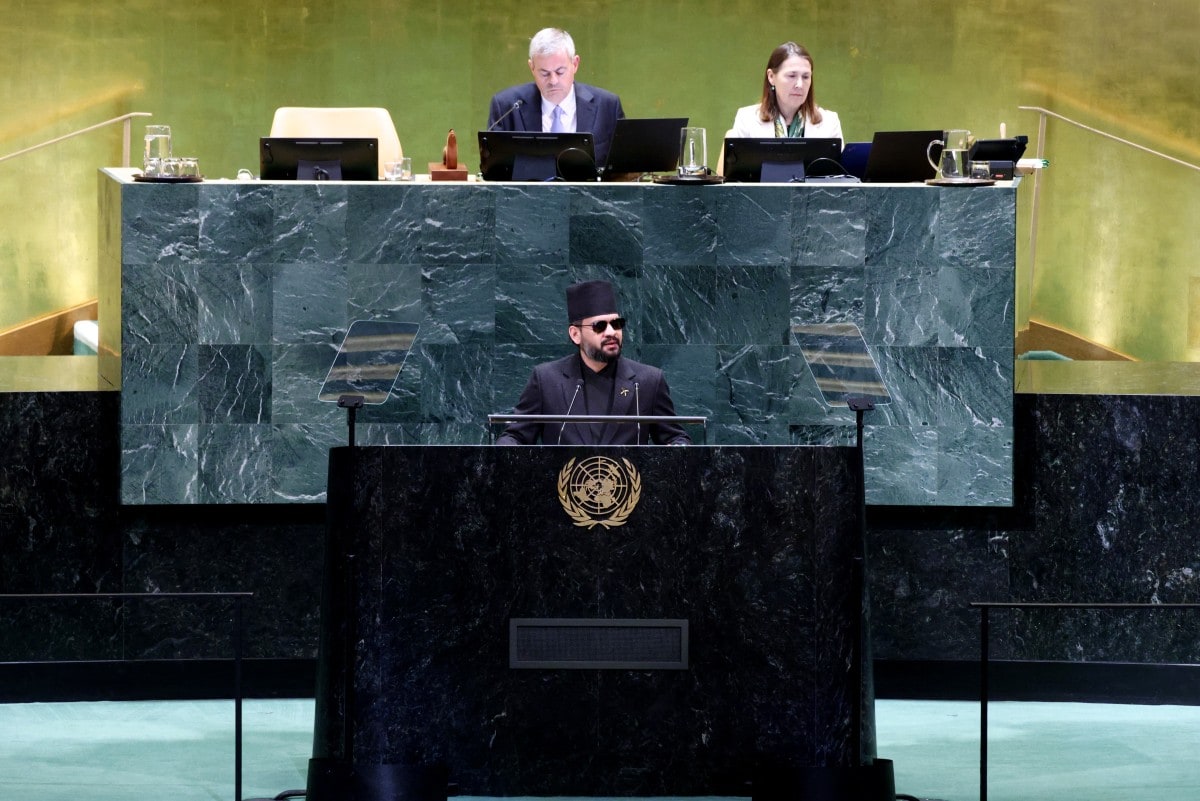
Nepal’s Prime Minister Balendra Shah speaks during the 81st United Nations General Assembly at UN headquarters in New York on September 24, 2026
Photo Credit: AFP
At 36, Shah spoke as the youngest head of government at the assembly this year, using the global platform to advocate for climate justice for South Asian nations.
“And this is not Nepal’s private misfortune. Ask Bangladesh. Ask Bhutan. Ask India. Ask the Maldives. Ask Pakistan. Ask Sri Lanka. Ask any other country in our region and you will hear the same account: hit by the climate we did not warm, and hit again by the wars we did not start. This tells us there is a lot more broken than meets the eye in the present order of global cooperation,” he said.
Shah’s hard-hitting speech followed the catastrophic Bhotekoshi floods in Nepal on August 26, 2026, which tragically killed over 1,400 people and left thousands missing. He broadened his message to include the shared vulnerabilities of the entire South Asian region, urging world leaders to look at the ground realities of the global order.
Nepal PM Proposes Himalayan Climate Resilience Mechanism
He then proposed that a Himalayan Climate Resilience Mechanism should be established since a warming climate is destabilising the region’s ecology and should be led by his country, India and China.
“The Hindu Kush Himalaya is home to nearly two billion people. These mountains provide water, ecosystems, agriculture and livelihoods to populations far beyond Nepal. The Himalayas are not peripheral to the planet. They are part of the planet’s life-support system,” Shah said.
“That is why, as an urgent first step, we propose that we establish a Himalayan Climate Resilience Mechanism, led by Nepal, India and China,” Shah said.
He said that through the mechanism, the countries can share satellite data and expertise with each other.
Speaking at the UNGA, the Nepali leader highlighted that climate change does not care for borders and that glaciers and floods do not travel with a visa and passports.
Balen Shah Thanks India, China For Assistance
Shah expressed Nepal’s deep gratitude to the countries that came to its aid in the aftermath of the deluge. “Our immediate neighbours, India and China, offered prompt and generous assistance. Other friendly countries, the United Nations system, humanitarian agencies, philanthropies, and people around the world stood with Nepal,” he said.
According to the Rapid Disaster Needs Assessment (RDNA) report prepared by a joint technical team of the National Planning Commission and the National Disaster Risk Reduction and Management Authority, the recent floods are estimated to have caused losses of US$2.69 billion.
The RDNA report estimates that US$4.77 billion will be required for the reconstruction and recovery of affected infrastructure and assets, equivalent to around 10 per cent of the country’s gross domestic product (GDP).