When Spain head coach Luis de la Fuente announced his World Cup squad back on May 25, it immediately sparked a heated debate at Real Madrid.
There were eight players from Barcelona in the 26-strong group, with several other domestic sides represented too, including Atletico Madrid, Athletic Club, Real Sociedad, Celta Vigo and Osasuna.
For the first time, not a single Real Madrid player was included.
There was no room for Dani Carvajal (who is leaving Madrid at the end of June) Alvaro Carreras nor Dean Huijsen — though 22-year-old back-up striker Gonzalo Garcia was called up for Spain’s World Cup warm-up friendlies.
The fact Madrid were not going to be represented became a huge talking point, with the situation amplified by the club’s presidential election campaign.
Florentino Perez’s challenger, 37-year-old businessman Enrique Riquelme, promised to sign “Madrid stars who can make Spaniards proud” if he was voted in, repeatedly criticising his rival over the issue. Perez, who won the June 7 election with a 65 per cent share, did not address the topic publicly.
Perhaps the 79-year-old always had a plan. With the €60million (£51.9m; $69.6m) signing of Marc Cucurella from Chelsea confirmed in the build-up to Spain’s 0-0 draw against Cape Verde on Monday, Madrid do now have a Spanish World Cup star. The 27-year-old is De la Fuente’s favoured option at left-back, and he is expected to compete with Carreras for a starting spot at the Bernabeu next term.
But it is interesting to look back on the controversy that swelled up, because it illustrates something instructive about Madrid’s domestic fan base — and its relationship with Spain, which is not quite as straightforward as you might think.
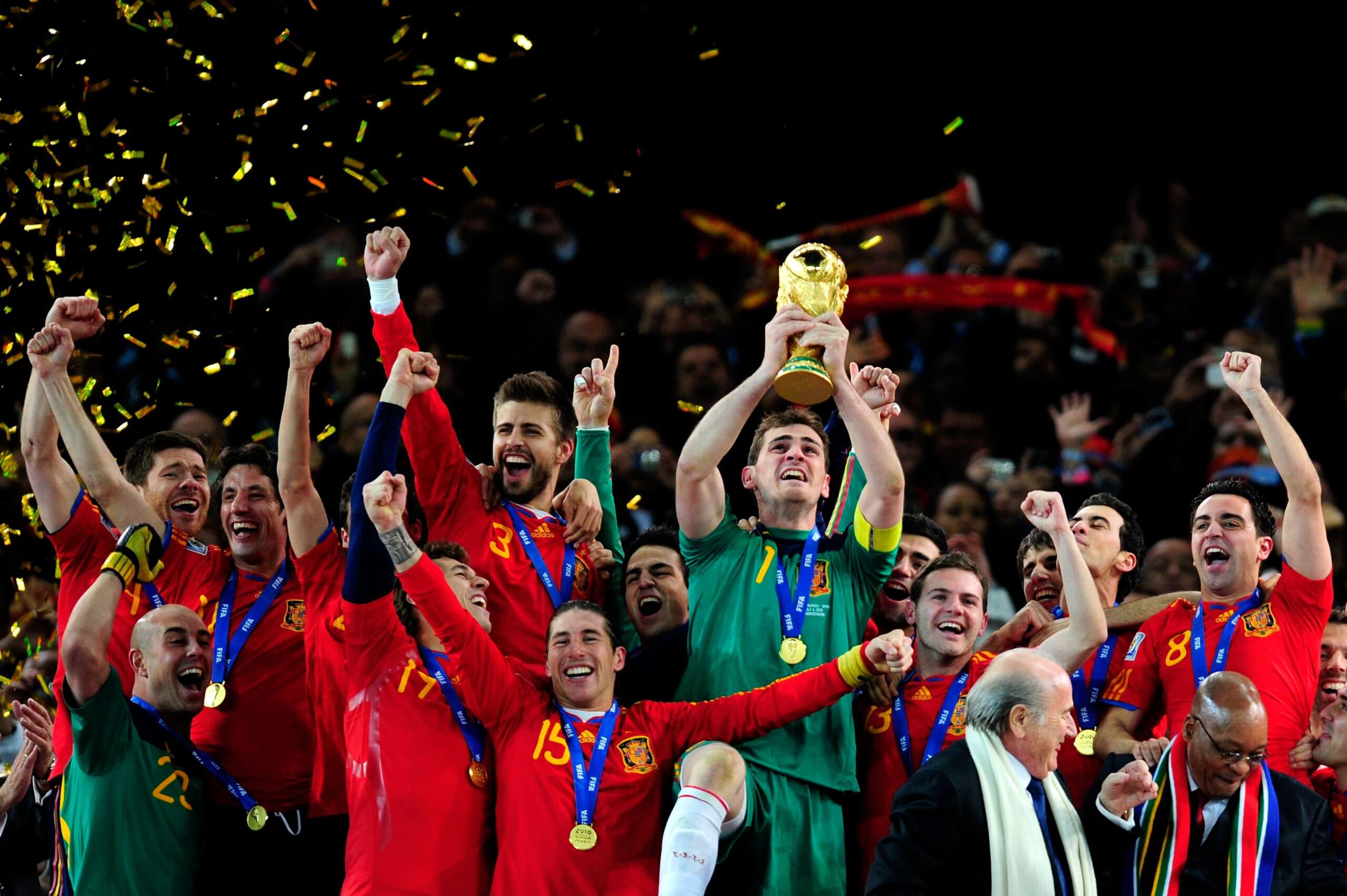
Former Real Madrid goalkeeper Iker Casillas lifting the 2010 World Cup with Spain (Jamie McDonald/Getty Images)
Before Spain’s golden run that brought two European Championships and their first World Cup between 2008-2012, they had repeatedly fallen short on the international stage.
Some Madrid fans contrasted this with their club’s continental success. Zinedine Zidane’s volley at Hampden Park in May 2002 sealed their ninth European Cup/Champions League trophy. A month later, Spain were dumped out of the World Cup quarter-finals by co-hosts South Korea.
And on the way to that Euro 2008 victory, Spain manager Luis Aragones upset Madrid fans by dropping club legend Raul. The national team’s brilliant new cycle did include key Bernabeu figures such as Iker Casillas, Sergio Ramos and Xabi Alonso (who in 2008 was with Liverpool), but the side was more heavily influenced by Barcelona.
At the 2010 World Cup, Barca supplied eight players to the squad (including David Villa, who agreed to join from Valencia before the tournament). Of these, seven started the final against the Netherlands. It would be far-fetched to say Madrid fans did not rejoice in Spain’s successes during this period, but such is the toxicity of the Clasico rivalry that it was certainly a tempering factor for some.
There was another factor at play here, too.
These days, great numbers of supporters around the world base their loyalties around individuals, an increasingly common theme in some corners of the globalised game.
At Madrid, even among what some might want to term the legacy fanbase, the individual has often been favoured over the collective to a further degree. It is almost written into the galactico methodology.
In terms of recruitment, Madrid will always chase the best talent, wherever they find it.
After Perez won re-election earlier this month, one of the first images posted on the club’s social media was a celebration of the team’s players who would be representing their national teams this summer, including Jude Bellingham for England, Vinicius Junior for Brazil and Arda Guler for Turkey.
Why Cape Verde and Spain’s draw was a shocking upset
Felipe Cardenas
Kylian Mbappe, captain of France, was for some reason absent, but the symbolism was still striking. Each could be considered their country’s leading figure.
People who have worked closely with Perez for years say he has always taken particular satisfaction in seeing Madrid’s players exchanging pennants (sometimes with each other) before kick-off in major international matches.
And facing the prospect of having no players in the Spain squad, many Madrid supporters felt it natural to instead choose one of their favourite players’ national teams to follow.
For many, Brazil was the first option that came to mind. Former Madrid boss Carlo Ancelotti is in charge, Vinicius Jr is on the wing and Endrick also in the squad after a productive loan spell at Lyon, with real curiosity about whether he can carry that momentum onto the biggest stage.
The rest of Madrid’s Brazilian contingent, Eder Militao and Rodrygo, would surely also have been picked had it not been for injury.

Brazil drew their opening World Cup match with Morocco 1-1 (Mauro Pimentel/AFP via Getty Images)
Supporting France, meanwhile, would mean wishing Mbappe on towards another World Cup trophy. He starred on the way to success in 2018, came close to another with a hat-trick in the 2022 final won by Argentina and now has the chance to define an international era outright.
England offers something slightly different. Bellingham is hugely popular but still feels like a work in progress; someone who arrived at Madrid with huge expectations and immediately met them, only to then hit a more uneven stretch. A strong World Cup would reinforce the idea that he is moving towards something much bigger than we have already seen.
Belgium brings Thibaut Courtois, though little expectation of title contention. Germany offers Antonio Rudiger, always reliable but not necessarily a star.
More attractive to some was Portugal, because of Cristiano Ronaldo. Even if the 41-year-old left Madrid eight years ago, many supporters still hold a strong emotional attachment to a player who defined an era of their fandom. This might be a final major chapter for him, and that alone can be enough to shape loyalties.
The limelight of the World Cup can also create new stars to which Madrid have responded — they signed Sami Khedira and Mesut Ozil following the tournament in 2010 and James Rodriguez and Toni Kroos four years later.
Madrid’s signing of Cucurella has avoided that unwanted historical headline — the club will continue their record of having at least one player in Spain’s World Cup squad.
But there might well be plenty of the club’s fans who still prefer to see Vinicius Jr and Mbappe in the final on July 19.