The most rewarding interviews tend to flow like natural conversations, and this usually depends on the interviewee being time-generous and committed to the subject. When this happens, it can feel appropriate to ask one last question off the track just beaten.
So it was with Andoni Iraola in his modest office at Bournemouth’s Vitality Stadium in February last year. Among football folk, Iraola has rare interests, and he had agreed to discuss his love of literature and particularly his interest in Mary Shelley’s historic novel, Frankenstein. Iraola had read it pre-Bournemouth, then discovered Shelley is buried in St Peter’s churchyard in the town centre. He and his wife visited the grave.
In his second language, Iraola spoke insightfully about Shelley’s novel. More broadly, he said what he gets from literature is “some distraction from football. When you start reading a book, you are thinking about other things; you don’t think of football for two hours or whatever. It’s like going for a walk or riding a bike.”
The reference to riding a bike underplayed Iraola’s deep love of cycling. He had mentioned it in previous interviews, about seeking hills in flat Dorset. So this was going to be the additional question squeezed in.
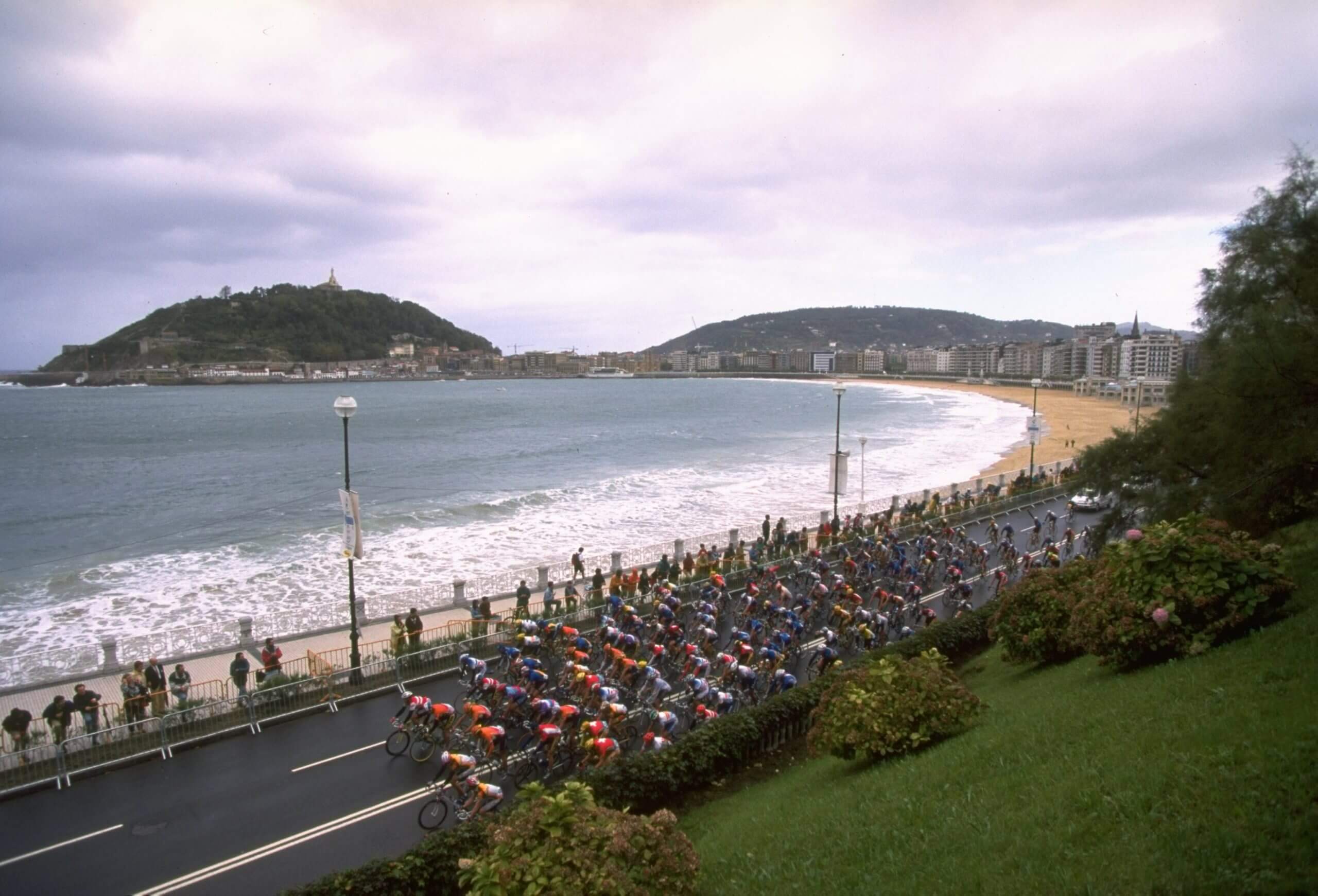
Iraola grew up in the Basque Country in northern Spain, where cycling is part of the culture and where, in 1992, the Tour de France held its opening three stages. These included the Prologue, an 8km (around five miles) individual time trial, in San Sebastian — the beautiful city on the beach 10km north-east of Iraola’s hometown, Usurbil.
Cyclists leave San Sebastian (Graham Chadwick /Allsport)
A reason to raise the 1992 Prologue with Iraola was that The Athletic’s correspondent had travelled to San Sebastian as a low-budget punter to see those opening stages, to witness in the flesh great cyclists such as Greg LeMond, Stephen Roche, Claudio Chiappucci, Pedro Delgado and others. Particularly one other.
This became the last-question small talk with Iraola. He was edging out of his seat, but as he listened, he sat back down. His smile grew and he said: “I was there. I remember it very well.”
More than three decades on, we were transported back to a Prologue quivering with drama and to the other cyclist in question, Miguel Indurain, from Navarre, a region that borders the modern Basque Country. He was known as ‘Big Mig’ and he won the Tour de France five years in a row. Indurain’s first Tour victory was in 1991, as Iraola happily pointed out. “Indurain,” he said, “was top.”
In the summer of 1992, Iraola had just had his 10th birthday, but he already understood the dynamics of watching elite cycling; that it can be a split-second blur of colour and noise, then over. Individual time-trialling can offer a wider perspective and in 1992, if memory is reliable, each team leader rode last. The effect was escalating anticipation, with the knowledge Indurain would be the final man out for the last team.
The brilliant Swiss, Alex Zulle, had set a standard not even the likes of Eric Breukink or Gianni Bugno could equal. It left one last rider: Indurain, a master of the time trial.
“It’s good watching this (time trial), because otherwise cycling is so fast, they go past,” Iraola said. “In time trials, at least you see everyone. Indurain started this in yellow, because he had won the previous year.”
What happened next — in 1992 — was that Indurain did what no one else could do. As the home fans roared and smacked the hoardings along sealed-off streets, Indurain pedalled furiously to a two-second win. Two seconds.
As a little Basque boy gasped, San Sebastian erupted.

Miguel Indurain puts on the yellow jersey after winning the Prologue of the 79th Tour de France cycling race, on July 4, 1992, in San Sebastian (Boris Horvat/AFP via Getty Images)
It was not always so joyous. The day before, the Basque separatist organisation, ETA, had set off a car bomb that damaged a vehicle being used to cover the race by UK broadcaster Channel 4; the green, red and white Basque flag, so prominent, had previously been banned by the Spanish government. Basque desire for independence stems from a distinct geographic and cultural identity, and political tension was never far from the surface.
But on this Saturday, the Basque Country was euphoric. A fresh-faced Iraola saluted his local hero and the bars and cafes of San Sebastian, one of which still sported a poster of John Aldridge on the wall, never closed.
Aldridge was the prolific Liverpool striker who left Anfield for San Sebastian club Real Sociedad in 1989. He departed two years later just as another former Liverpool forward, John Toshack, took over as the manager. At Iraola’s beloved Athletic Club along the coast in Bilbao, former Everton hero Howard Kendall had just been manager — there’s a strong Liverpool-Basque connection to Iraola’s young life.
“I was 10 years old,” he said. “At 10, you remember everything that happens.”

John Aldridge swapped Liverpool for Real Sociedad (Allsport UK/Allsport)
Fittingly for the World Cup summer of 2026, Iraola’s thoughts jumped immediately two years ahead to underline his view of memory. “My World Cup is USA 94,” he said. “I remember everything: the teams, the players. You ask me something that happened two years ago and I can’t remember. When you are young, everything is big.”
Spain reached the quarter-finals in 1994, losing to eventual runners-up Italy. Not long after, Iraola entered the youth system at Athletic Club on his way to a 17-year playing career and, in 2008, a first cap for Spain. It was two months after the country had won Euro 2008 and was the first of seven caps. Now, in his office, a minute on from recalling the mighty Indurain, Iraola was on his feet talking about memory and what we forget.
“I remember 2008, 2010 (the World Cup in South Africa, which Spain won) and the 2012 Euros (another Spanish title),” he said.
He had been close to making the squad in 2012, having shown great form in Athletic’s 63-game 2011-12 season. Under Marcelo Bielsa, they reached the Europa League final and Copa del Rey final. Iraola played in 50 of those matches.
Is Andoni Iraola the next Jurgen Klopp?
Jon Mackenzie
“In ’12, I missed the team (Spain’s squad) because of an injury,” he said. “I was thinking, ‘It doesn’t matter because we are not going to win’ — they won it again easily.”
He laughed at himself and his poor judgement.
But he had admitted to Spain’s selectors he was not fully fit. He could have kept quiet, been included in the squad, watched from the sidelines and collected a medal.
“I finished the season with the Europa League final, the Copa del Rey final — with Bielsa,” he said. “To play those finals, I had to have cortisone injections. After them, I couldn’t even kick a ball. I wasn’t going to play a minute anyway (at the Euros, even if he was fit). I could have said nothing!”
Iraola was smiling again and with that, he was out of the office door and on to a journey that has since led him to Liverpool; Anfield and the former club of Aldridge and Toshack.

Andoni Iraola, wearing the red and white of Athletic Club, tackles Espanyol’s Valmiro Lopes in 2008 (Rafa Rivas/AFP via Getty Images)
And the wheels turn elsewhere.
Once again, as in 1992, the 2026 Tour de France begins in the north of Spain. It starts in Barcelona on Saturday with a team time trial. Make no mistake, even as Liverpool head coach, Iraola will find time to tune in.
His house-hunting on Merseyside is likely to factor in proximity to cycle paths and, in a recent interview with TNT Sports’ cycling commentator Rob Hatch, Iraola said he always tries to catch up on footage of the latest Classics. He has been to not just the Tour de France, but to La Vuelta in Spain and he told Hatch his favourite climb is the Koppenberg in the Tour of Flanders.
Iraola has even scaled that infamously steep cobbled climb himself, no mean feat given it once forced the legendary Eddy Merckx to dismount and walk up. “You might as well make the cyclists climb ladders with bikes around their necks,” Merckx said, as Peter Cossins reports in his book The Monuments.
Wide-eyed, as only a genuine enthusiast would be, Iraola told Hatch: “The Tour of Flanders for me is like a myth.”

Cyclists, led by Andre Weumissen, are forced to walk up the Koppenberg on the 1985 Tour of Flanders (Graham Watson/Getty Images)
Now Iraola has gone from the Koppenberg to the Kop — boom-boom! — and from the latter he will observe this year’s Tour de France Prologue knowing Tadej Pogacar can join Merckx, Jacques Anquetil, Bernard Hinault, and Indurain as the only riders to win Le Tour five times.
Another theme to remind him of 1992 will be interest in teenager Paul Seixas, the latest French hope to win the Tour. In ’92, there was some angst that it had been seven years since a Frenchman had triumphed. Today, the wait is up to 41 years.
Back then, attention fell on Richard Virenque.
Later disgraced in the Festina doping affair, young Virenque claimed the yellow jersey on the third stage out of San Sebastian to Pau in France. No doubt Iraola remembers because, as he said, at 10, you do.