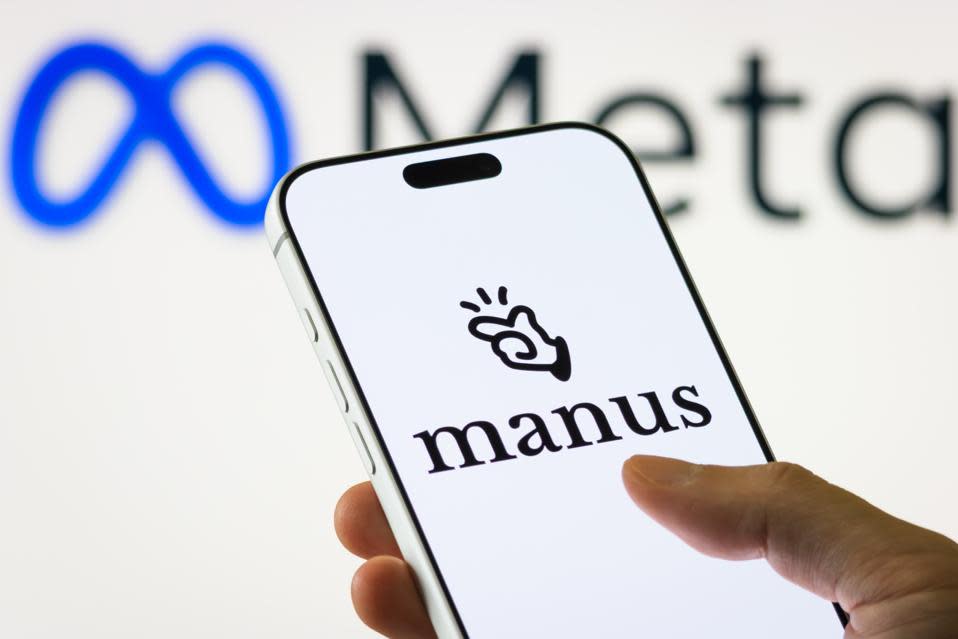
CHONGQING, CHINA – JANUARY 07: In this photo illustration, the Manus logo is displayed on a smartphone screen, with the Meta logo visible in the background, on January 7, 2026 in Chongqing, China. (Photo illustration by Cheng Xin/Getty Images)
What makes this case unusual isn’t the ruling itself. It’s how both sides responded. Meta and Manus both said they would “respect and comply with the regulatory decision.” No lawsuits. No political theater. For a company that spent years fighting TikTok bans in Washington, Meta’s quiet acceptance of a Chinese regulator tearing up a signed contract is worth noting.
Something else is going on here
For three years, the U.S.-China tech story followed a simple script: America blocks the upstream, China plays defense. Chips, GPUs, semiconductor equipment — Washington drew hard lines around the hardware that trains AI models. Beijing retaliated with its own export controls but mostly stayed on the back foot.
The Manus block suggests the script is flipping. China is now drawing lines around the downstream — the products, the applications, the companies that turn AI into something people use. And here’s the part few people are talking about: Washington seems to be going along with it.
Meta didn’t fight this. The deal had already closed. Manus staff had already been absorbed into Meta’s AI division. Undoing it will be messy and expensive. Yet both parties rolled over. That doesn’t happen without conversations behind closed doors, without some understanding that this outcome serves both sides’ interests in ways they won’t say out loud.
Look at what each side gets
Beijing stops a Chinese AI company from disappearing into an American tech giant. Manus had already moved its headquarters to Singapore, laid off most of its China-based team, and cut domestic operations. The “general AI agent” that went viral on Chinese social media was, by the time of the Meta deal, barely a Chinese company anymore. The block keeps the technology and talent pipeline inside China’s orbit — or at least prevents full absorption by a U.S. platform company.
Washington gets something too. The U.S. has struggled with how to handle Chinese AI investments. Total bans choke off capital flows. Total openness risks technology transfer. The Manus case offers a middle path: let American companies invest, let Chinese companies take foreign money, but draw a hard line at outright acquisition. Keep the capital flowing, keep companies nominally independent. It’s a looser version of what the U.S. already does with CFIUS.
This only works if China can offer its AI companies a credible alternative to selling out. That part is starting to look real. Last year, Zhipu AI and MiniMax went public, raising capital from domestic markets. The pipeline is opening. For founders who once saw a Silicon Valley acquisition as the only exit, “staying Chinese” is becoming a viable financial strategy, not just a patriotic one.
Manus will feel the squeeze short-term. It has to unwind a completed merger, repay investors who expected a Meta exit, and rebuild a standalone business. But its earliest backers — Tencent and ZhenFund — may end up better off than if the deal had gone through.
When Tencent invested in Manus founder Xiao Hong’s previous company, Nightingale Technology, and reportedly led a later round in Manus parent company Monica, it bought in at a fraction of today’s price. A Meta acquisition would have cashed Tencent out at a fixed price with a modest return. Now Tencent keeps its stake in a company whose valuation has grown significantly since those early rounds. If Manus eventually lists on a Chinese exchange — the path Beijing prefers — Tencent’s paper value could be substantially higher. The block turned a liquidation event into a hold-and-appreciate position.
The same logic applies to ZhenFund and other early Chinese investors. They keep their chips on the table.
Double-track Strategy Comes to Light
Tencent, meanwhile, has spent the past month laying out a possible path forward. Amid the ongoing disputes between the governments and commercials, it released Hy3 preview, the latest version of its Hunyuan model family. The technical improvements are real — better coding performance, longer context windows — but the more interesting signal is what Tencent didn’t do. It didn’t sell the model to a foreign company. It didn’t relocate the team overseas. It open-sourced the weights and kept the training infrastructure in China.
Four days earlier, Tencent launched QClaw, an overseas version of its consumer AI agent, in the U.S., Canada, Singapore, and South Korea. The product was built in five days using OpenClaw, with 99% of the code generated by AI itself. It operates under Tencent’s control, not as a spun-off entity with foreign headquarters.
This is the model that fits the new rules: technology goes out, capital comes in, ownership stays home.
The Manus block will be remembered as the moment China formally claimed the right to veto AI company sales to foreign buyers. But the deeper story is that both sides are converging on a shared understanding: AI sovereignty matters, and neither country wants the other’s tech giants swallowing its startups whole. The chip war was America’s move. The application layer is China’s.
For founders and investors caught in between, the message is clear. The easy exits are closing. The hard work of building standalone, nationally-rooted AI companies is just beginning. Tencent’s Hy3 and QClaw aren’t the blueprint yet — they’re the first draft, written while the rules are still being negotiated in the background.
This article was originally published on Forbes.com