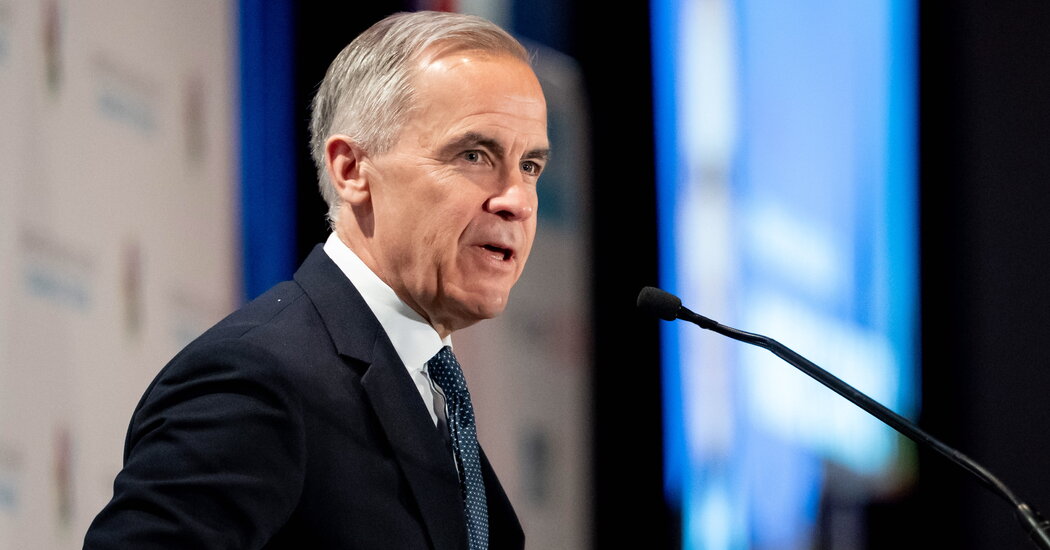
Prime Minister Mark Carney of Canada on Monday drew on his experience with Brexit to warn that a referendum the province of Alberta is planning for October on a possible separation from Canada could turn out to be a “dangerous bluff.”
Mr. Carney was governor of the Bank of England during the vote by Britain to leave the European Union in 2016.
He now leads a country that could see its Western oil-rich province break away after Premier Danielle Smith of Alberta announced last week she would push for a referendum on separation.
The vote, scheduled for Oct. 19, will ask Albertans to decide if they want to remain in Canada or if they want to hold a separate, binding referendum to secede. Ms. Smith has been roundly criticized for her decision to hold the referendum and for the specific phrasing.
Pro-independence activists argue they’re being robbed of a chance to truly ask Albertans if they want their own independent country, while supporters of staying in Canada are incensed that the question is even being asked.
“I saw firsthand what happened in the United Kingdom when the view was, vote for this, it’ll be soft, and then we’ll negotiate,” Mr. Carney told the news media in Ottawa on Monday. He was referring to the suggestion by some voters and politicians, who did not necessarily want Britain to leave the European Union but wanted to have a referendum on it, that the Brexit vote would help extract concessions from the European Union while staying in the bloc.
“They’re still, 10 years later, trying to undo what people didn’t think they were voting for,” Mr. Carney added.
As the country’s central bank governor, Mr. Carney had cautioned against Brexit, a position some criticized him for at the time as a breach of his apolitical role. After the vote, he had the task of forming monetary policy to support the British pound as the country’s currency and economy took a post-Brexit hit.
Separatism in Alberta has long had the support of a small minority of voters, but the movement has grown in recent years.
One issue that has contributed to the grievances some Albertans have expressed over how Canada’s federal government in Ottawa has treated their province is the increasingly stringent regulations of oil and gas.
Alberta is home to Canada’s oil industry, and environmental and other regulations, particularly those put in place by the previous government led by Justin Trudeau, were seen as unfairly stifling the industry’s growth. At the same time, because Alberta is a wealthy province, its contributions to federal taxation were seen by some Albertans as unfairly benefiting poorer parts of the country.
A poll by the Angus Reid Institute that was released on Monday found that 35 percent of Albertans would vote to pursue secession from Canada, meaning they would answer “yes” to the question to be posed in October. Polls in recent months have generally put support for secession at 25 percent to 30 percent.
Mr. Carney’s comments were the harshest he’s made yet on the topic. Up until now, he has been working closely with Ms. Smith, the Albertan premier, to advance a pro-oil agenda with a particular commitment to help build a pipeline to take Albertan oil to the Pacific Coast in British Columbia to sell to Asian markets.
But his comments comparing the referendum to Brexit, showed that Mr. Carney was prepared to criticize Ms. Smith while working with her. She has said that she personally wants Alberta to remain in Canada and will campaign for that position.
But she also made it easier to hold a referendum on separation and, when a lower court struck down a petition to hold the vote, she stepped in to have it happen anyway, albeit under phrasing different from the one the pro-independence activists wanted.
Explaining why she wanted to push ahead with the referendum, Ms. Smith last week said it was because she wanted to honor the democratic rights of Albertans who were actively campaigning to hold a vote for the province to either separate from or remain in Canada.
Mr. Carney dismissed that idea.
“Is it helpful to ask these fundamental questions?” he asked. “No, it’s not helpful. Of course, it’s not. Is it the democratic will of Albertans? Did they vote for this in the last provincial election? No, they didn’t. It wasn’t on the ballot paper; it wasn’t in the mandates or platforms of the governing party and the official opposition.”
“It is what it is,” he added.