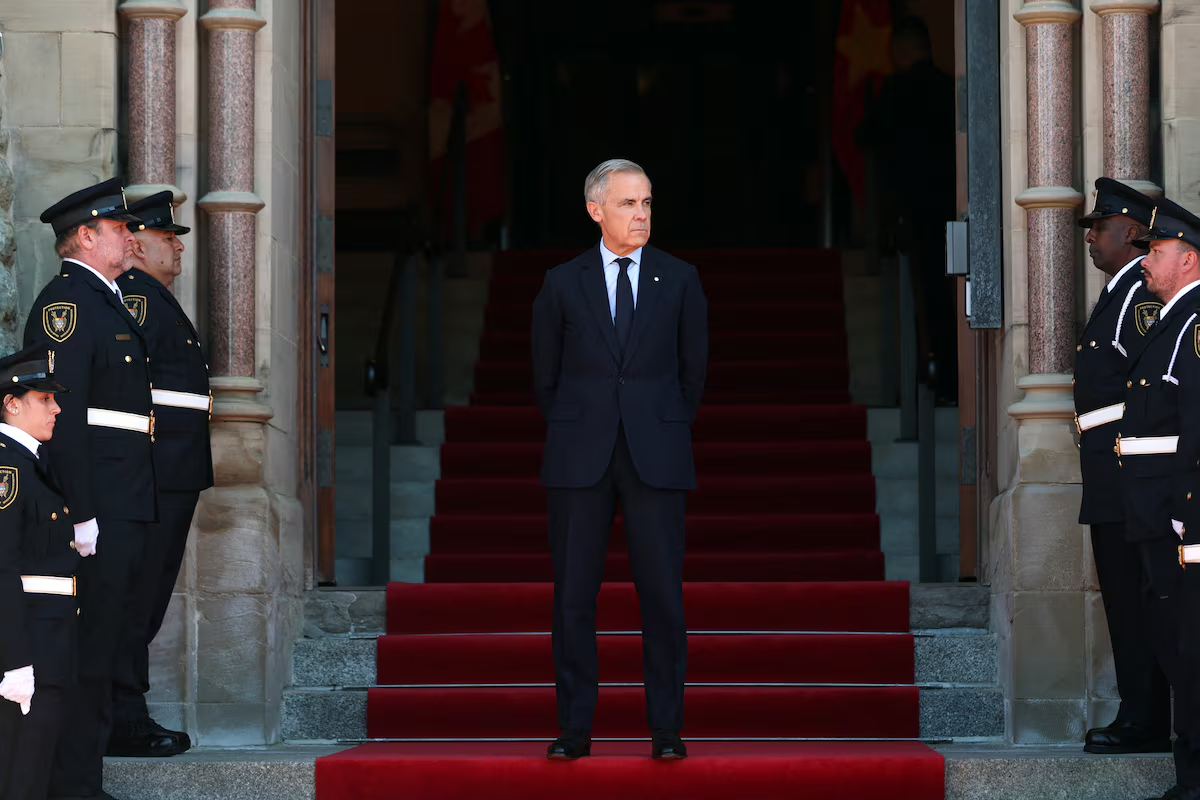
Prime Minister Mark Carney before greeting Vietnamese President Tô Lâm during a welcoming ceremony in Ottawa on Thursday.DAVE CHAN/AFP/Getty Images
There’s a certain water-is-wet quality to noting the furious pace of Prime Minister Mark Carney’s government. The busyness feels less like a byproduct than a self-conscious mission statement, even a dare: this is how we roll, so keep up or get left behind.
Even by those standards, the past two weeks have been frenetic.
There was the investment summit in Toronto, a sort of pan-Canadian trade show for global billionaires, with payoffs yet to be determined.
Then Mr. Carney was off to the European Parliament, where Ursula von der Leyen, president of the European Commission, proposed “associate member” status for Canada. The Prime Minister’s reception in Europe was so laudatory and starry-eyed that we might all do worse in life than to find ourselves someone who looks at us the way European leaders look at “dear Mark.”
This week was the United Nations General Assembly, followed by yet another international agreement, this one a strategic partnership with Vietnam, cemented during President Tô Lâm’s one-day state visit to Ottawa.
There’s a common thread to all of this: it’s laying down the foundations for big-picture economic improvement that – if it works – will unfold over a long-time horizon.
Campbell Clark: Carney’s Davos speech diagnosed the problem. His EU speech lays out the cure
Mr. Carney’s interest and energy is clearly focused on the macro picture: pulling the big levers that will slowly reshape the economy. That approach makes perfect sense for a former central banker.
But he’s a central banker who’s become a surprisingly successful politician. And the strange circumstance of his political ascent means that one emergency (the tangerine menace of Mar-a-Lago) overshadowed another (the cost of living) that became less visible without ever getting fixed.
A new article published this week by the Bank of Canada examined how income and spending changed between 2020 – when the pandemic upended everything – and 2025. Inflation has cooled, and on average, income gains kept up with higher spending last year, Yaz Terajima, senior research director in the Bank of Canada’s Financial Stability Department, found. But that aggregate picture masks what’s happening to different households.
For most age groups, disposable income rose faster than spending in 2025 and put them at least slightly in the black, with the 45-to-54 cohort having the biggest surplus, at $1,781.
Households under the age of 35, however, spent $4,249 more than they made annually.
The pattern is similarly uneven when households are grouped by income. The bottom three quintiles are in the red, spending between $4,236 and $6,805 more than they made last year, while the top two brackets sit tidily in the black, with the wealthiest quintile of families making $14,006 more than they spent in 2025.
The article explains that younger and lower income households tend to spend a larger share of their money on food and housing – where prices remain high – and easing inflation “does not erase” the higher costs people have been absorbing all along.
“A large number of Canadians continue to view their budgets as stretched even though inflation has slowed since the pandemic,” Mr. Terajima wrote. “These concerns are valid and reflect an important reality.”
Opinion: Mark Carney marks the return of the consequential political speech
With the House of Commons returning this week, you could see this playing out in Question Period – at least to the extent that an insulting pantomime in which no one asks a real question or offers a real answer could be said to reflect anything at all.
The Conservatives hammered the government with anecdotes of people in their ridings suffering from the high cost of living, coupled with accusations that the government’s profligate spending and obstructionist policy was the cause.
“He’s proven once again that he is absolutely out of touch and Canadians are absolutely out of money. All they have gotten from him is big talk around the world and big bills here at home,” Conservative Leader Pierre Poilievre said on Monday of Mr. Carney. He added that Lolita from Mississauga, working two jobs to survive, “can’t eat speeches, summits or signing ceremonies.”
Finance Minister François-Philippe Champagne on Wednesday encapsulated the government’s rebuttal, pointing to the Canadian groceries and essentials benefit going to 12 million households, the federal gas tax holiday extended into early 2027 and a plan to speed up housing starts. The last point is an odd highlight to choose, given that the numbers are uninspiring, though the provinces and cities of course share that shame.
A short time later in the House, Mr. Champagne switched to full scolding mode, saying it was “shocking to hear the Conservatives talking the economy down at a time where Canadians are united to fight for Canada.”
As far as I can discern – because the Prime Minister tends not to explain or defend things he feels are self-evident and beyond questioning – Mr. Carney’s central economic plan for this country is to engineer a rising tide that will lift all boats.
Those big, esoteric projects like mines and ports and highways in far-flung parts of the country, various forms of energy generation and transport, and the bouquet of international trade agreements he loves to brandish are all, presumably, intended to build a Canadian economy that is less dependent on the U.S. and more robust on its own terms.
The idea seems to be that we will sell more of what we have to more buyers and we will get more investment money flowing in once we’ve proven that we want to build and not thwart. And eventually, everyone benefits, with wages catching up to inflation so that people don’t feel so much like they’re being strangled.
This is what I understand the plan to be – but again, that’s just my best guess as someone who watches closely, because Mr. Carney and his government have really not connected A to B to C for anyone.
For now, that’s working out fine, because people’s deferential trust in the Prime Minister is still cresting high. But eventually, that long-term plan and economic triumphalism will have to be squared with the immediate pain that’s still all around us, hiding just under the surface.