Key Points
-
AMD stock is up 187% so far this year, handily outperforming Nvidia.
-
While AMD has signed landmark deals with artificial intelligence (AI) hyperscalers, the company’s data center business pales in comparison to Nvidia.
-
AMD is a much more expensive stock than Nvidia based on earnings multiples.
- 10 stocks we like better than Nvidia ›
The trillion-dollar club just ushered in its newest member. As of midday trading on Sept. 23, Advanced Micro Devices (NASDAQ: AMD) boasts a market cap of $1 trillion. AMD now joins Nvidia (NASDAQ: NVDA), Taiwan Semiconductor Manufacturing, Broadcom, Samsung, and Micron Technology as the semiconductor stocks with a trillion-dollar valuation.
This is the kind of milestone that makes some people stop thinking and start buying blindly. Here’s the thing: AMD is not Nvidia. It is the distant No. 2 in the artificial intelligence (AI) accelerator market, and at its current price point, Wall Street is paying a premium as if the gap is about to vanish. Let me explain why it’s not.
Missed AI’s “Act 1”? Act 2 Could Be 15x Bigger. Most investors think they missed the AI boat because they didn’t buy Nvidia in 2005. But according to our analysts, we’re only at the end of “Act 1″—the R&D phase. “Act 2” is the global rollout. Continue »
Image source: The Motley Fool.
AMD’s journey to a trillion-dollar valuation
When Lisa Su became CEO of AMD on Oct. 8, 2014, the company was a turnaround project. At the time, AMD was worth about $2 billion, and shares looked like they were headed toward penny-stock status. Fast-forward to today, and AMD trades around $614 — a gain of nearly 19,000%.
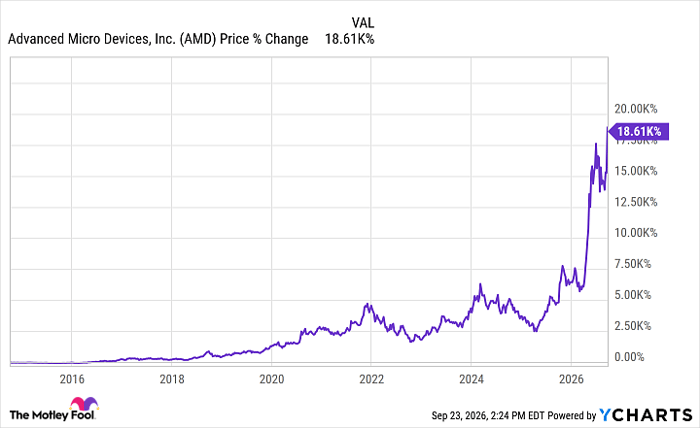
AMD did not reclaim relevance following one lucky quarter. Under Su, the company has executed a number of rebuilds. First came Ryzen in PCs, followed by Epyc in servers. AMD subsequently acquired Xilinx and Pensando, which gave the company FPGAs, DPUs, and a broader data center story. The latest chapter is Instinct accelerators and the Helios rack-scale system — GPUs, Epyc CPUs, and networking solutions sold as a full AI stack instead of a bag of parts.
AMD is landing logos, but Nvidia is still the king
ChatGPT was launched to the public on Nov. 30, 2022. Around that time, Nvidia’s data center business generated about $3.6 billion in quarterly sales while AMD’s data center segment did about $1.6 billion. According to the latest prints, Nvidia’s quarterly data center revenue is now $89 billion — up 117% year over year. Meanwhile, AMD’s data center division most recently generated $6.7 billion in revenue during the second quarter — an increase of 107% year over year.
While AMD is growing fast, Nvidia is clearly operating on another level. This disparity is the part AMD’s $1 trillion headline conveniently skips. The company is trading on a hype narrative thanks to a number of deals it has won with AI hyperscalers.
OpenAI agreed to power 6 gigawatts using AMD GPUs, beginning with 1 gigawatt of Instinct MI450 deployed in the second half of 2026. In addition, the deal also provides OpenAI with a warrant to purchase up to 160 million AMD shares. Meta Platforms used the same template. The social media giant partnered with AMD on 6 gigawatts, with the first wave also due during the second half of 2026, again with AMD issuing a large warrant package.
Anthropic committed up to 2 gigawatts of MI450 series GPUs, while AMD pledged up to a $5 billion strategic investment into the Claude developer. Meanwhile, Oracle is lining up a cluster of 50,000 MI450 Instinct GPUs while Microsoft is integrating Helios into Azure for AI inference.
Indeed, these are not press release customers. But at their current scale, they are not contributing enough to close the gap with Nvidia. Nvidia owns the default software stack (CUDA), the networking fabric thanks to savvy partnerships with Marvell Technology, Coherent, Nokia, and Lumentum, and boasts a first-mover advantage in GPU design.
With only an estimated 5% market share in the GPU realm, AMD is playing second fiddle to Nvidia. In reality, the hyperscalers are buying AMD chips for two reasons. First, to diversify beyond Jensen Huang’s empire. And second, to leverage AMD’s progress on the CPU front — a market Nvidia is also now aggressively penetrating with Vera Rubin.
AMD’s valuation multiples show why the stock is overvalued
AMD trades at a trailing price-to-earnings (P/E) ratio of around 158, while its forward P/E hovers around 81 based on the next 12 months of EPS estimates. Nvidia, on the other hand, trades closer to 28 times trailing earnings and roughly 24 times forward earnings. In other words, investors are paying a much higher premium for AMD’s smaller data center business, thinner profit margins, and the clear No. 2 platform.
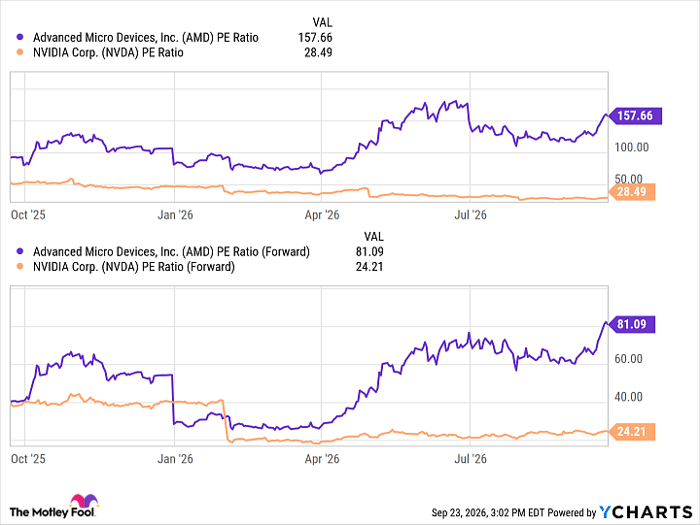
AMD PE Ratio data by YCharts
The takeaway here is that a $1 trillion valuation assumes AMD keeps landing monster deals and that those deals show up in earnings in short order. If you already own AMD stock, I think now is an ideal opportunity to trim your exposure and take some gains while keeping a core position if you believe in the company’s ramp-up. If you do not own AMD stock and are itching to buy it, do not fall for the trap of thinking its trillion-dollar sticker automatically makes it a buy. Momentum traders are doing the selling right now. Smart investors should not chase at these prices and become their exit liquidity.
Should you buy stock in Nvidia right now?
Before you buy stock in Nvidia, consider this:
The Motley Fool Stock Advisor analyst team just identified what they believe are the 10 best stocks for investors to buy now… and Nvidia wasn’t one of them. The 10 stocks that made the cut could produce monster returns in the coming years.
Consider when Netflix made this list on December 17, 2004… if you invested $1,000 at the time of our recommendation, you’d have $384,839!* Or when Nvidia made this list on April 15, 2005… if you invested $1,000 at the time of our recommendation, you’d have $1,385,657!*
Now, it’s worth noting Stock Advisor’s total average return is 936% — a market-crushing outperformance compared to 213% for the S&P 500. Don’t miss the latest top 10 list, available with Stock Advisor, and join an investing community built by individual investors for individual investors.
*Stock Advisor returns as of September 25, 2026.
Adam Spatacco has positions in Microsoft and Nvidia. The Motley Fool has positions in and recommends Advanced Micro Devices, Broadcom, Coherent, Lumentum, Marvell Technology, Meta Platforms, Micron Technology, Microsoft, Nvidia, Oracle, and Taiwan Semiconductor Manufacturing. The Motley Fool has a disclosure policy.