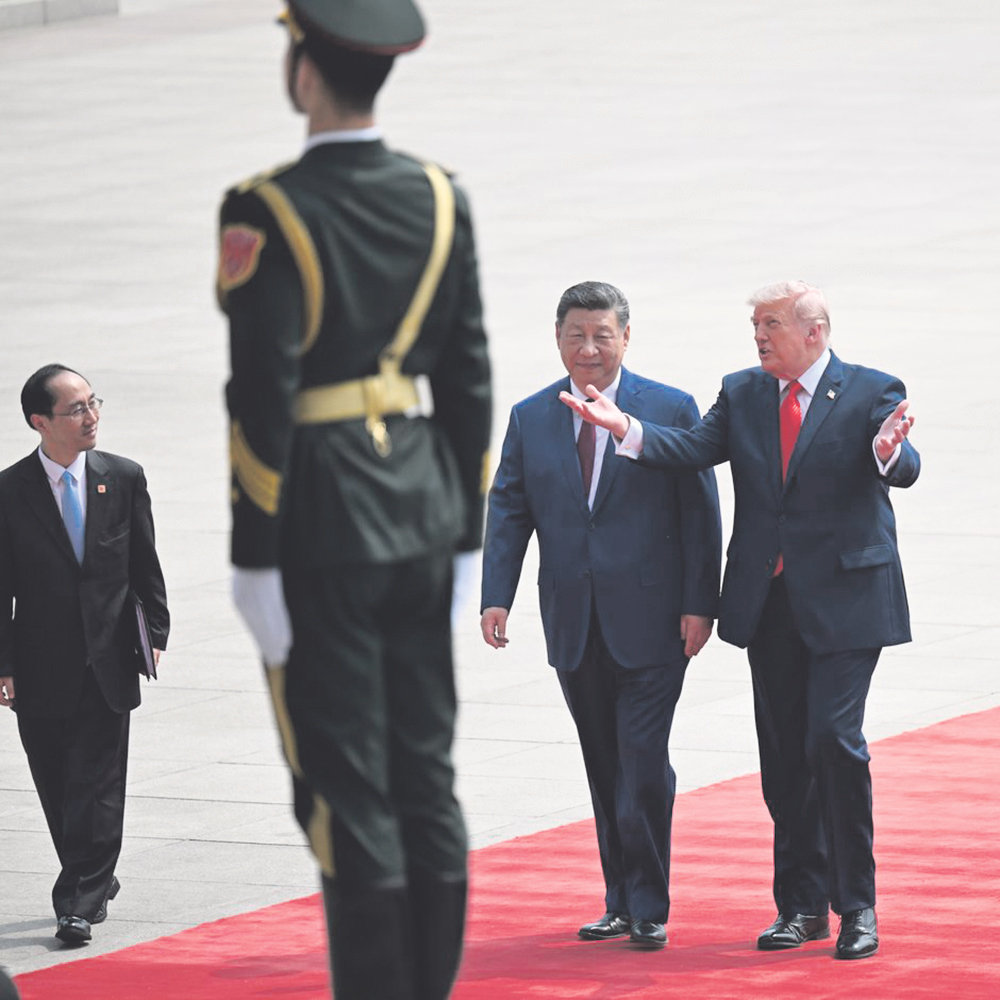
When China’s top leader, Xi Jinping, and President Donald Trump meet in Washington this week, the two men will be operating on vastly different clocks.
The U.S. president is constrained by the immediate demands of a midterm election in November and a grinding war. The Chinese leader is gearing up for a norm-shattering fourth term as head of the ruling Communist Party, that will keep him in power for another five years.
For Xi, the disparity in political realities gives him an edge in maintaining the truce that the two countries reached last year. A renewed trade fight would hit American consumers right before the election — a risk Trump can ill afford. China’s economy is struggling, too, but Xi answers to no electorate, giving him the patience to prolong the detente on his terms.
“Each of Xi’s face-to-face encounters with Trump in his second term would only have reinforced Xi’s prior conviction that Trump is leading an America that is dangerous but declining,” said Jonathan Czin, a researcher at the Brookings Institution who previously worked at the CIA analyzing Chinese politics.
Xi, who will sit down for talks with Trump on Thursday, may be wagering that leaning into Trump’s preference for leader-to-leader diplomacy can insulate the relationship from flash points such as the status of Taiwan, the self-governed island claimed by Beijing, and the competition to dominate artificial intelligence.
Keeping Trump at bay would give Xi breathing room to work on rejuvenating his listless economy, which has been weakened by a property crisis, high youth unemployment and excess production. It would give him time to rebuild the upper echelons of his military leadership, which he has hollowed out in a drive against corruption and disloyalty. And it would allow him to continue expanding his country’s industrial, technological and military strength for a future showdown with the United States.
Analysts say China benefits every time Trump’s attention drifts elsewhere. By quarreling with traditional U.S. allies or sinking deeper into the war in Iran, Trump is weakening his country’s global standing and pulling troops away from the Pacific.
“Xi would love to tell Trump, ‘Go on, stay the course,’” said Suisheng Zhao, executive director of the China Center at the University of Denver. “For Xi, Trump represents a window of opportunity for China, so his priority is to buy more time.”
An emboldened Xi heads to Washington
Since first meeting Trump at Mar-a-Lago more than nine years ago — a gathering best remembered for being when Xi learned about U.S. missile strikes on Syria while dining on what Trump described as the “most beautiful chocolate cake” — Xi has had an extraordinary amount of time for a Chinese leader to size up his chief geopolitical rival.
Early in Trump’s first term, Xi was somewhat accommodating toward the American president. In 2018, his government agreed to purchase $200 billion in additional U.S. goods and services to offset a trade imbalance (though Beijing never fully honored that deal.)
Last year, Xi flipped the dynamic between the two superpowers.
Faced with Trump’s Liberation Day tariffs, Xi was the only world leader who refused to back down, choosing instead to match his opponent with one sky-high tariff after another. Xi then reached for his ace card by throttling exports of Chinese critical minerals, or rare earths, which companies globally need for modern technologies. Backed into a corner, the Trump administration called for a truce.
It was a payoff years in the making: a rare instance in which Beijing not only withstood U.S. pressure but turned the tables and forced it to relent. Beijing, as a result, is emboldened today and sees itself more as an equal to Washington, analysts say.
The Trump administration “thought they could use massive unilateral pressure to force China to make concessions. And that did not occur. In fact, the opposite did,” said Scott Kennedy, a researcher at the Center for Strategic and International Studies in Washington.
“I think now this is Xi Jinping’s world and we’re all living in it,” he added.
The superpowers should put limits on competition, Xi’s argument goes, to avoid what he has warned could be a catastrophic clash. To this end, he has pushed a formula he calls “constructive strategic stability.”
In practice, what this means is that Beijing wants Washington to accept boundaries on where it can challenge China.
In July, for example, when the U.S. Federal Communications Commission proposed a ban on Chinese-made humanoid robots, China’s Ministry of Commerce invoked the phrase, demanding that Washington roll back the restrictions to preserve “strategic stability.”
American analysts view the slogan not as a serious effort at ironing out differences but as an attempt to get Washington to recognize China’s clout and back off. China could apply it to any new U.S. restrictions on chip exports or arms sales to Taiwan.
“The truce is not constructive because little diplomatic infrastructure is being built,” Czin said. “It is tactical rather than strategic. And therefore it is inherently unstable.”
Xi appears to have calculated that the best way to manage the United States is to engage Trump in high-profile summits rich in optics but thin in substance.
The planned meeting Thursday will be their third face-to-face in less than a year, a pace that could continue with talks in November at the Asia-Pacific Economic Cooperation summit in Shenzhen, China, and at the Group of 20 summit in Miami in December.
“Head-of-state diplomacy is the cornerstone of China-U.S. relations,” China’s top diplomat, Wang Yi, told Secretary of State Marco Rubio in a call Thursday.
But beyond extending the trade truce, the meetings have produced few breakthroughs. China may agree to more agricultural purchases this week, but expectations are low on issues such as AI safety or China’s trade imbalances.
That is by design, analysts say. Enticing Trump with the pageantry of summits he seems to relish lowers the risk that he may do something to derail relations — such as green-lighting a package of arms to Taiwan.