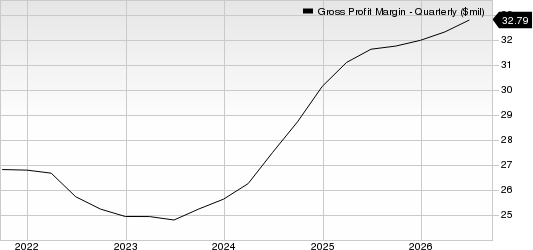
Spotify Technology SPOT saw its second-quarter profitability receive a lift from gross-margin expansion, highlighting economics across its audio platform. Gross margin reached 33.4%, increasing 193 basis points year over year. The improvement reflected gains in the Premium and Ad-Supported businesses, although the underlying drivers differed across the two segments.
Within Premium, revenues grew faster than music costs after accounting for marketplace programs. Lower audiobook and video-podcast costs also supported the segment’s margin performance. Together, these factors indicate that Spotify is generating stronger returns from its subscription business while managing the expenses associated with broadening its content offering.
Spotify Technology Gross Margin (TTM)
Spotify Technology gross-margin-ttm | Spotify Technology Quote
The Ad-Supported segment contributed to the profitability improvement. Favorable podcast and tax effects more than offset higher music costs and other costs of revenue. This balance is important because it shows that benefits outside the subscription operation helped strengthen gross profitability despite continuing cost pressure in advertising-supported activities.
Spotify reported operating income of €655 million in the quarter, translating its gross-margin progress into operating profitability. However, expenses increased due to temporary investments in marketing and cloud and artificial intelligence initiatives, excluding social charges. Operating expenses also included €1 million in social charges related to share-based compensation. These investments raised near-term spending but did not prevent the company from delivering substantial operating income.
Overall, the quarter’s central takeaway is that margin expansion remains a key pillar of Spotify’s profitability story. Revenue growth outpacing relevant content costs in Premium, combined with podcast and tax benefits in Ad-Supported, strengthened the company’s earnings structure. At the same time, Spotify continued funding marketing and cloud and AI capabilities. With 7,302 full-time employees worldwide at quarter-end, the company is balancing cost discipline with investment intended to support its platform and operations. The results suggest Spotify’s improving cost-to-revenue relationship, rather than expense restraint, drove the quarter’s profitability advance.
How Do Two Streaming Peers Compare?
Apple AAPL and Amazon AMZN remain peers in audio streaming. Apple benefits from tight integration between its music service and device ecosystem, while Amazon can connect streaming with Prime memberships and smart speakers. Spotify, however, relies more directly on subscriber growth, ARPU gains and advertising execution because audio anchors its business. For investors, Apple represents an ecosystem-led model, whereas Amazon demonstrates the appeal of bundled services. Spotify’s improving monetization indicates that its focused strategy remains competitive.
SPOT, AMZN and AAPL currently carry a Zacks Rank #3 (Hold) each. You can see the complete list of today’s Zacks #1 Rank (Strong Buy) stocks here.
Radical New Technology Could Hand Investors Huge Gains
Quantum Computing is the next technological revolution, and it could be even more advanced than AI.
While some believed the technology was years away, it is already present and moving fast. Large hyperscalers, such as Microsoft, Google, Amazon, Oracle, and even Meta and Tesla, are scrambling to integrate quantum computing into their infrastructure.
Senior Stock Strategist Kevin Cook reveals 7 carefully selected stocks poised to dominate the quantum computing landscape in his report, Beyond AI: The Quantum Leap in Computing Power.
Kevin was among the early experts who recognized NVIDIA’s enormous potential back in 2016. Now, he has keyed in on what could be “the next big thing” in quantum computing supremacy. Today, you have a rare chance to position your portfolio at the forefront of this opportunity.
Spotify Technology (SPOT) : Free Stock Analysis Report
Amazon.com, Inc. (AMZN) : Free Stock Analysis Report
Apple Inc. (AAPL) : Free Stock Analysis Report
This article originally published on Zacks Investment Research (zacks.com).