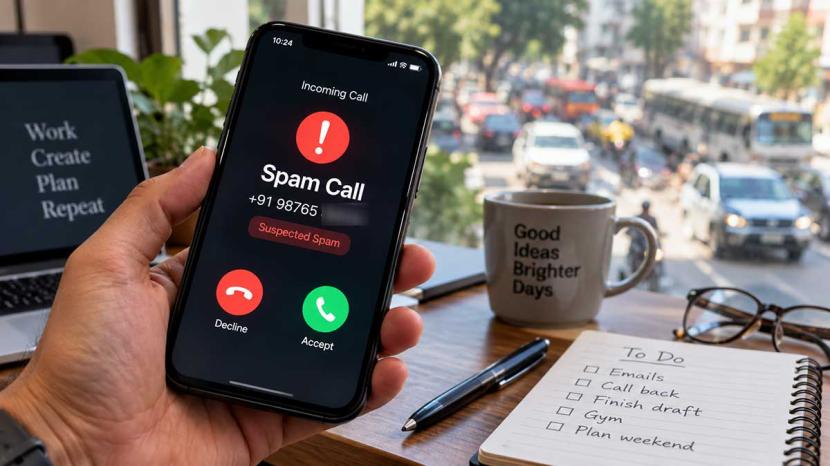
Trai has brought app-based spam calls under tighter regulations through new A2P call rules.

Kindly note that this illustration generated using ChatGPT has only been posted for representational purposes.
India’s telecom regulator has strengthened regulations to curb spam calls while widening the net to include such calls originating from apps.
The regulator has also introduced a termination charge of up to 5 paise that telecom service providers (TSPs) can levy, if not pre-declared by the apps.
In amendments to the Telecom Commercial Communications Customer Preference Regulations, 2018 on Friday, Trai has defined Application-to-Person (A2P) calls as calls initiated by an application, software system or automated platform without direct human dialing, including auto dialing, robocalls and pre-recorded or artificial voice technologies.
Key Points
- Apps must pre-declare A2P numbers or risk spam classification and a termination charge of up to 5 paise.
- AI-based spam detection is now part of the regulatory framework with faster action against repeat offenders.
- Three consumer complaints, combined with AI flags, can now trigger investigations.
- Truecaller and similar apps cannot automatically label 140, 1600 and 1601 series calls as spam.
A2P Calls Under Scanner
Entities using A2P calls will have to pre-declare their use and the numbers being used to their telcos and any calls made outside this disclosure will be treated as spam.
The disclosure coupled with the termination charge will act as a deterrent to spammers as well as scammers, the regulator said.
Termination charges will not be levied on A2P calls made through the 140, 1600 and 1601 series designated by the authority for regulated commercial calls and authority-authorised calls.
AI Spam Detection Rules
Trai also brought AI based spam detection into the regulatory ambit, but put the onus of sharing suspected spam numbers on telcos, with the amendments specifying that the TSPs will identify numbers with a high probability of being used for sending spam and share the information among themselves.
Where five or more numbers associated with a sender are flagged within 10 days, further investigation and graded action will follow.
They include know-your-customer (KYC) re-verification, physical verification, barring of outgoing services and disconnection in cases of repeated violations.
New Consumer Complaint Trigger
Now, three or more unique consumer complaints, versus five or more earlier, can trigger action by a telco if a suspected spam identity is simultaneously flagged by its AI/machine learning (ML) system.
This would enable early identification and action against suspected spam senders.
Truecaller Blocking Restricted
Trai also prohibited call-management applications like Truecaller, from blanket blocking, filtering or tagging calls from designated 140, 1600 and 1601 series, as spam.
Earlier, this was a direction, but now it has been included in the regulation.
Trai has allowed such communication based on a customer’s inquiry, for seven days.
This, it said, was aimed at facilitating e-commerce and e-service platforms that use commercial communication.
However, the inquiry must be made in writing or digitally and retained by the sender in a verifiable form.
Legacy Consent Gets Recognition
The amendments also introduced a consumer appeal mechanism post resolution of the complaint if found inadequate by the consumer.
Trai has also expanded the definition of consent to include legacy consents already available with the entities.
However, legacy consents would be considered valid only if they are obtained through verifiable means and are subsequently registered on the digital platform of the telcos.
Feature Presentation: Ashish Narsale/Rediff