
China/Kiwi Coffee Crossover
New Zealanders are serious about their coffee. But while most of the coffee consumed here comes from traditional producing nations such as Brazil and Colombia, another coffee-growing region is quietly attracting attention: China’s Yunnan province.
Coffee grows in a band around the globe known as the “green belt”, which spans the region between the Tropics of Cancer and Capricorn. China’s southwestern province of Yunnan sits on the northern edge of that zone and has spent the past two decades building a reputation as a producer of Arabica coffee.

A coffee farm in China’s Yunnan province.
Supplied
Kelly Qu, co-owner of MQ Coffee in Auckland, told RNZ’s Here Now that a visit to a coffee farm in Yunnan changed the way she thought about coffee.
Qu first encountered the region’s coffee industry while travelling through Yunnan, where she learned how coffee is picked, processed and roasted at origin.
“The average coffee consumer doesn’t always think about where coffee comes from. They just think about the final product,” she said.
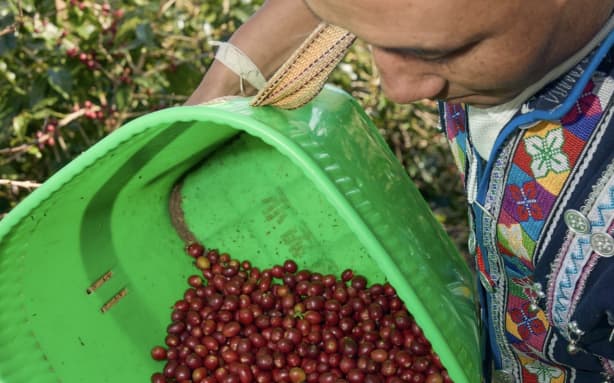
Coffee beans grown in Yunnan
MQ Coffee
MQ Coffee’s head of education Hubs Tong said investment, research and strong domestic demand had transformed China’s coffee sector.
“At first, it was not of very good quality Arabica,” he said. “But with more and more resource being poured into it … the procedures being taken at the region to produce higher quality coffee has been expanding and growing.”
While coffee production has grown rapidly in China, the country’s coffee culture has evolved differently from New Zealand’s.
Tong said coffee was still relatively new in China, gaining mainstream popularity after the arrival of Starbucks. Since then, a generation of growers, roasters, café owners and specialty coffee enthusiasts has emerged.

Hubs Tong
RNZ/Liz Garton
One of the biggest differences is how coffee is consumed.
In China, specialty coffee drinkers often preferred brewed or filter coffee rather than espresso, Tong said.
Filter coffee produces a lighter, less intense drink that highlights delicate flavours such as citrus, floral and honey notes. Tong believes that preference aligns closely with China’s long tea-drinking tradition, as filter coffee is “a more tea-like beverage”.
Most coffee grown in Yunnan is consumed within China, but Qu said New Zealand consumers were starting to see it appear in some specialty roasteries.
Tong described Yunnan coffee as having plenty of sweetness, body and complexity.

Kelly Qu
Supplied
Qu adds, “It holds up well in the milk beverage”, which could make it a good fit for New Zealand’s enduring love affair with flat whites.
Despite growing interest in filter coffee, Tong said New Zealand’s mature café culture could make consumers slower to embrace new trends.
“Our coffee culture [has] had its heyday,” he said. “Our consumer market is now finding it hard to take on newer ideas and research that’s being done in coffee.”
Still, he believes tastes are changing.
The New Zealand Specialty Coffee Association recently revived its brewers competition after a long hiatus, reflecting growing interest in pour-over and filter coffee.
If we continue to see consumer demand shift, that gap may start to narrow. And for New Zealand coffee lovers, the next great cup could come from an origin they least expect.