Key Points
-
Nvidia is generating gobs of free cash flow that could pave a transition from a hypergrowth stock to a more consistent dividend growth stock.
-
Nvidia isn’t a good buy for income investors based on its current yield.
-
Long-term investors should focus on the income-generating potential during the lifetime of an asset rather than what it yields today.
- 10 stocks we like better than Nvidia ›
In its second-quarter fiscal 2027 release, Nvidia (NASDAQ: NVDA) said that it would pay a cash dividend of $0.25 per share on Oct. 1 to all shareholders as of record on Sept. 10. It marks the second consecutive quarter Nvidia is paying a $0.25 per share dividend — up 2,400% from its previous quarterly payout of just $0.01 per share.
Nvidia is far from high-yield territory, but it’s showing more commitment to its dividend. For context, Nvidia now yields more than Apple, Alphabet, and Meta Platforms, while some megacap growth stocks like Amazon, Tesla, and Space Exploration Technologies don’t even pay dividends.
Missed Nvidia in 2009? This Rare Signal Is Flashing Again. In 2009, a “Double Down” signal flashed for a little-known chipmaker called Nvidia. For the first time in years, that same “Total Conviction” signal is flashing for a company 1/100th the size of Nvidia. Continue »
Here’s how many shares of Nvidia you’d need to generate $10,000 in yearly dividends and why investors can expect that number to drop in the coming years.
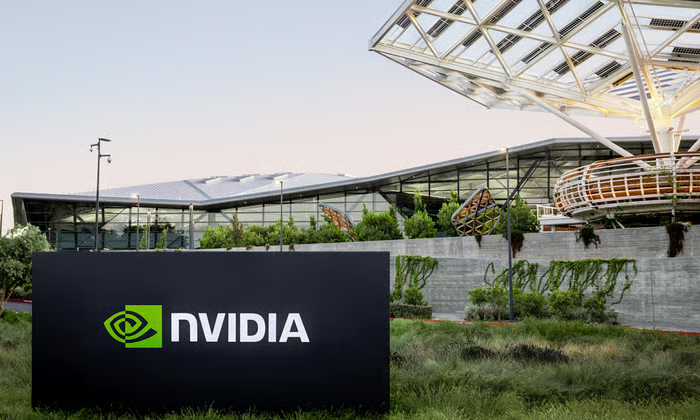
Image source: Nvidia.
The power of holding dividend growth stocks over the long term
At $0.25 per quarter or $1 per share per year, simple math tells us that it would take 10,000 Nvidia shares to generate $10,000 in yearly dividend income. At $225.73 per share as of market close on Sept. 8, a 10,000-share Nvidia position would be valued at a staggering $2,257,300. Meaning at this stage, Nvidia isn’t a good stock for investors whose primary objective is to generate passive income. But it could become the perfect dividend growth stock over time.
Companies that steadily grow their earnings, and in turn their dividends, can benefit long-term investors through a combination of unrealized capital gains and growing passive income. JPMorgan Chase (NYSE: JPM) is a textbook example. The stock yields 1.7% today, based on its $1.50-per-share quarterly dividend. But investors who bought the stock 10 years ago are getting a high yield on their initial investment because the company has increased its dividend year after year, and the payout has more than tripled over that period, while the stock price has more than quintupled. Investors who bought the stock 10 years ago at around $67 per share would be producing a yield on cost of 9%, which is today’s annual payout of $6 per share divided by the cost basis of $67 per share. This example showcases the power of buying a company whose growing earnings justify a higher share price and, in turn, more dividends for shareholders, which puts the dividend-income-earning power of the initial investment in ultra-high-yield territory.
Nvidia is laying the groundwork for recurring revenue
A common mistake is assuming a stock is a good or bad source of passive income based solely on its current dividend yield. A far better approach is to ask whether a company has the runway for future earnings growth that justifies higher dividend raises and, in turn, increases the passive income generated by that initial investment. I could see Nvidia’s dividend increasing significantly in the years to come, driven by management’s commitment to returning cash to shareholders and new opportunities in artificial intelligence (AI) data centers.
On its fiscal Q2 2027earnings call Nvidia said it has returned 60% of free cash flow (FCF) to shareholders so far this fiscal year — ahead of its 50% target. But even with the dividend raise, buybacks were more than 3 times higher than dividend payments in Q2. Nvidia is generating so much FCF that it can easily afford to grow its dividends while still aggressively buying back its stock. That’s reason alone to expect another dividend hike.
However, the runway for Nvidia to become a reliable dividend growth stock has more to do with its evolving business model than its current capital return program. If AI adoption continues, Nvidia will become less dependent on one-off cyclical hardware sales and become a far more consistent business, ideally suited for steady dividend growth. Nvidia’s CUDA software and leading graphics processing units (GPUs) already gave it an enviable edge in data center computing power. But its Vera Rubin platform expands that moat by adding a rack-scale solution that goes beyond GPUs to include central processing units and networking.
Nvidia is controlling a larger share of the data center market with the goal of providing the most efficient computing at the lowest cost — making it a foundational AI infrastructure provider. The market is recognizing this position, as evidenced by a recent $500 billion partnership between Nvidia and six financial institutions to raise capital for investments in Nvidia AI computing infrastructure, which can be sold to enterprises, AI labs, AI start-ups, and cloud companies.
If overall computing demand and the pool of customers using Nvidia’s hardware and software increase, then Nvidia will pave the way for steadily growing FCF from new demand and from swapping out older racks with its latest platforms. As AI infrastructure matures, the pace of Nvidia’s revenue growth would likely slow, but it could remain a moderate-growth cash cow that steadily grows its earnings and, in turn, its dividends.
Nvidia remains the top AI stock to buy now
It takes 10,000 Nvidia shares to generate $10,000 in yearly dividend income, but that’s only based on the company’s present payout. If Nvidia quadruples its dividend over the next decade — which it could afford to do today if it didn’t buy back stock — then investors would only need to buy 2,500 shares to generate $10,000 in yearly dividend income.
Nvidia is a good lesson in why long-term dividend investors should focus more on expected dividend growth than on present yield alone. Nvidia went years without raising its dividend and only recently made a sizable increase. But based on its capital return plan, management’s commentary on recent earnings calls and investor presentations, and where I think the business is headed, Nvidia transitioning from a high-flying growth stock to a balanced dividend growth stock makes a ton of sense. This is why Nvidia remains a great buy for investors looking for a reliable AI stock to anchor their portfolios.
Should you buy stock in Nvidia right now?
Before you buy stock in Nvidia, consider this:
The Motley Fool Stock Advisor analyst team just identified what they believe are the 10 best stocks for investors to buy now… and Nvidia wasn’t one of them. The 10 stocks that made the cut could produce monster returns in the coming years.
Consider when Netflix made this list on December 17, 2004… if you invested $1,000 at the time of our recommendation, you’d have $410,024!* Or when Nvidia made this list on April 15, 2005… if you invested $1,000 at the time of our recommendation, you’d have $1,372,815!*
Now, it’s worth noting Stock Advisor’s total average return is 950% — a market-crushing outperformance compared to 211% for the S&P 500. Don’t miss the latest top 10 list, available with Stock Advisor, and join an investing community built by individual investors for individual investors.
*Stock Advisor returns as of September 10, 2026.
JPMorgan Chase is an advertising partner of Motley Fool Money. Daniel Foelber has positions in Nvidia. The Motley Fool has positions in and recommends Alphabet, Amazon, Apple, JPMorgan Chase, Meta Platforms, Nvidia, and Tesla. The Motley Fool has a disclosure policy.