Kevin Rudd says Australia should join the United States in deterring China from invading Taiwan, but refused to be drawn on whether Canberra would participate in a potential conflict.
The former prime minister delivered a wide-reaching address at the National Press Club in Canberra on Thursday, canvassing everything from Australia’s former automotive industry to sovereign AI.
Mr Rudd drew headlines earlier this year when he warned there was a one-in-three chance Beijing would attack Taiwan in 2028.
That date largely revolved around the 2028 presidential election in Taiwan, which will likely see the ruling pro-independence Democratic Progress Party go up against the increasingly pro-China Kuomintang.
“My concern is the Chinese leadership interpreting that as the tripwire,” he said.

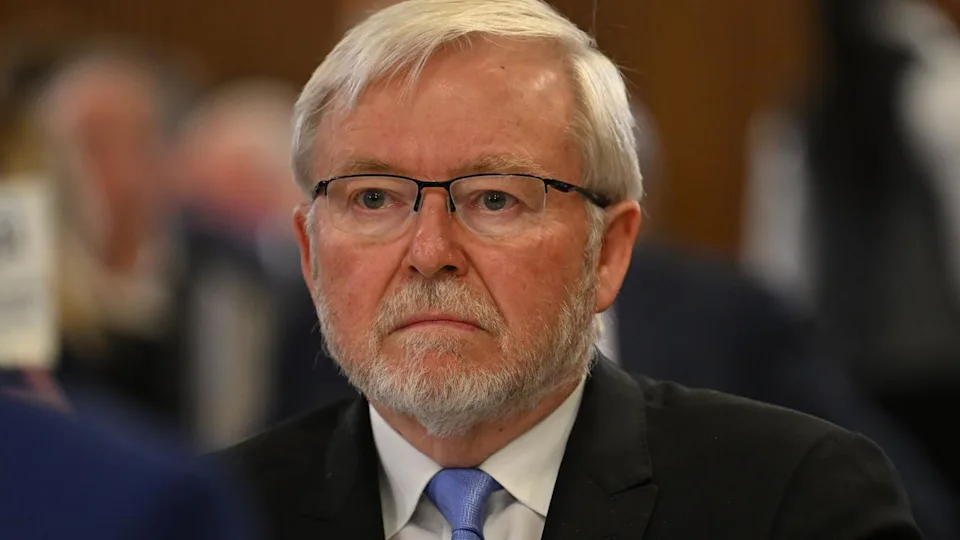
Kevin Rudd says Australia should join the United States in deterring China from invading Taiwan. Picture: NewsWire / Martin Ollman
“The casus belli for invoking the anti-secession law of 2005, putting all those factors together, which is why I point to elevated risk,” he said, referring the China’s legal framework for an invasion of Taiwan by military means.
Mr Rudd said Xi Jinping’s fourth term as leader and his advanced aged were also a “risk factor”.
“What do you do about it? It’s pretty simple. It’s called deterrence, deterrence, deterrence,” he said.
“What is required is a combination of both declaratory and operational policies and strategies by the US and its allies around the world to elevate that risk in the perception of the Chinese leadership.”
He went on to describe the “shaving mirror test for Xi (Jinping)”.
“Which is: I’m having a shave in the morning. I’m looking in the mirror and you want every day the response in the mirror to be comrade, it’s still too risky.”
As for the “Australian response”, Mr Rudd said “our response should simply be to double down with the United States and friends, partners and allies on the deterrence equation”.
However, he refused to be drawn on whether Australia should join military action.
“Unless, if deterrence fails, what then to do? … It’s not responsible for anyone who served as prime minister, foreign minister, or ambassador to the United States to engage in hypotheticals”.
More to come