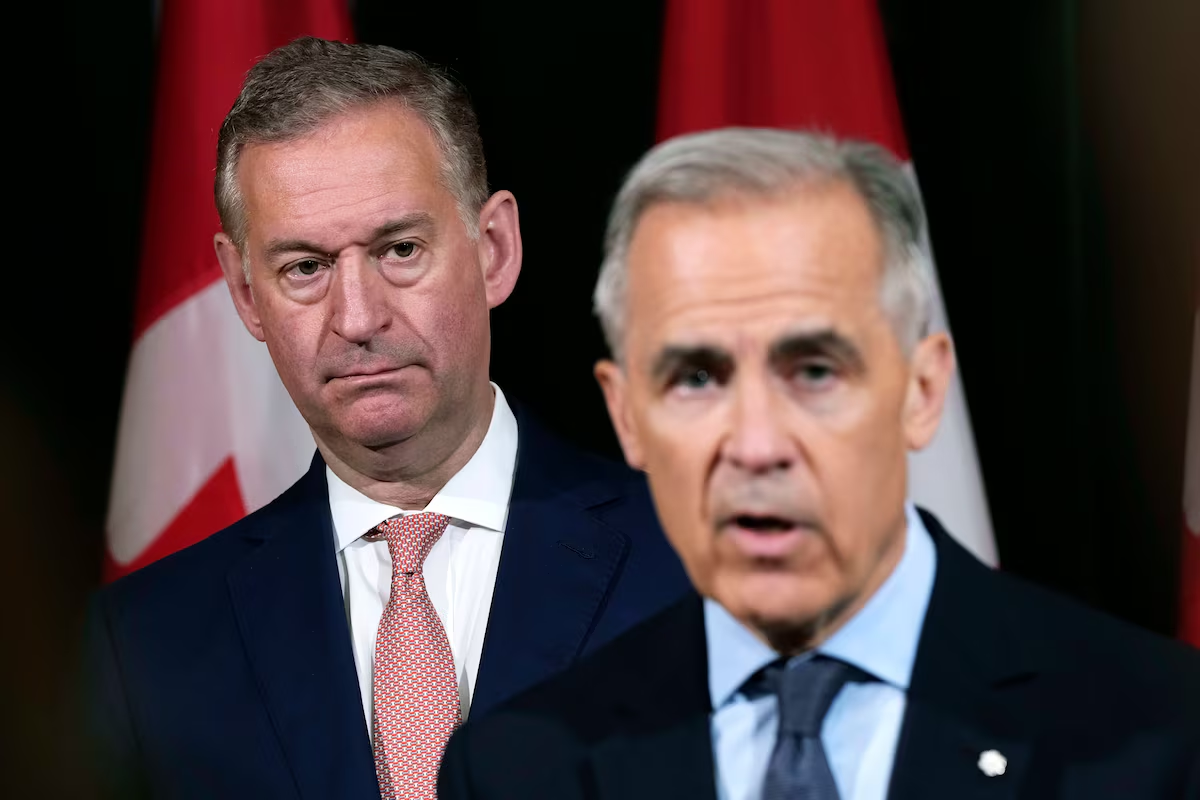
Doug Guzman, CEO of the Defence Investment Agency, left, with Prime Minister Mark Carney in Ottawa in May.Justin Tang/The Canadian Press
Eugene Lang is an assistant professor at the School of Policy Studies at Queen’s University.
“Triangle of inertia.”
It’s a clever phrase uttered by Doug Guzman, CEO of the federal government’s new Defence Investment Agency, at a CIBC “defence and resiliency” conference in Toronto in May. He was describing the challenges he faced in his efforts to reform the process of defence procurement and accelerate project approvals.
Mr. Guzman’s triangle seems to refer to the entrenched thinking and ways of doing business within the three departments most responsible for defence procurement – National Defence, Public Services and Procurement Canada, and Innovation, Science and Economic Development Canada. The Defence Investment Agency was launched to overcome such institutional inertia and in so doing shift the paradigm those three departments have been wedded to for so long.
The Globe and Mail’s Robert Fife reported this week that Mr. Guzman, a career banker, former colleague of Prime Minister Mark Carney at Goldman Sachs and hand-picked by Mr. Carney to lead the DIA to prosecute this reform agenda, is expected to leave his job after less than a year. The reason cited by sources in Mr. Fife’s article for Mr. Guzman’s premature departure is that he is “frustrated by the slow pace of government bureaucracy in getting defence procurement projects moving and approved.” In other words, the triangle of inertia is prevailing.
Carney’s summit to push Canadian resources, defence and tech to global investors
It is not surprising Mr. Guzman has had enough of Ottawa’s bureaucracy. Private-sector executives rarely succeed when they move into the top ranks of the federal public service, with its more “complex” environment, where the two Ps – process and politics – dominate.
Business people tend to find the endless processes of the federal bureaucracy, where the objective is often to find the lowest common denominator and maintain the integrity of the decision-making process more than the decision outcome itself, as foreign to their experience. The politics that necessarily arise one way or another in all major government decisions can also be frustrating for the business mind. The public-service executive, in other words, is no place for revolutionaries.
But all revolutions need revolutionaries. And make no mistake, Mr. Carney’s defence procurement reform agenda and defence industrial policy – the latter of which aims to diversify suppliers and build up Canada’s defence industrial base through buying Canadian “whenever possible”– is revolutionary by Ottawa standards.
Mr. Guzman was leading that revolution. He was the change agent trying to break through the natural institutional inertia and aversion to risky, big change that afflicts most public-sector organizations.
One of the worst kept secrets in Ottawa is that many in the public service and military bureaucracy do not share the Carney government’s enthusiasm for fundamental reform to defence procurement or a defence industrial policy aimed at buying Canadian.
The Sunday Editorial: The hunt for a Liberal defence plan
Hit by tariffs, Canadian tool-and-die makers eye opportunities in defence industry
But what the Prime Minister and Mr. Guzman seem to recognize that others evidently miss is that the government’s massive, planned defence spending increases – from 2 per cent of GDP today to 4 per cent by 2030 – will eventually make contact with the enemy. Namely, funding trade-offs in other areas of government spending, like social programs or federal-provincial transfers, tax increases or perpetually growing deficits, will be needed to finance the defence bill. It is at that point that the defence consensus that exists today – public opinion surveys show solid support for big increases in defence spending – will face its first real test.
The government’s leadership seems to have concluded that busting up the old defence procurement model, expediting military procurements and showing Canadians there are big, tangible domestic job and economic rewards from doing so is the best way to maintain public support for the unprecedented defence funding that is coming down the track and will force those trade-offs. That is the basic political economy of the government’s defence plan, which seems lost on some in the public service and military bureaucracy.
It would be an overstatement to say the government’s defence procurement reform and defence industrial policy agenda is in peril with Mr. Guzman’s departure. Everyone is replaceable. But given the nature of Mr. Guzman’s exit – less than a year into the job and frustrated by the Ottawa system – it is unclear who would be qualified and willing to prosecute the revolution he was leading.