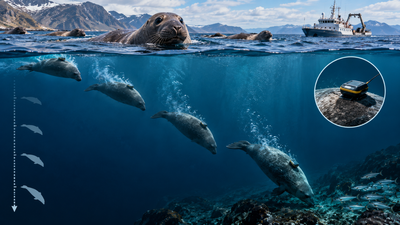
A female northern elephant seal disappeared beneath the Pacific surface carrying a small electronic recorder that would reveal just how far these animals can travel into the ocean’s depths. The device recorded the seal’s movements as she descended hundreds of metres below the surface, entering a part of the water column that cannot be observed easily from above. Her dives formed part of a much larger record collected by scientists using time-depth recorders and satellite tags to follow female elephant seals during their long foraging migrations. The data showed that these animals routinely make deep, repeated dives while searching for food, with one recorded dive reaching 1,735 metres. Researchers found that diving depth and duration varied among individuals, by time of day and stage of the migration. Modern recorders can preserve these measurements for months, allowing scientists to reconstruct underwater journeys that would otherwise remain hidden. The resulting records provide detailed evidence of how female elephant seals use the deep Pacific. The instruments followed them into the depths.
How electronic tags tracked northern elephant seals for 17 years
The tracking programme combined several types of electronic equipment. According to the study published in PLOS ONE, titled ‘Foraging Behaviour and Success of a Mesopelagic Predator in the Northeast Pacific Ocean: Insights from a Data-Rich Species, the Northern Elephant Seal’, researchers fitted adult female seals with satellite transmitters, time-depth recorders and VHF transmitters. The time-depth recorders sampled underwater depth repeatedly, allowing researchers to reconstruct the animals’ diving patterns after they returned. Instruments were attached shortly before the seals left their colonies and removed after their return. This approach allowed the researchers to connect underwater behaviour with the animals’ movements across the northeast Pacific. Adult females were particularly useful for this work because they make extended foraging migrations and repeatedly return to land, where instruments can be attached and recovered.Researchers combined tracking and diving information collected over 17 years, preserving both raw and processed records. The study explains that modern time-depth recorders can measure depth through pressure sensors at consistent sampling intervals, producing detailed dive records over multiple months. The researchers also applied quality-control procedures to distinguish genuine behaviour from possible instrument errors. Dive records were visually examined for unusual patterns, including repeated deep dives to identical depths that might indicate malfunction. The processed dataset excluded individual dives with durations exceeding 150 minutes because these values fell outside the realistic range used by the researchers’ filtering procedure.
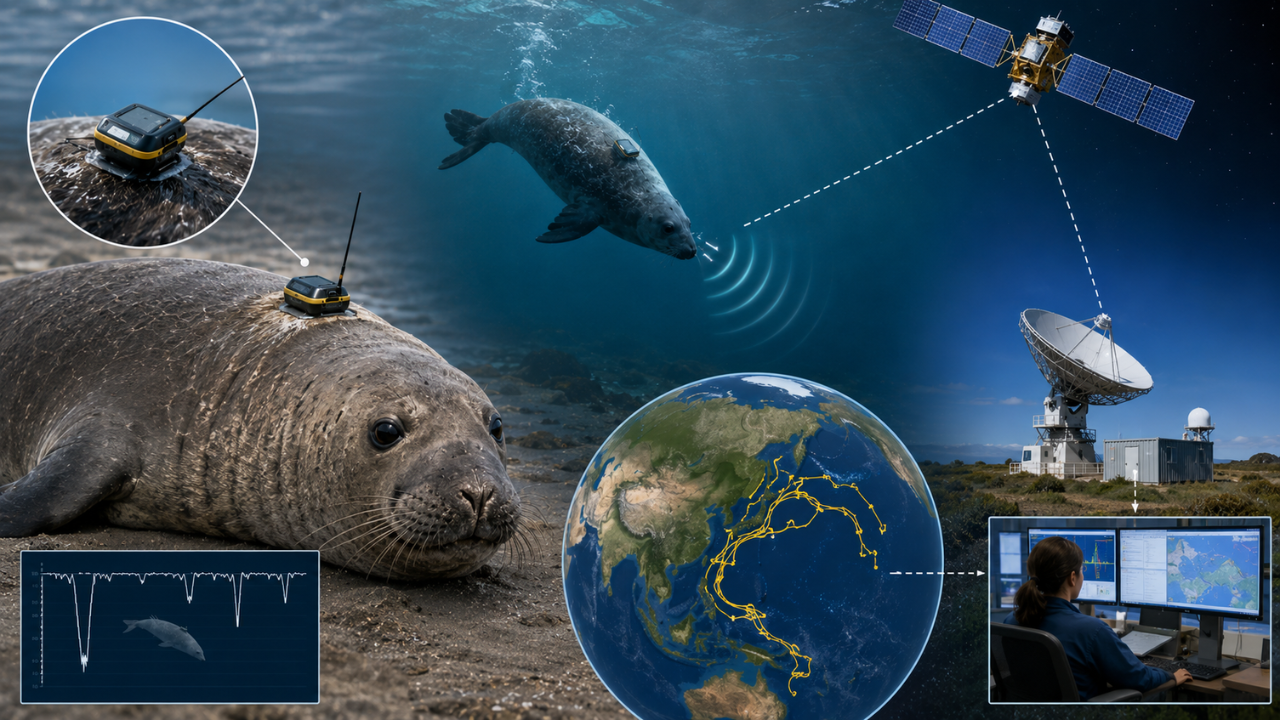
Image Ai generated
How deep do northern elephant seals dive while foraging
The deepest dives are part of a broader foraging pattern. Researchers found that elephant seals generally fed between about 400 and 600 metres, although some dives went considerably deeper. Their dive depths changed with the time of day, a pattern consistent with predators following prey that migrate vertically through the water column. The researchers noted that acoustic studies of deep scattering layers had generally found their highest prey densities at shallower depths than the depths used by elephant seals. As a result, the seals appeared to be exploiting prey resources that had not yet been adequately characterised. The study also recorded individual differences in diving behaviour, showing that seals did not all use the water column in the same way.The relationship between diving and foraging was also visible in the duration of individual dives. Individual differences accounted for 33 per cent of variation in diving depth and 50 per cent of variation in dive duration. Dive duration increased as migrations progressed, which the researchers associated with changes in physiological condition during continuous diving. The seals also performed drift dives, which the study describes as dives that serve as food-processing periods. Their diving behaviour therefore involved more than simply descending to a particular depth and returning to the surface. The recorded patterns included different dive types, changing durations and repeated movements through the water column as the seals travelled towards and remained in areas used for feeding.
Why do northern elephant seals dive deeper during the day
The instruments also allowed researchers to examine the relationship between diving and light conditions. According to the study published in Nature, titled ‘Two decades of three-dimensional movement data from adult female northern elephant seals’, individual dives were assigned locations using interpolated tracking data, and researchers calculated solar elevation at the beginning of each dive. This created a record combining diving measurements, geographical position and solar conditions. The procedure provides a way to examine dives in relation to the changing light environment, including the distinction between daytime and nighttime behaviour. The researchers found a pronounced diel pattern in dive depths, with seals tending towards deeper dives during the day and shallower dives at night. These measurements demonstrate that the animals’ underwater movements varied systematically with the daily cycle rather than remaining constant throughout a migration.The scale of the resulting record is significant because direct observation of elephant seals underwater is difficult. Little was known about their movement and diving behaviour before satellite tags and time-depth recorders became available. Early tagging work established that northern elephant seals were deep divers, with records reaching 630 metres. Modern instruments have extended that record, while also allowing researchers to combine diving data with locations and environmental information. Reportedly, millions of dives have been collected from hundreds of animals, providing a long-term record of how female northern elephant seals move through the Pacific. The data can therefore document repeated underwater behaviour across migrations and years, including dives that descend beyond 1,700 metres.