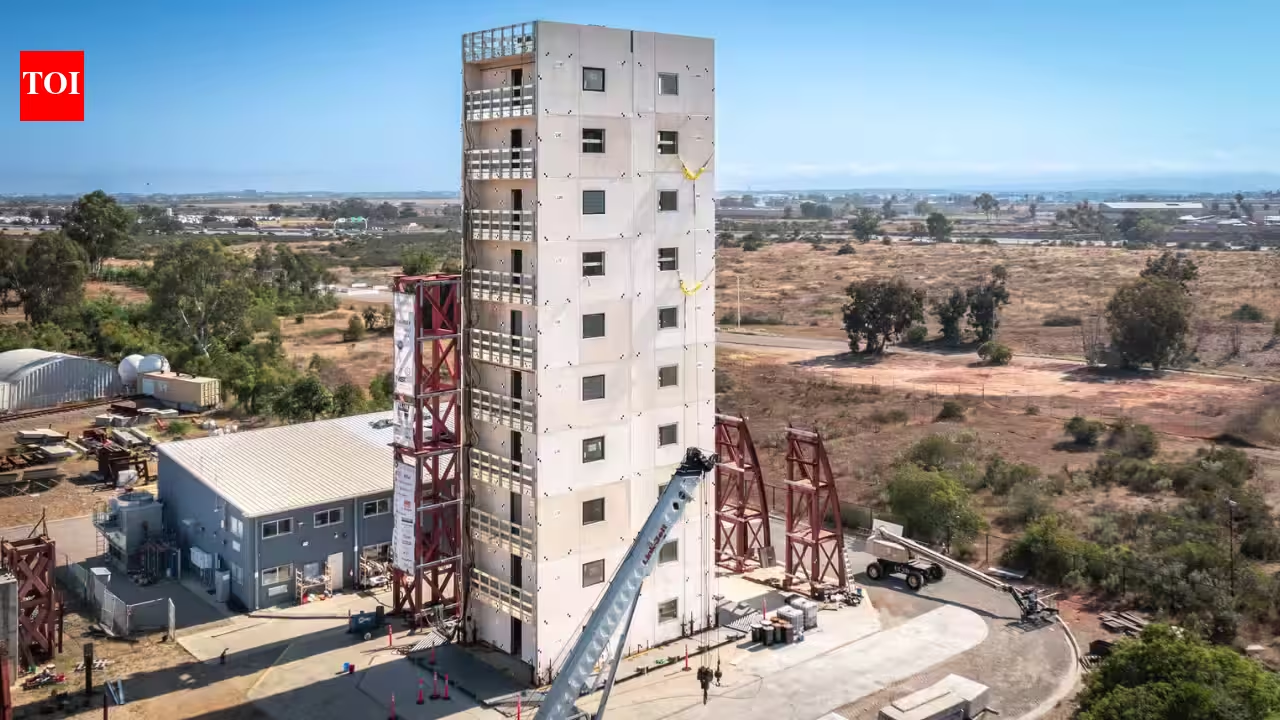
A 10-story building made from cold-formed steel was shaken 18 times at the University of California San Diego in 2025, which included simulations based on major earthquakes. After the seismic tests, researchers set controlled fires on two floors of the same building to study what could happen when a fire follows an earthquake.The building’s load-bearing structural system was able to retain its integrity through the earthquake series, according to UC San Diego. The results are being studied as researchers consider whether cold-formed steel construction could eventually be used in buildings taller than the current U.S. code limit of six stories in areas with moderate to high seismic risk.
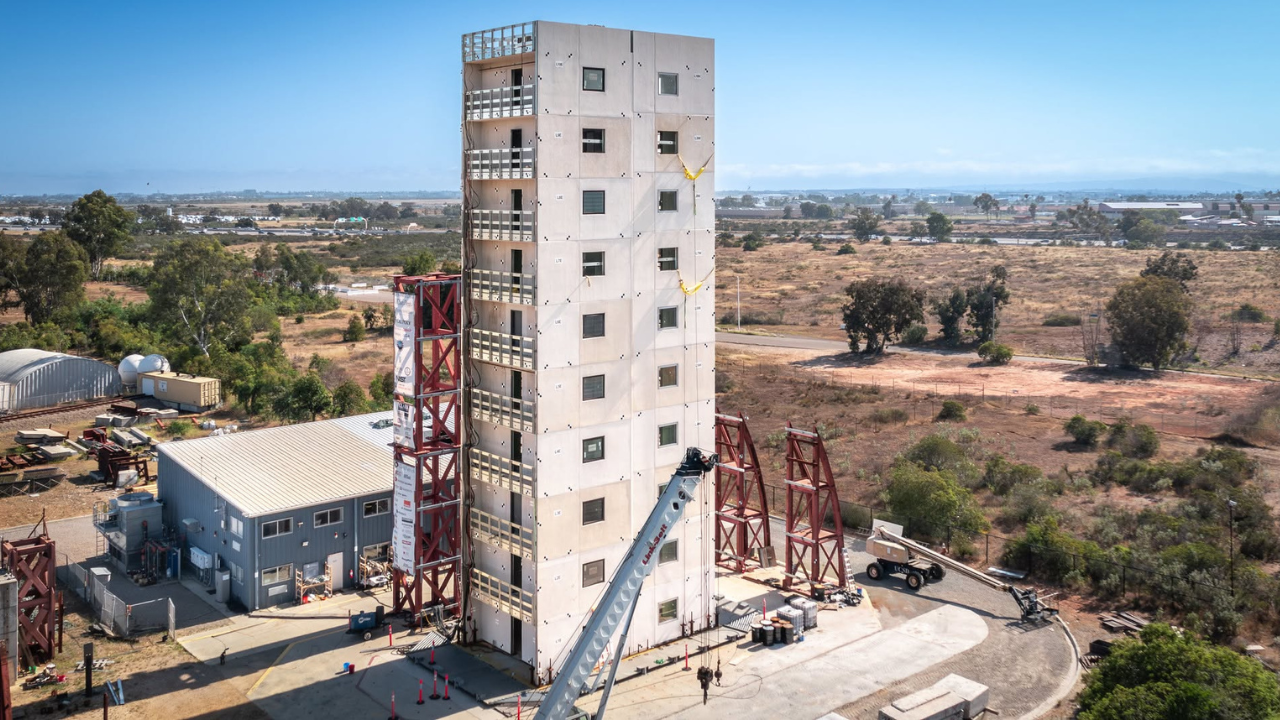
The building’s load-bearing structural system was able to retain its integrity through the earthquake series | Facebook/UC San Diego
The building was deliberately taller than the code limitThe test structure stood about 100 feet tall and contained 10 stories, and its frame was built from cold-formed steel, which is a lightweight material shaped from steel sheets at room temperature into components such as studs and floor joists. Cold-formed steel buildings in moderate- to high-seismic-risk areas are limited to 65 feet, or about six stories under current U.S. building codes. The CFS10 project was designed to examine whether that limit could eventually be extended to 100 feet.The experiment was a collaboration involving UC San Diego, Johns Hopkins University and other academic, government and industry partners. The National Science Foundation funded the shake-table facility, while the test program also received support from the U.S. Department of Housing and Urban Development, the California Seismic Safety Commission, the California Office of Emergency Services and the National Institute of Standards and Technology.Parts of the building used traditional stick framing, while other sections used prefabricated panels and three-dimensional modular units. That gave researchers an opportunity to examine different ways of assembling taller cold-formed-steel buildings within the same test structure.Eighteen earthquakes were simulatedThe testing took place on UC San Diego’s Large High Performance Outdoor Shake Table, a facility capable of moving a structure in six degrees of freedom. The table can reproduce motion in different horizontal and vertical directions as well as rotational movements such as roll, pitch, and yaw. Researchers used recorded earthquake motions, including the magnitude 6.9 Loma Prieta earthquake that struck Northern California in 1989. The tests increased in intensity as the series progressed.The building was fitted with nearly 1,000 sensors that recorded acceleration, displacement and local strains. Researchers also wanted detailed measurements that could be used to compare the physical response of the building with computer models and future structural-design methods. During the 18 tests, the building swayed and twisted as it was subjected to increasingly severe motions. Three of the tests were at or above the level that design engineers must consider when designing buildings, according to UC San Diego. After the series, project lead Tara Hutchinson said the load-bearing structural system had retained its integrity, and the stairs, which were designed to move with the structure during an earthquake, also remained functional.Then researchers tested fire after earthquake damageResearchers returned to the building for controlled live-fire experiments a few weeks after the earthquake tests. Fires were conducted on the sixth and ninth floors, and used finished interior spaces that included drywall around the steel framing. The setup was intended to reproduce a situation known as a fire-following-earthquake. A strong earthquake can damage electrical systems, gas lines or other equipment, and potentially leave a building exposed to fire after the shaking stops.The researchers wanted to see how the fire behaved inside a building that had already experienced seismic loading, and they also examined the drywall layers that protect the steel frame from high temperatures. Fire engineers led by Richard Emberley of Cal Poly San Luis Obispo worked with Hutchinson’s structural-engineering team. Drones were used to monitor the fires while firefighters stood by during the tests. The research focused on temperature, smoke and particulate movement and on how the protective layers surrounding the steel performed after the building had been shaken.
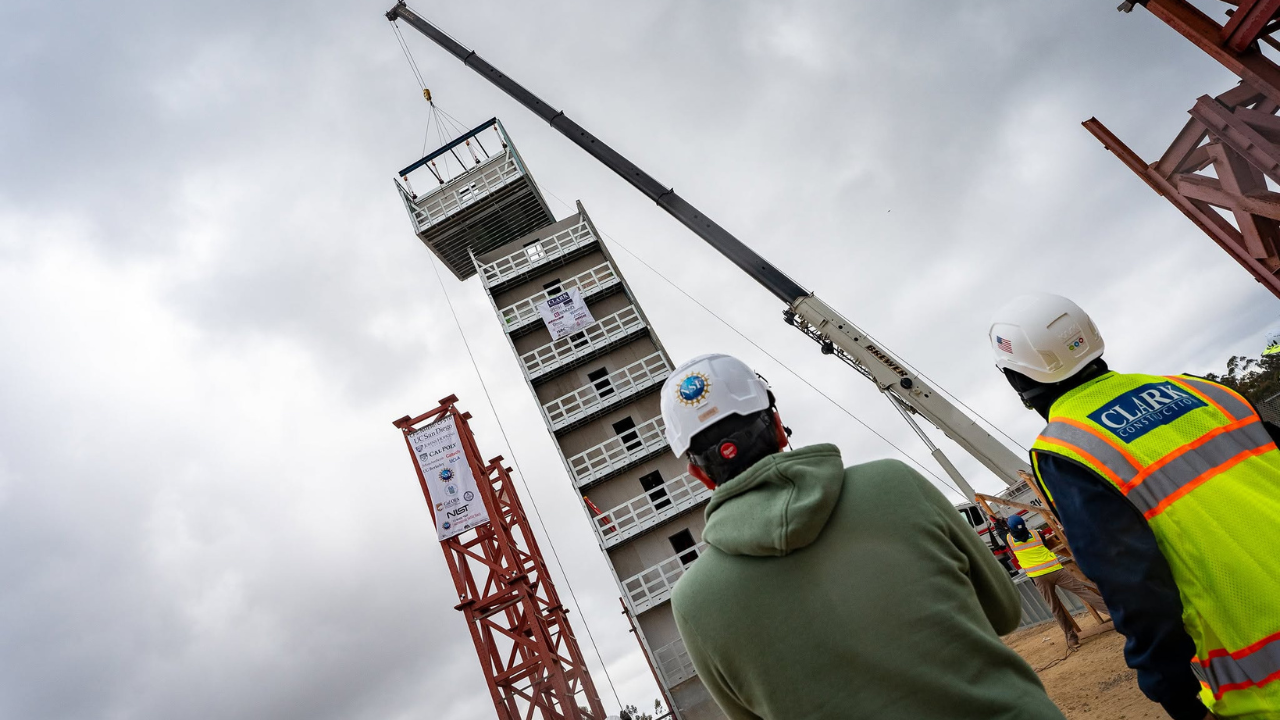
The researchers included drywall, stairs, mechanical systems and other nonstructural components in the experiment | Wikimedia Commons
The steel frame was only part of the questionCold-formed steel itself does not burn, but that does not mean a steel-framed building is unaffected by fire since high temperatures can weaken steel, while the materials surrounding the frame can be damaged or stripped away. That is why the researchers included drywall, stairs, mechanical systems and other nonstructural components in the experiment. A building can remain standing while individual systems inside it suffer enough damage to affect evacuation, fire protection or later occupancy.The CFS10 program was designed around that broader question of resilience, and its researchers are studying both the structural frame and the systems that people would actually depend on after a major earthquake. The seismic tests also took advantage of a $17 million upgrade to the UC San Diego shake table completed in 2022. The upgrade gave the simulator six degrees of freedom, which made it possible to reproduce the multidirectional movements seen in real earthquakes rather than moving a building along a single axis.Researchers are continuing to analyze the large dataset generated by the earthquake and fire tests, with the longer-term aim of providing evidence for the design of taller cold-formed-steel buildings. For now, the 10-story CFS10 structure has provided a full-scale building subjected first to repeated earthquake simulations and then to controlled fire tests in the same structure, something which ordinary laboratory experiments cannot.