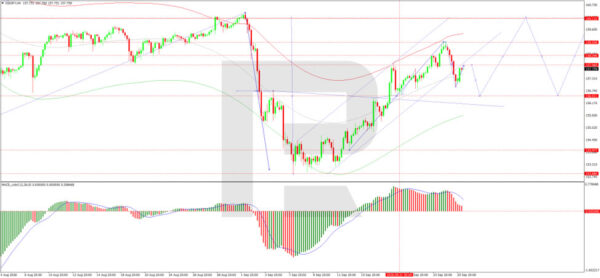
USD/JPY opens the week at 157.30. Last Friday, the Japanese yen moved away from two-week lows and snapped a five-session losing streak.
The yen was supported by comments from Finance Minister Satsuki Katayama. She stated that Donald Trump had expressed concern over the yen’s weakness during a meeting with Prime Minister Sanae Takaichi earlier in the week.
Markets were already closely monitoring intervention risk as USD/JPY approached the psychologically important 160 level. This mark could serve as a test of how far Tokyo is prepared to allow further weakening of the national currency.
Katayama also confirmed that she will continue coordinating with US Treasury Secretary Scott Bessent following the joint intervention by Japan and the United States in late July-the first such action since 1998.
At the same time, pressure on the yen has not entirely dissipated. Expectations of further Federal Reserve rate hikes maintain the wide US-Japan rate differential, while uncertainty over the pace of further Bank of Japan policy tightening also limits the yen’s strengthening potential.
Technical Analysis
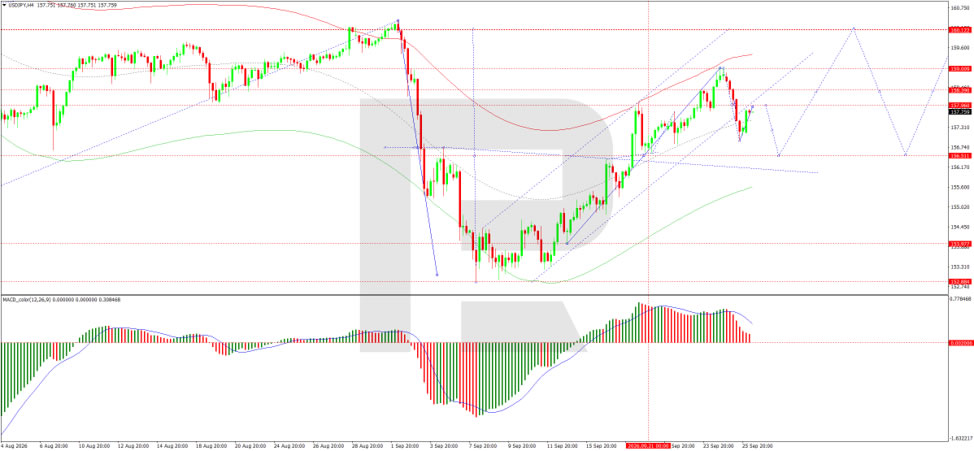
On the H4 USD/JPY chart, following the completion of a growth wave to 159.00, the market formed a corrective impulse and broke the lower boundary of the upward channel around 157.96. The current structure retains the priority of a decline towards the reference level of 156.51, which serves as both the nearest target and a potential retest zone from above. A rebound from 156.51 could return the pair to 157.96, and a break above that resistance would open potential for a subsequent move to 159.00 and 160.12. As long as the price remains below 157.96, the underlying short-term scenario remains corrective. The MACD confirms the weakening of the previous uptrend: the histogram is contracting, and the signal line is turning downwards in positive territory.
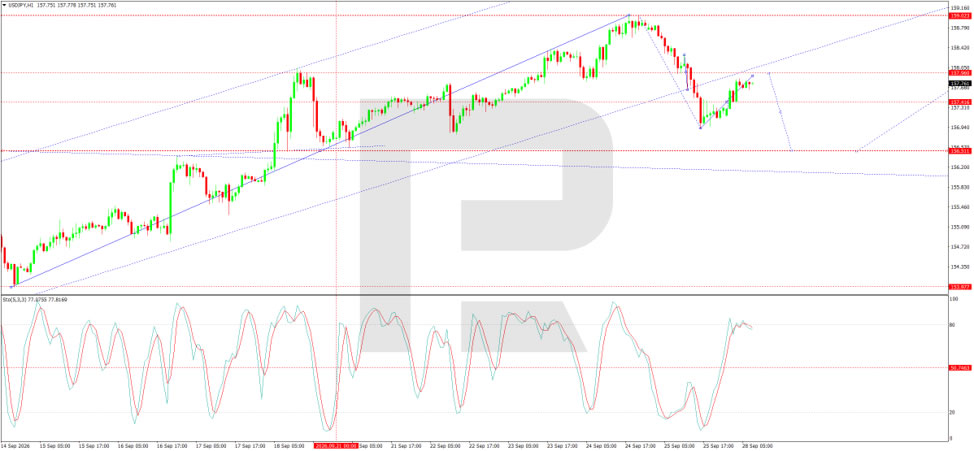
On the H1 chart, following the decline from 159.02, the market formed a local recovery from 156.93 and approached the 157.96 zone. This area represents key resistance and simultaneously the retest level of the broken growth structure. Early in the day, the correction may complete within the 157.90–157.96 range, after which a new decline wave is expected towards 157.42 and subsequently 156.51. A breakdown below 156.51 would increase selling pressure and create conditions for the correction to continue. The Stochastic oscillator is positioned near the overbought zone and is beginning to turn downwards, consistent with the scenario of completing local growth. The intraday trend is assessed as bearish while quotes remain below 157.96. An alternative scenario would involve confident consolidation above 157.96, which would postpone the decline and allow the market to continue recovering towards 158.39 and 159.00 within the current structure.
Conclusion
The Japanese yen has pulled back from two-week lows, supported by intervention warnings from Finance Minister Katayama and reported concerns from Donald Trump over the currency’s weakness. However, the yen’s upside remains constrained by the wide US-Japan rate differential, persistent Fed tightening expectations, and uncertainty over the BoJ’s policy trajectory. The 160 level remains the key psychological threshold that could trigger intervention.
Technically, USD/JPY maintains a corrective bias below 157.96, with a potential decline towards 156.51 in the near term. A rebound from that level could return the pair to 157.96, while a break above would open the door for a recovery towards 159.00 and 160.12. The intraday trend favours further downside as long as the pair holds below 157.96, with the Stochastic supporting the completion of local growth.