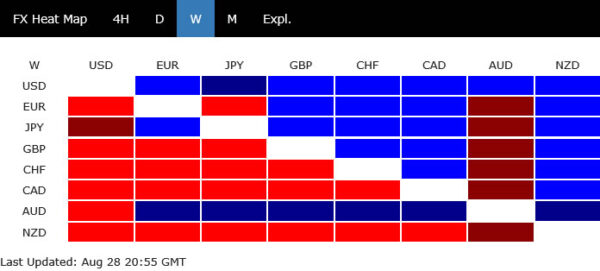
TL;DR: Kevin Warsh’s first Jackson Hole speech as Fed Chair pushed September hike odds to 57% and reinforced institutional discipline against Treasury accommodation — giving the Dollar two distinct reasons to rally, though the reaction stayed concentrated at the front end rather than confirming a structural reversal.
Jackson Hole Delivers a Very Different Fed Message
A year after Jerome Powell used Jackson Hole to prepare markets for easier policy, Kevin Warsh used his first keynote as Fed Chair to establish almost opposite framework. He did not explicitly call for a September hike and deliberately avoided conventional forward guidance. Yet substance was unmistakably hawkish: inflation remains too high, financial conditions are not broadly restrictive, labor market is close to full employment, and Fed has more work to do unless underlying price pressures move clearly back toward 2%.
But rates were only half of market reaction. Warsh also repeatedly emphasized discipline, central-bank responsibility and primacy of conventional monetary policy. He never mentioned Treasury Secretary Scott Bessent, Treasury buybacks or Fed-Treasury coordination. Any independence signal was therefore implicit, not stated. Still, after weeks in which markets had worried that Treasury intervention might eventually pull Fed toward fiscal accommodation, Warsh presented a framework that looked difficult to reconcile with that outcome.
Dollar consequently received support through two interlinked channels: higher probability of earlier tightening and lower perceived risk that Fed would subordinate monetary discipline to fiscal needs.
First Dollar Support: Warsh Was an Implicit Hawk
Warsh’s inflation diagnosis was considerably tougher than absence of an explicit rate call might suggest. He described Fed’s 2% PCE objective as a “firm, fixed target” and said “The responsibility for 65 months of sustained, elevated inflation sits squarely with the central bank. And that is where it belongs.”
Latest numbers gave that argument weight. Twelve-month PCE inflation was running at 3.7%, but six-month annualized pace was even hotter at 4.1%. Breadth also remained uncomfortable: 54% of 199 PCE components had risen more than 3% over past 12 months, versus a pre-pandemic norm around 32%, while 49% exceeded 3% over latest six months.
Warsh therefore refused to treat better recent monthly prints as evidence problem had been solved. His operative standard was clear:
“We must be confident that underlying inflation is moving to our objective, clearly and at sufficient speed. Otherwise, we have work to do.”
Nor did he see much evidence that current 3.50–3.75% policy rate was materially restraining economy. Strong capital spending, corporate profits, narrow credit spreads, healthy issuance and relatively easy lending conditions led him to conclude he would be “hard pressed to describe broad financial conditions as restrictive.”
Labor market offered little reason to offset that concern. Warsh characterized employment conditions as broadly consistent with full employment, leaving inflation as dominant immediate problem.
Taken together, this was not a September commitment. But it was a reaction function that made an earlier hike easier to justify.
FedWatch Reprices Timing, Not a New Tightening Cycle
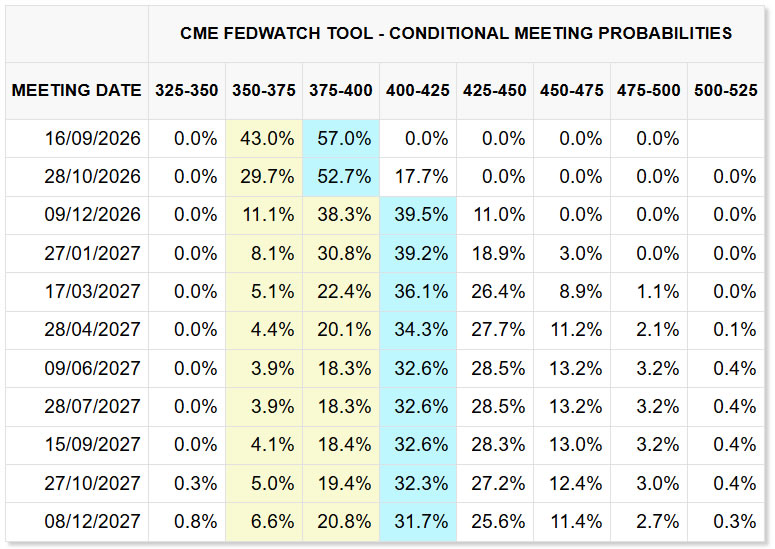
Markets responded accordingly. CME FedWatch put probability of a September 16 hike at 57% after speech, up sharply from roughly 37% a day earlier.
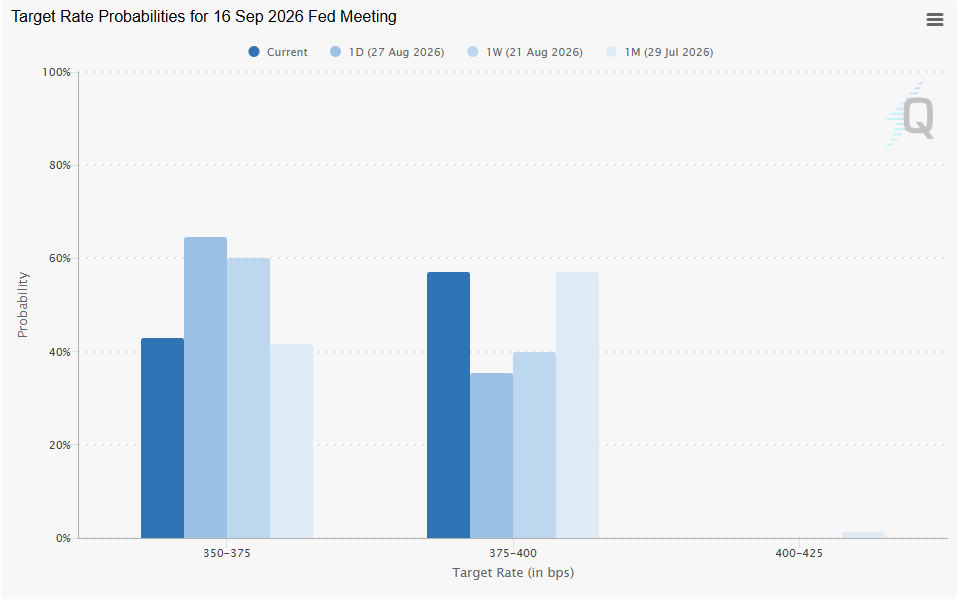
By December, probability that at least one hike has occurred rises to about 89%. Distribution is still relatively balanced rather than aggressively hawkish: around 38.3% probability sits on one hike by December and 39.5% on two, with another 11% assigned to three.
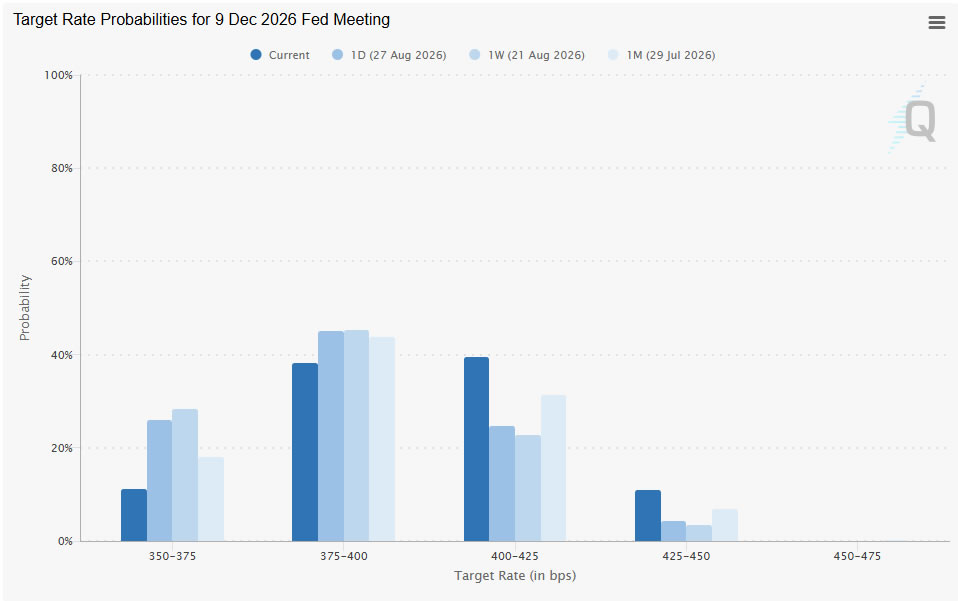
That distinction matters. Warsh did not convince investors that Fed is beginning a long tightening campaign. He convinced them that a modest path already considered plausible may start sooner.
Indeed, Friday’s repricing looks partly like reversion rather than fresh discovery. September odds had drifted sharply lower during previous weeks as Dollar weakened and fiscal-credibility/debasement trades gained traction around Treasury’s expanded buybacks. Warsh reversed part of that dovish drift.
Further out, FedWatch distribution reinforces same conclusion. From mid-2027 onward, 4.00–4.25% generally becomes largest individual target-rate bucket, while probabilities for three or more additional hikes decline progressively. Market is pricing greater conviction around one or two moves—not a fundamentally different terminal-rate regime.
Second Dollar Support: “Discipline” Pushes Back Against Fed-Independence Anxiety
Warsh’s second impact was less explicit but potentially just as important for Dollar.
He did not say Fed would resist Bessent. He did not discuss Treasury buybacks. He did not explicitly reject closer Treasury-Fed coordination. Those claims should not be put into his mouth.
What he did was lay down principles that markets could reasonably interpret as hostile to routine fiscal accommodation.
Most important was his statement that:
“Short-term interest rates are the predominant tool to achieve the dual mandate.”
He added that unconventional measures designed to stimulate economy may be appropriate in genuine crises but should otherwise be used “sparingly, if at all.”
Combined with a fixed 2% inflation target, explicit Fed responsibility for persistent inflation and his rejection of policy promises designed to comfort markets, that amounted to an implicit market-discipline framework.
This mattered because one of central worries behind recent debasement trade was not simply that Treasury was buying back bonds. It was whether pressure to control government financing costs could eventually spill over into Fed policy.
Warsh did not answer that concern institutionally. But rhetorically, he made a fiscally accommodating Fed look less likely.
His closing line captured that philosophy:
“I stand here today committed to a discipline, not to a decision.”
The first half of that sentence mattered almost as much to markets as second.
Yield Curve Separates the Two Channels
Treasury market provides perhaps clearest evidence of what investors actually repriced.
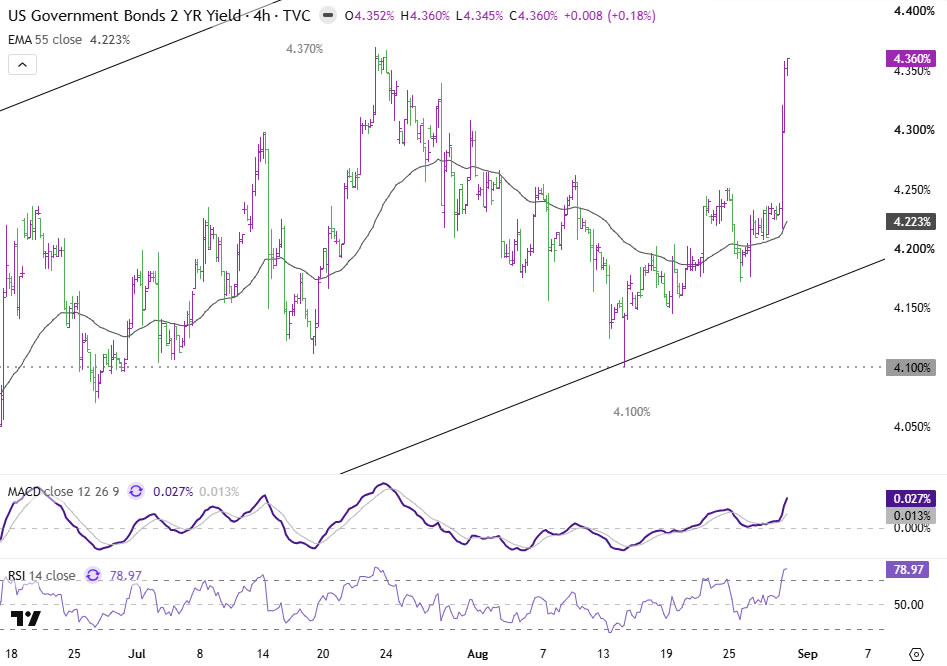
Reaction was heavily concentrated at front end. 2-year yield jumped roughly 13bp to 4.36%, while 10-year rose around 5bp to 4.72% and 30-year moved only around 1–2bp to 5.21%.
That gradient looks like a near-term Fed-policy repricing rather than renewed loss of long-run fiscal or inflation credibility.
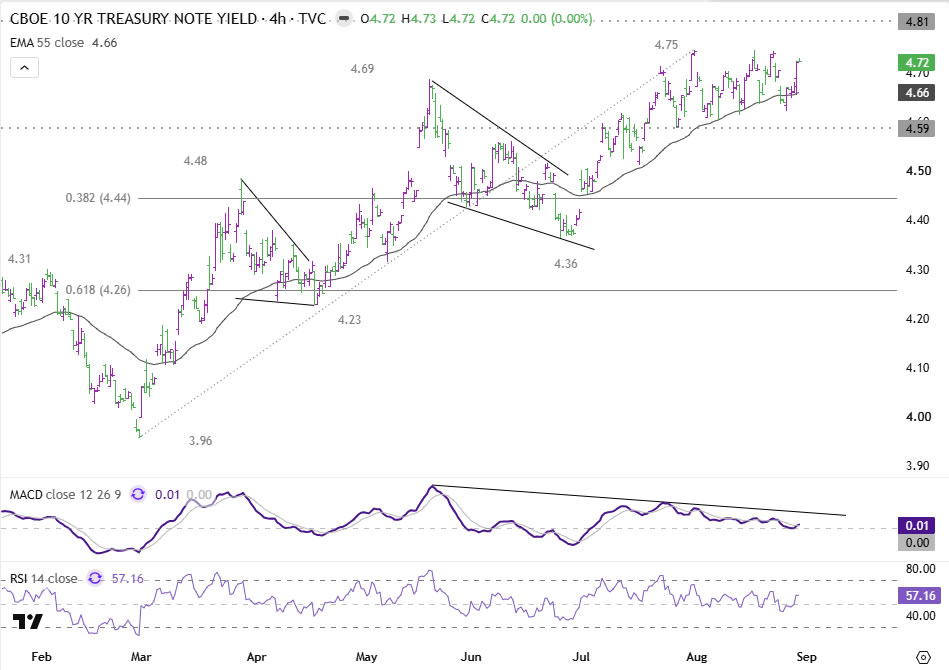
If Warsh had intensified concerns that Fed would tolerate inflation to accommodate Treasury, pressure should have been much more visible in long-end term premium. Instead, front end did overwhelming amount of adjustment, while 30-year barely moved.
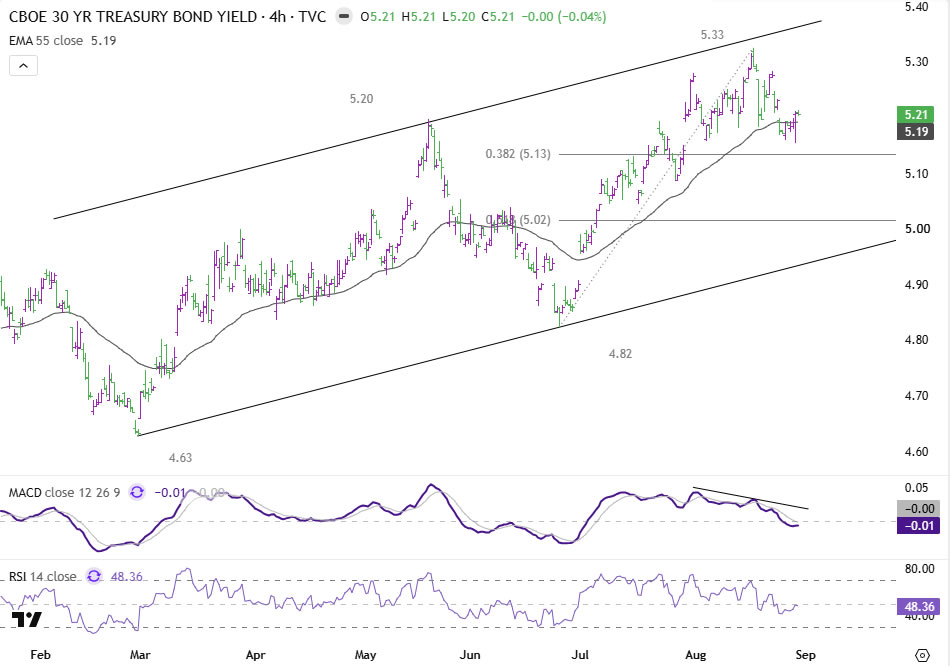
In other words, market heard “Fed may hike sooner”, not “US long-run inflation credibility just deteriorated.”
That fits the second channel too. If Warsh’s discipline-first framework reduced some concern over fiscal dominance, there was little reason for long-end yields to surge alongside 2-year.
Warsh dramatically changed price of two-year money. He barely changed long-run Treasury story.
Gold and Silver Show Credibility Channel Was Also Being Repriced
Cross-asset reaction adds another dimension.
Gold fell 3.23% on Friday and Silver dropped 4.21%, reversing sharply after Silver had led precious metals higher before speech. Platinum fell as well, while Bitcoin also weakened.
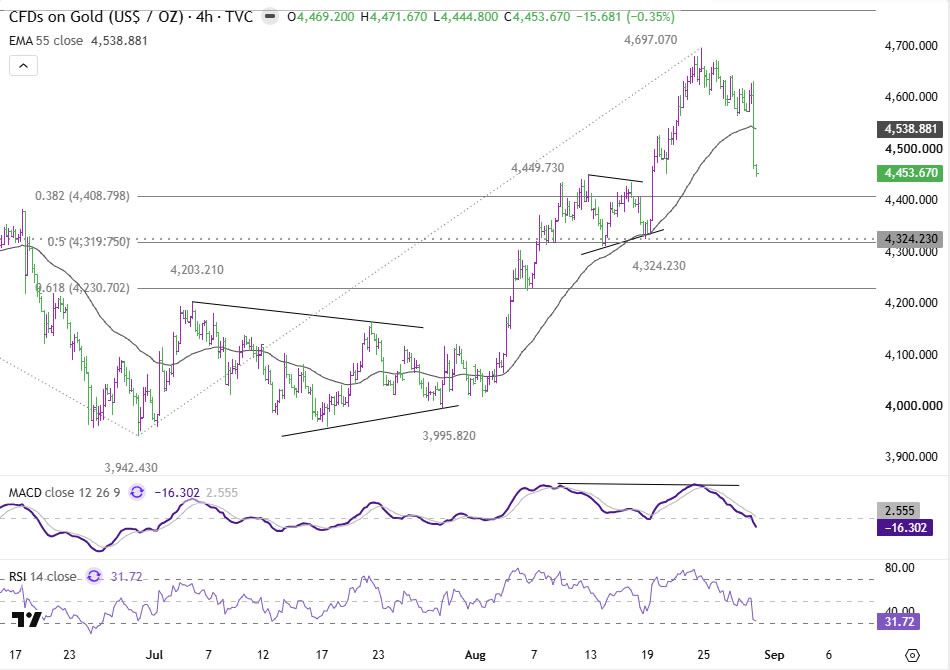
Part of that reaction is straightforward rates mathematics. Higher front-end yields make non-yielding assets less attractive and strengthen Dollar.
But rates alone probably do not tell whole story. Gold in particular had become one of clearest expressions of concerns surrounding monetary debasement, Treasury intervention and Fed independence. Warsh’s discipline-heavy framework therefore challenged not only expected rate path but also one of narratives supporting precious metals.
The correct interpretation is not that Warsh explicitly resolved Fed-independence debate—he did not. Rather, markets behaved as though his framework reduced some of institutional-risk premium that had accumulated ahead of Jackson Hole.
That is why two Dollar channels are interlinked. Hawkish inflation diagnosis pushed yields higher at front end. Discipline message simultaneously made fiscal accommodation appear less likely, reducing support for debasement-sensitive assets.
DXY Finds a Short-Term Floor
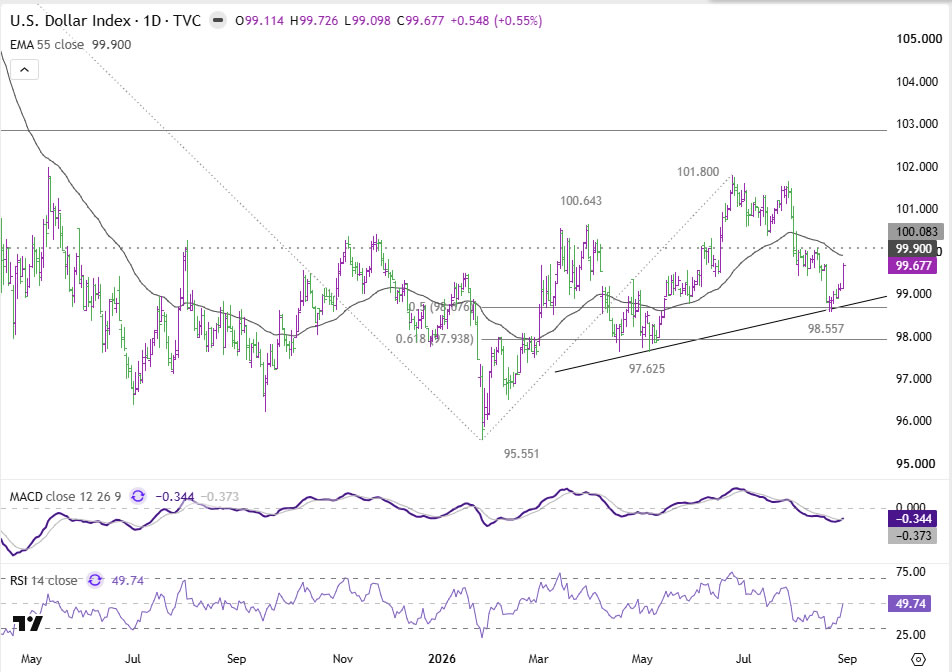
Dollar Index reflected both effects, rising 0.55% to 99.68 on Friday in its strongest daily advance in weeks.
Daily technical picture has improved materially. DXY bounced from 98.56, held above 98.67, 50% retracement of 95.55–101.80 rise, while daily MACD crossed above its signal line from negative territory. Those developments increase probability that fall from 101.80 was a correction rather than immediate resumption of broader decline.
Next hurdle is 100.08. Firm break would strengthen short-term bottoming case and turn focus back toward 101.80.
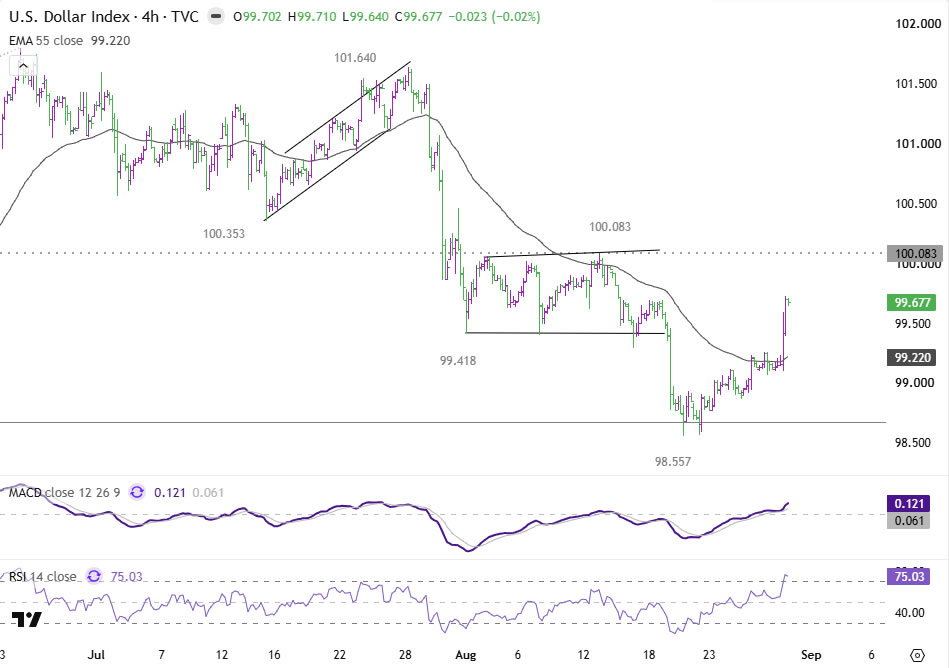
But Friday did not yet establish a structural Dollar reversal. The rebound from 95.55 is not implusive so far. Weekly structure remains unresolved too. Weekly MACD is still below its signal line and DXY closed almost directly on 55-week EMA near 99.72. Larger down trend from 101.76, 2025 peak, remains intact.
A much more significant threshold lies at 102.84, 50% retracement of decline from 110.18 to 95.55. Decisive break there would be needed to argue Dollar is undergoing a genuine medium-term trend reversal rather than a powerful rebound inside broader downtrend.
Two Reasons to Rally, but Not Yet a New Dollar Bull Market
Fundamentals and technicals are therefore telling remarkably similar stories.
Warsh gave Dollar two reasons to rally. His inflation-first diagnosis made an earlier rate hike more credible, while his emphasis on discipline reduced some of market anxiety that Fed could eventually accommodate Treasury’s financing pressures.
FedWatch confirms greater confidence about timing but no dramatic extension of tightening cycle. Treasury curve confirms policy repricing was concentrated at front end rather than long-run inflation premium. Gold and Silver selloff suggests credibility/debasement trade was hit alongside rates channel. DXY confirms a real short-term bottoming attempt without yet breaking its broader bearish structure.
That makes Friday important—but not decisive.
Warsh changed how markets price Fed’s next move and how they perceive Fed’s institutional posture. Whether those two shifts are strong enough to turn Dollar’s rebound into a lasting reversal will require more than one Jackson Hole speech.
Key Takeaways
- Warsh’s implicit hawkishness pushed September hike odds from 37% to 57%, driven by a “firm, fixed” 2% inflation target and a refusal to call current policy restrictive.
- The reaction was concentrated at the front end of the yield curve (2-year +13bp) with the 30-year barely moving, signaling a near-term rate repricing, not a long-run credibility shift.
- Warsh’s “discipline, not a decision” framing, without ever mentioning Bessent or Treasury buybacks, still reduced institutional-risk premium tied to fiscal-dominance concerns.
- Gold fell 3.23% and Silver 4.21%, showing the debasement trade was hit alongside the rates channel, not purely a yield-driven reaction.
- DXY rose 0.55% to 99.68 in a real short-term bottoming attempt, but the broader downtrend from 101.76 stays intact until a break above 102.84 confirms a genuine reversal.