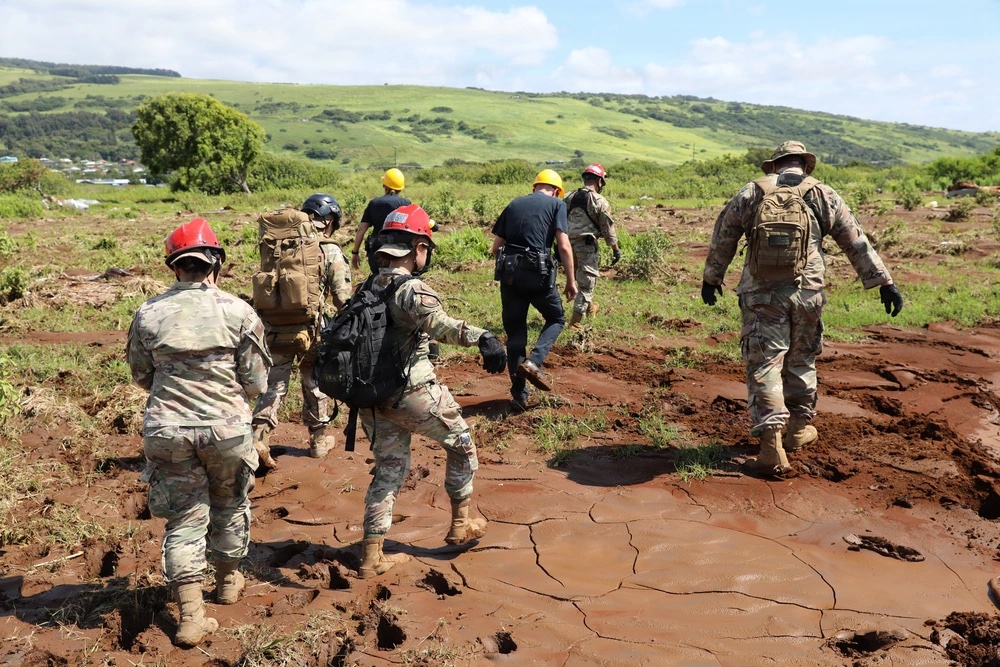
Hawaii National Guardsmen alongside first responders conducting searches in the Ka’u District on Aug. 19. Hawaii National Guard public domain photo.
Coffee farms across southern Hawaii Island are assessing crop, tree and infrastructure losses following Hurricane Lala, which brought damaging winds and extreme rainfall to some of the state’s key coffee-growing areas earlier this month.
Meanwhile, federal, state and local relief efforts are underway to address agricultural losses that, for many coffee growers just entering harvest season, may have long-term financial impacts.
Damage in Ka’u
The storm passed just south of Hawaii Island on Aug. 15, bringing extreme rain and flooding to the island’s southern districts. The deluge prompted a flash-flood emergency in Ka’u, where roads and bridges washed out, water systems were damaged and some communities were temporarily isolated.
The storm came just as many coffee farms in the region were initiating their 2026 harvest, a critical time in the annual cycle of coffee plants, and for the economic outlook for individual farms.
“The removal force for a ripe cherry is much lower than for a green cherry,” Hawaii-based coffee consultant, scientist and Grok Coffee owner Shawn Steiman told Daily Coffee News. “I think the biggest damage is seedlings being uprooted or washed out, or cherries being ripped off and, of course, not having access to get to your farm, even just by foot.”
As of Aug. 24, nearly 70 farmers and ranchers statewide had self-reported more than $3.2 million in Hurricane Lala losses across approximately 320 acres through the Hawaii Agriculture Disaster Response dashboard. Nearly $2 million of the reported damage was on Hawaii Island, according to Hawaii Public Radio. Those numbers are expected to grow as more people gain access to their farms and report damage.
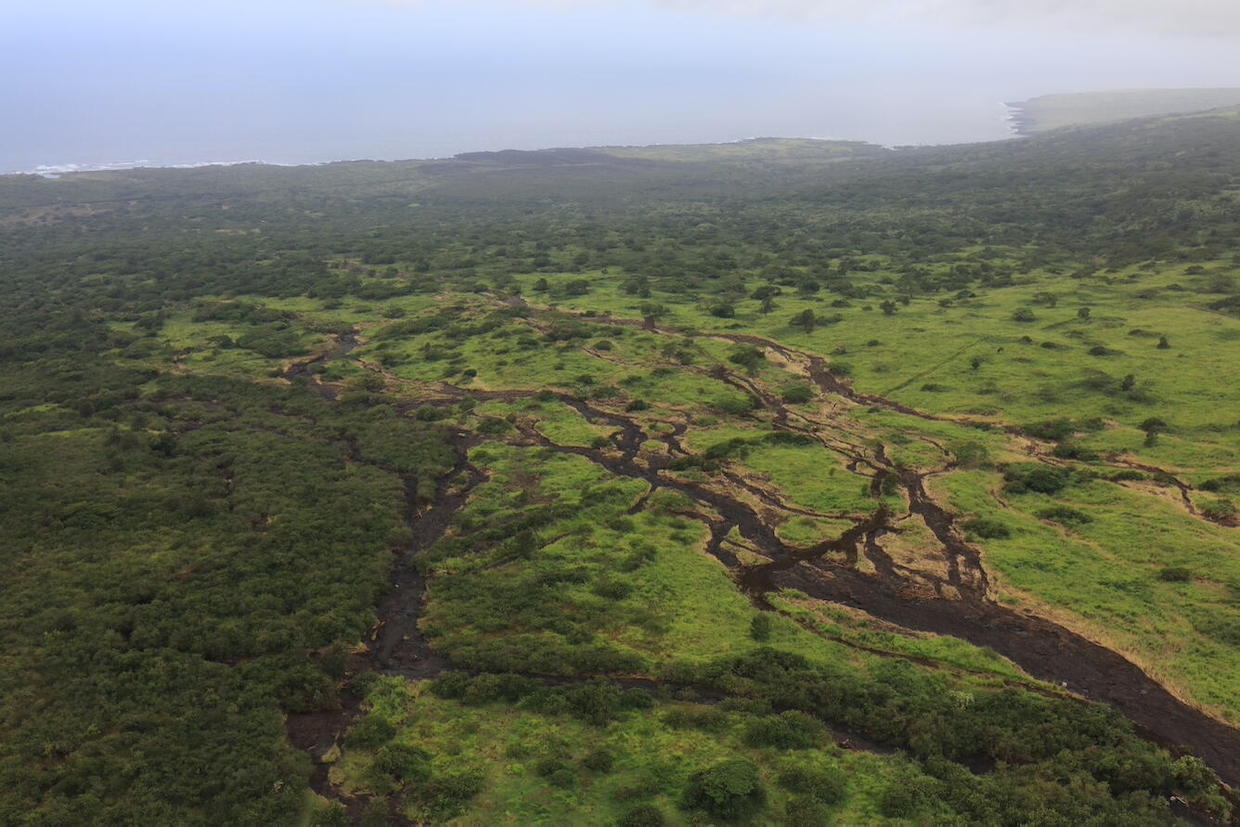
Agricultural lands in Southern Hawaii scoured by floodwaters from Hurricane Lala, with vegetation stripped down to underlying lava rock in some areas. USGS photo by M. Zoeller. Public domain.
Coffee farms are among those reporting significant damage. The Hawaii Coffee Association told Hawaii Public Radio that growers in Ka’u, Wood Valley and Miloli’i were among the hardest hit, while some growers farther north around Holualoa reported losing 20% or more of their coffee trees, often after larger trees fell onto coffee plantings. The association was still assessing the overall impact on the coffee sector.
At Miranda’s Farms in Ka’u, co-owner Maria Miranda told Hawaii Public Radio that hundreds of coffee trees had already been lost across the family’s roughly 80 acres, with some trees uprooted or crushed, and others stripped of limbs and cherry. Alla Kostenko, co-owner of A Coffee Farm in Pahala, told SFGATE that thousands of trees were down or washed away across its properties, including roughly half the trees at one site, predominantly younger plantings. Meanwhile, Ka’u producer and roaster Rusty’s Hawaiian told visitors to its website that it was forced to pause roasting and shipping after the storm took out power and destroyed transportation infrastructure.
President Donald Trump on Aug. 25 approved the state’s request for a federal emergency declaration covering Hawaii County, Maui County and the City and County of Honolulu, authorizing Federal Emergency Management Agency support.
For individual coffee growers, separate U.S. Department of Agriculture (USDA) programs may provide more direct assistance with tree, crop, land and infrastructure losses.
What Coffee Growers Can Do Now
The University of Hawaii College of Tropical Agriculture and Human Resources (UH-CTAHR) has assembled a new Post-Hurricane Lala resource guide for Hawaii County growers, including coffee-specific instructions and contacts for USDA Farm Service Agency programs.
One of the guide’s strongest recommendations is thorough documentation. Growers are advised to photograph damaged roads, buildings, irrigation and water systems, processing equipment, erosion, damaged or missing trees, fallen or unharvested coffee cherries and stored parchment or green coffee. They should also document cleanup labor, save receipts and keep historical production records to estimate potential losses over the next three to five years.
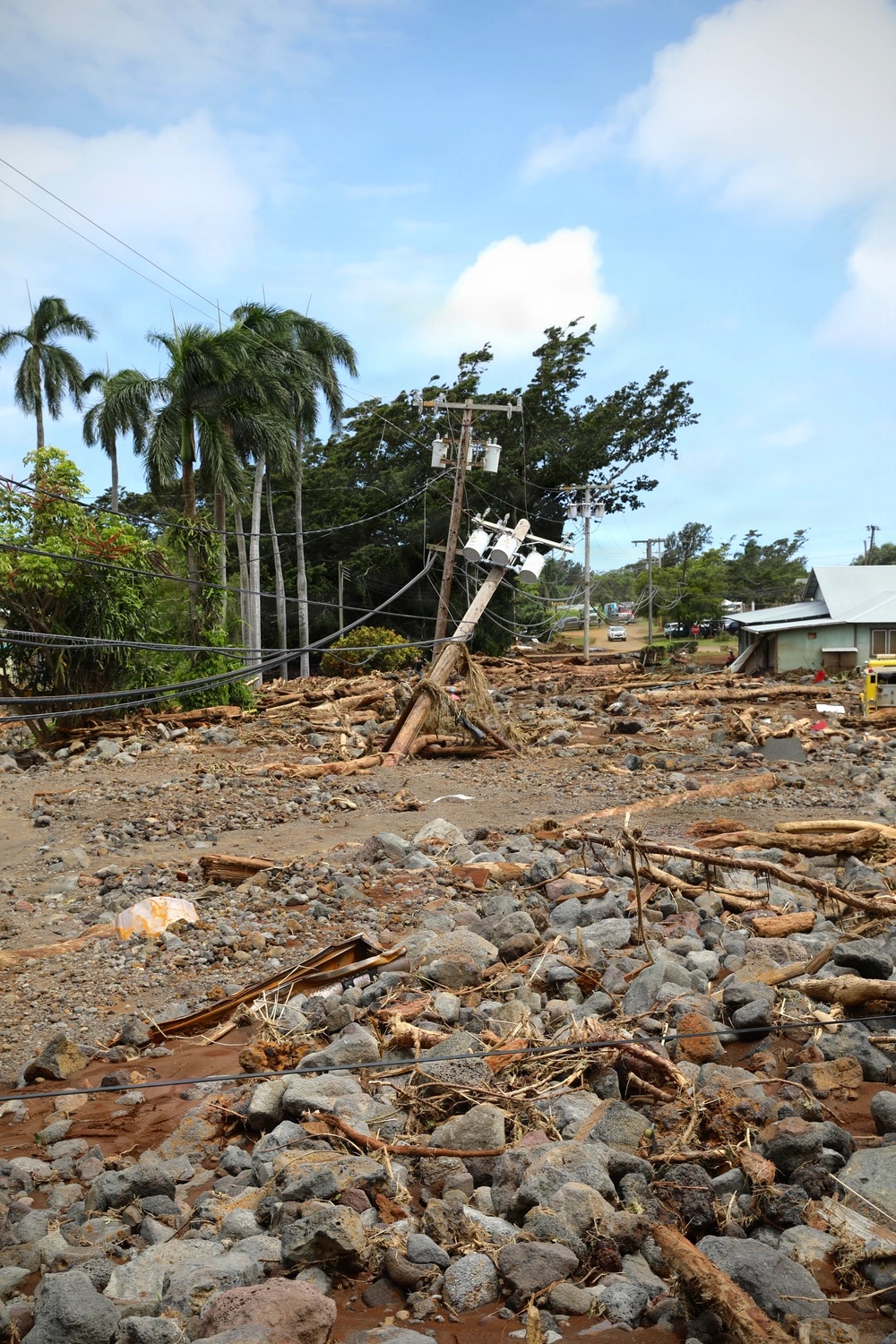
Severe damage in Na’alehu on Aug. 18. Hawaii National Guard public domain photo.
One of the most directly applicable federal programs is the USDA Tree Assistance Program, or TAP, which helps eligible commercial growers rehabilitate or replace perennial crop trees damaged by natural disasters. Applications generally must be filed within 90 days of the disaster or when the loss becomes apparent.
The USDA’s Emergency Conservation Program, or ECP, can help pay for restoring farmland damaged by floods, hurricanes and other disasters, including debris removal, grading or reshaping land, repairing permanent fencing and restoring water-conservation structures. UH-CTAHR said applications related to Lala will open Sept. 1. The ECP generally covers up to 75% of approved costs, subject to funding availability.
USDA is urging affected growers to contact their local Farm Service Agency office as soon as possible to report losses and determine which programs may apply. Growers with federal crop insurance should also report damage to their insurance agent.
Beyond This Year
Shawn Steiman noted that immediate crop losses may have long-term implications for many coffee growers.
“If you’ve lost 10% of the trees you planted, then that reverberates to the future in a significant way,” Steiman said. “Not just yields, but the cost of replacing.”
He also noted that significant defoliation of surviving mature trees could reduce future production by limiting photosynthesis and the trees’ ability to produce new fruit, flowers and leaves.
Steiman said green coffee buyers can play a role in helping with the immediate recovery by simply inquiring about green coffee availability. “If there’s a little coffee lying around, people need and want to sell it. People need money. They need to recuperate,” he said.
However, due to the disastrous timing of the storm at the start of harvest season, Steiman suggested long-term support will be needed, too.
“If we’ve lost coffee, we’ve lost trade,” Steiman said. “People should be aware that helping means helping across time, not just in a moment, and that’s true of any coffee area, any natural disaster.”
Comments? Questions? News to share? Contact DCN’s editors here. For all the latest coffee industry news, subscribe to the DCN newsletter.
Nick Brown
Nick Brown is the editor of Daily Coffee News by Roast Magazine.