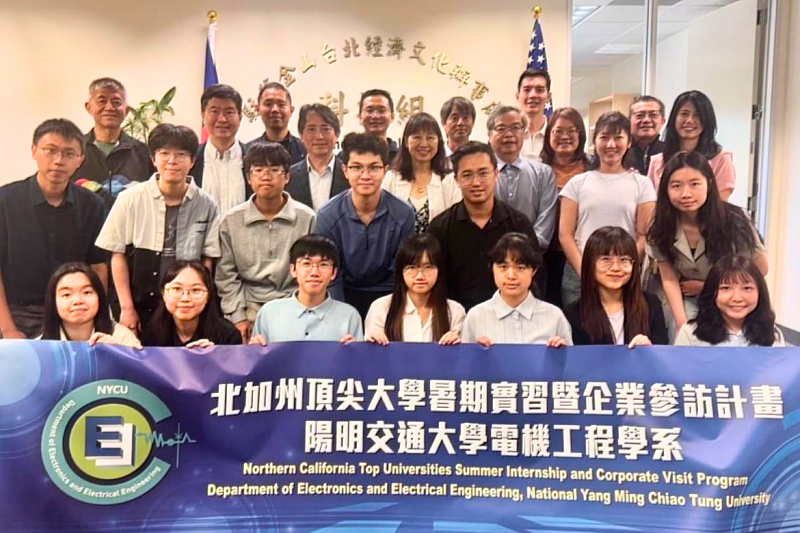
(中央社訊息服務20260806 10:11:44)Students from National Yang Ming Chiao Tung University (NYCU) are spending two months in Northern California this summer, conducting research at some of the world’s leading universities and gaining a firsthand look at Silicon Valley’s technology ecosystem.
The Department of Electrical Engineering selected outstanding third- and fourth-year students for research placements at Stanford University, the University of California, Berkeley, and the University of California, Davis.
Their projects span artificial intelligence, robotics, integrated circuit design, satellite communications, biomedical microelectromechanical systems, sensors and particle physics. The program is designed to give students early exposure to international research environments while strengthening their technical, collaborative and problem-solving skills.
At UC Berkeley’s Berkeley Sensor & Actuator Center, or BSAC, Pei-Hu Chang is conducting research on BioMEMS and analog integrated circuits. The center brings together researchers in electrical engineering, mechanical engineering and biomedicine — an approach Chang said showed him the importance of working across disciplines.
“At BSAC, integrated circuit design is closely connected with BioMEMS and biomedical sensing,” Chang said. “The experience has helped me better understand the interdisciplinary skills that the semiconductor industry will increasingly require.”
Yuan-Ting Lin, who is working on AI and robotics research, said US laboratories place a strong emphasis on independence. Students are expected to plan their schedules, raise questions with faculty members and take responsibility for their results. The experience, Lin said, reinforced the value of stepping outside one’s comfort zone, communicating proactively and taking the initiative when entering a new field.
At UC Davis, Pei-Hsuan Li is working on satellite communications. She said NYCU’s rigorous coursework gave her a solid foundation in theory and hands-on engineering, while her time in the United States introduced her to a different research culture.
Rather than beginning with a clearly defined problem and a standard answer, Li said, research often starts with uncertainty. Team members are encouraged to question assumptions and propose new directions — shifting the focus from solving existing problems to asking questions that could lead to new knowledge.
At SLAC National Accelerator Laboratory, operated by Stanford University, Yen-An Chen is helping develop a testing system for a large-scale particle physics experiment.
Working alongside researchers from different countries and disciplines has given Chen a close-up view of how major international science projects are organized. She said the experience strengthened her interest in pursuing international research in the future.
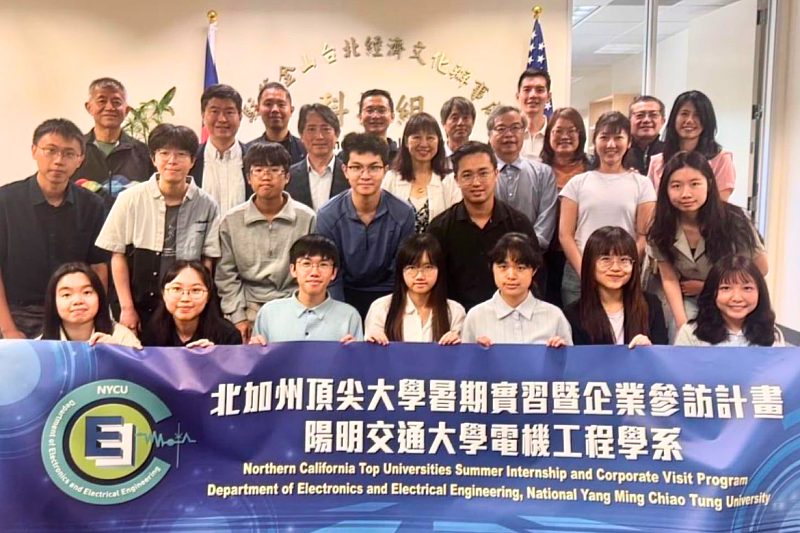
The program also takes students beyond university laboratories. NYCU faculty and students visited the Science and Technology Division of the Taipei Economic and Cultural Office in San Francisco, where they met Taiwan-born professionals and alumni working in the United States. The discussions offered practical perspectives on graduate study, research and career development in Silicon Valley.
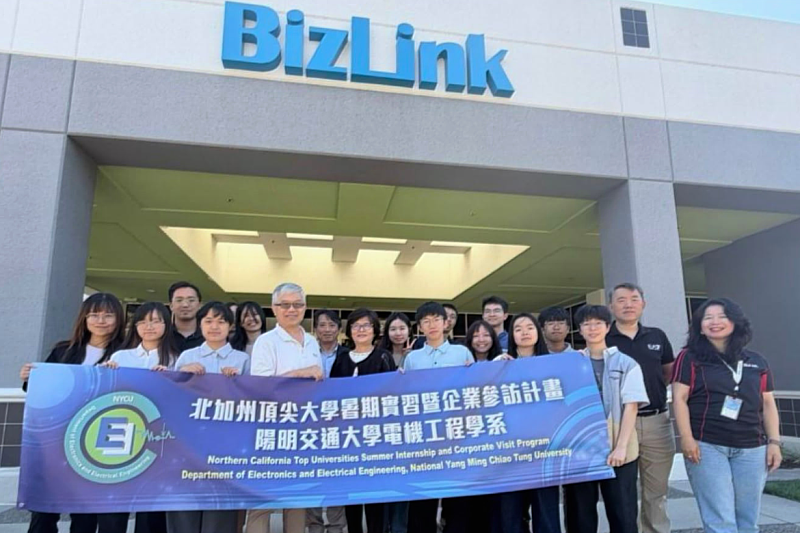
The group also visited global technology company BizLink in an exchange arranged by Roger Liang, chairman of BizLink and president of the NYCU Electrical Engineering Alumni Association. Company executives discussed BizLink’s global operations, technology strategy, talent development and the skills needed to work in an international business environment.
Kai-Ten Feng, chair of NYCU’s Department of Electrical Engineering, said the department aims to cultivate more than technical expertise. “We want our students to become engineers who also have a global outlook, interdisciplinary capabilities and an innovative mindset,” Feng said.
The department plans to deepen its partnerships with leading universities, overseas alumni and international companies, building a broader platform to prepare students for careers in global research and the technology industry.