Key Points
-
About 60% of Alphabet’s second-quarter technical infrastructure investment went to servers — the biggest single line in its capital budget.
-
Bloomberg reported that prices on servers built around Nvidia’s AI chips are rising more than 15% in many cases, effective on systems shipping early next year.
-
Alphabet’s second-quarter capital spending exceeded its operating cash flow, leaving free cash flow at negative $5.9 billion.
- 10 stocks we like better than Alphabet ›
Alphabet (NASDAQ:GOOG)(NASDAQ:GOOGL) expects its capital expenditures to reach $195 billion to $205 billion this year, a range management raised in July from a prior $180 billion to $190 billion. And on theearnings callthat set it, chief financial officer Anat Ashkenazi said about 60% of the second quarter’s technical infrastructure investment went to servers. The other 40% went to data centers and networking equipment.
That mix makes servers the largest single line in the budget. On Saturday, Bloomberg reported that the most important artificial intelligence (AI) servers may be about to cost more — more than 15% more, in many cases.
Missed Nvidia in 2009? This Rare Signal Is Flashing Again. In 2009, a “Double Down” signal flashed for a little-known chipmaker called Nvidia. For the first time in years, that same “Total Conviction” signal is flashing for a company 1/100th the size of Nvidia. Continue »
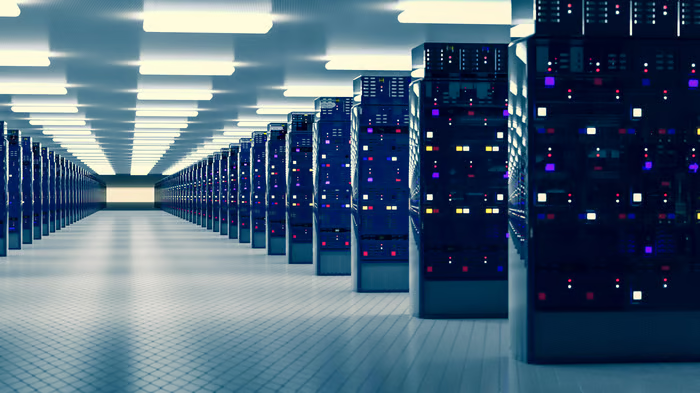
Image source: Getty Images.
Servers: the biggest line
Start with the midpoint of Alphabet’s guidance, about $200 billion. Technical infrastructure investment accounts for the vast majority of that total, and if the second quarter’s mix holds, servers’ 60% share would put server purchases near $100 billion this year.
And the spending has been accelerating for a year. Alphabet’s capital expenditures went from $24.0 billion in the third quarter of 2025 to $27.9 billion in the fourth quarter, $35.7 billion in the first quarter of this year, and $44.9 billion in the second, about double the year-ago figure.
The company can point to demand for every dollar. Google Cloud revenue grew 82% year over year to $24.8 billion in the second quarter, an acceleration the company called out in its release. Total revenue climbed 24% to $119.8 billion, and operating income rose 30% year over year, with the operating margin expanding 2 percentage points to 34%.
In short, servers keep being bought because customers keep renting the computing resources they provide. I’d argue that part of the case is working.
The increase lands on 2027
Bloomberg’s report said contract manufacturers that build AI servers for major data center operators have told customers that prices are rising by more than 15% in many cases. The affected systems include those built around Nvidia (NASDAQ:NVDA) chips such as its Vera Rubin and Grace Blackwell lines. The operators served include Microsoft, Google, and Oracle.
The increases reportedly vary by chip generation and memory configuration, and they take effect on systems shipped early next year.
The cause, according to the report, is memory, with prices soaring as AI demand outruns supply. Nvidia’s representatives didn’t respond to Bloomberg’s requests for comment, and the company hasn’t confirmed any of it.
However, the timing is worth noticing. Alphabet set its capital spending range a month before the report surfaced, and the increases reportedly apply to systems shipped in early 2027. This year’s budget is probably safe. The budget the higher prices land on is the one Alphabet hasn’t sized yet.
“[W]e continue to expect our CapEx to increase significantly in 2027, and we’ll provide more details at a later date,” Ashkenazi said on the July call.
Of course, Alphabet has some insulation. The company designs its own tensor processing units (TPUs) and offers them through Google Cloud, so not every server it buys is built around Nvidia silicon. But the root cause here is memory, and Bloomberg noted that the operators pursuing in-house chip programs still depend on access to memory from the industry’s three big suppliers. A company that designs its own chips still has to buy the memory that goes into them.
Can Alphabet carry it?
Alphabet has the war chest for it. The company held $242.5 billion in cash and marketable securities at the end of June, and its operating income grew 30% year over year last quarter.
The pressure shows up in the cash flow instead. Alphabet’s operations generated $39.1 billion in cash in the second quarter, while capital spending totaled $44.9 billion, resulting in free cash flow of $5.9 billion. Over the trailing 12 months, it was $53.3 billion.
And the company supplemented its own cash during the quarter, collecting $49.6 billion from a June stock sale and $20.3 billion from a debt offering.
In other words, a business that generates enormous cash is building faster than the cash arrives, and it has sold stock and borrowed to help cover the difference. That was true before the reported price increases.
I don’t think the report changes the investment case by itself. Shares trade near $347 as of this writing, or about 23 times the earnings analysts expect the company to produce next year, and 24% revenue growth arguably carries that price. What the report changes is 2027’s bar. Management has said only that next year’s spending will be significantly higher. If Bloomberg’s reporting holds, many of those dollars would buy a little less computing than they did. The returns on this build-out were already the thing shareholders were watching. Now the bill for it is rising, too.
Should you buy stock in Alphabet right now?
Before you buy stock in Alphabet, consider this:
The Motley Fool Stock Advisor analyst team just identified what they believe are the 10 best stocks for investors to buy now… and Alphabet wasn’t one of them. The 10 stocks that made the cut could produce monster returns in the coming years.
Consider when Netflix made this list on December 17, 2004… if you invested $1,000 at the time of our recommendation, you’d have $431,488!* Or when Nvidia made this list on April 15, 2005… if you invested $1,000 at the time of our recommendation, you’d have $1,279,584!*
Now, it’s worth noting Stock Advisor’s total average return is 958% — a market-crushing outperformance compared to 212% for the S&P 500. Don’t miss the latest top 10 list, available with Stock Advisor, and join an investing community built by individual investors for individual investors.
*Stock Advisor returns as of August 25, 2026.
Daniel Sparks and his clients do not have positions in any of the stocks mentioned. The Motley Fool has positions in and recommends Alphabet, Microsoft, Nvidia, and Oracle. The Motley Fool has a disclosure policy.
