Ex-bureaucrat, former diplomat, BCG India chairman on RBI board
Syllabus:
Preliminary Examination: Current events of national and international importance.
Mains Examination: General Studies II: Statutory, regulatory and various quasi-judicial bodies.
What’s the ongoing story: The government has appointed former senior finance ministry official Annie George Mathew, economist and management consultant Janmejaya Kumar Sinha and former diplomat Syed Akbaruddin as part-time, non-official directors on the Central Board of the Reserve Bank of India (RBI) for a four-year term.
Key Points to Ponder:
• The RBI is a statutory body or a constitutional body?
• When was Reserve Bank of India established and nationalised?
• Why is RBI called the mother of banks?
• What is the central board of the RBI?
• What is the Composition of RBI Central Board?
• How is Central Board of RBI is different from the Monetary Policy Committee?
• What Section 8(1)(c) of the Reserve Bank of India Act, 1934 says?
• Who appoints and nominates RBI directors?
• Why are non-official directors appointed?
Key Takeaways:
• As of today, the current strength of the board is 11, including the governor and deputy governors. After today’s appointments, it will become 14.
• The appointments were approved by the Appointments Committee of the Cabinet under Section 8(1)(c) of the Reserve Bank of India Act, 1934.
• According to an order issued by the Department of Personnel and Training on Saturday, the appointments will take effect from the date of notification and will continue for four years or until further orders, whichever is earlier.
• The three bring experience in public finance, economics, corporate strategy and international diplomacy to the RBI’s central board.
• The government had appointed former ISRO Chairman Somnath S and Mahindra group Chairman Anand Mahindra on the central board of the RBI last week. Mathew, 62, is a former Special Secretary in the Department of Expenditure, Ministry of Finance, and is currently a full-time member of the Sixteenth Finance Commission. An officer of the Indian Audit and Accounts Service, she has more than three decades of experience in public finance, financial management, government audit and accounts. She has also served on the boards of public sector financial institutions.
• Sinha, 66, is a prominent economist and management consultant and has held senior leadership positions at the Boston Consulting Group. He has served as chairman of BCG Asia-Pacific and has been associated with several government and regulatory committees, including those relating to financial-sector reforms.
• Akbaruddin, 66, is a former Permanent Representative of India to the United Nations and a former spokesperson of the Ministry of External Affairs. He is currently associated with the Kautilya School of Public Policy in Hyderabad.
Do You Know:
• According to the Reserve Bank of India website, it was established on April 1, 1935 in accordance with the provisions of the Reserve Bank of India Act, 1934.
• The Central Office of the Reserve Bank was initially established in Kolkata but was permanently moved to Mumbai in 1937. The Central Office is where the Governor sits and where policies are formulated. Though originally privately owned, since nationalisation in 1949, the Reserve Bank is fully owned by the Government of India.
• According to the Reserve Bank of India website, the Reserve Bank’s affairs are governed by a central board of directors. The board is appointed by the Government of India in keeping with the Reserve Bank of India Act.
—Appointed/nominated for a period of four years
—Constitution: Official Directors (Full-time : Governor and not more than four Deputy Governors) and Non-Official Directors (Nominated by Government: ten Directors from various fields and two government officials and Others: four Directors – one each from four local boards).
• The Reserve Bank of India (RBI) is a statutory body. It was established on April 1, 1935, under the Reserve Bank of India Act, 1934, which gives it legal backing and statutory status.
Other Important Articles Covering the same topic:
📍Knowledge Nugget | RBI Foundation Day Special: History, new initiatives, and rupee stabilisation
Previous year UPSC Prelims Question Covering similar theme:
1) Consider the following statements: (UPSC, CSE, 2021)
1. The Governor of the Reserve Bank of India (RBI) is appointed by the Central Government.
2. Certain provisions in the Constitution of India give the Central Government the right to issue directions to the RBI in public interest.
3. The Governor of the RBI draws his power from the RBI Act.
Which of the above statements are correct?
(a) 1 and 2 only
(b) 2 and 3 only
(c) 1 and 3 only
(d) 1, 2 and 3
Previous year UPSC Mains Question Covering similar theme:
📍What do you mean by Digital Rupee ? In this context, explain the working and progress of India’s Central Bank Digital Currency (CBDC). (UPSC, GS3, 2026)
Doval heads to Beijing, boundary talks with Wang Yi tomorrow
Syllabus:
Preliminary Examination: Current events of national and international importance.
Mains Examination: General Studies II: Bilateral, regional and global groupings and agreements involving India and/or affecting India’s interests.
What’s the ongoing story: Ahead of a possible visit by Chinese President Xi Jinping to India for the summit of the BRICS leaders next month, National Security Advisor Ajit Doval is travelling to Beijing Monday for Special Representative-level talks on the boundary issue with his Chinese counterpart Wang Yi.
Key Points to Ponder:
• What is the Special Representatives (SR) mechanism in India-China border talks?
• What are the key objectives of working mechanism for consultation and coordination on India–China border affairs (WMCC)?
• Standoff between India and China-what you know about the same?
• Friction between India and China-what are the reasons?
• India-China Relations during Nehruvian Era-Know in detail
• The 1962 India-China War-Know the background
• India-China Border Dispute- what is the present situation?
• What are the major factors responsible for the persistence of the India-China boundary dispute?
• Map Work– Line of Actual Control, McMahon Line, Chang Chenmo river, Gogra-Hot Springs, Kongka Pass, Galwan Valley, Depsang Plains, and Charding Nala region
Key Takeaways:
• The 25th round of SR-level talks will be held Tuesday. Both Doval and Wang are the designated SRs for the boundary talks mechanism which was established in 2003 to comprehensively address the longstanding boundary dispute between the two countries.
• In the last week of June, Wang visited India for a meeting of the BRICS NSAs and met Doval on the side-lines. Wang, who is also China’s Foreign Minister, underlined it is “imperative” for India and China to respect each other’s “core interests” and take concrete actions to implement the “important consensus” reached by both sides.
• The two countries have been moving to repair ties that plummeted after the military standoff along the Line of Actual Control (LAC) in eastern Ladakh. Since late 2024, both sides have taken steps to ease tensions.
• After he met Wang in New Delhi last year, Doval said the India-China border had been “quiet” and there had been an “upward trend” in bilateral ties.
• Earlier this month, responding to a question on reports of some tension along the LAC, the Ministry of External Affairs said the state of the border with China will reflect on the state of the “larger bilateral ties” and that maintenance of peace and tranquillity along the LAC is of “utmost importance”.
• Randhir Jaiswal, spokesperson for the MEA, also rejected China’s criticism of New Delhi identifying 27 places and features in Arunachal Pradesh by their standard names, maintaining that the state is an “inalienable and integral” part of India and nothing can change this “indisputable reality”. This was reiterated at a meeting of the Working Mechanism for Consultation and Coordination on India-China Border Affairs (WMCC). “At this meeting, the two sides engaged in frank discussions and reviewed the situation along the LAC,” Jaiswal said.
Do You Know:
• The Special Representative (SR)-level talks on the India-China boundary question are a high-level diplomatic mechanism established in 2003 to find a fair, mutually acceptable political solution to the long-standing border dispute along the 3,400-kilometer Line of Actual Control (LAC).
• Atal Bihari Vajpayee, in the capacity of Minister of External Affairs of India, had first suggested the SR mechanism during his visit to China in 1979. During another visit to China by Vajpayee, this time in the capacity of Prime Minister, in June 2003, the mechanism was mentioned in an agreement between the two countries.
• During the 15th round of the SR talks in 2012, the Working Mechanism for Consultation and Coordination was set up.
• The Working Mechanism for Consultation and Coordination on India–China Border Affairs (WMCC) was set up through an India–China agreement in January 2012 for improved institutionalised information exchange on border related issues.
Other Important Articles Covering the same topic:
📍Making progress on normal ties after border peace: India, China
Previous year UPSC Prelims Question Covering similar theme:
2) “Belt and Road Initiative” is sometimes mentioned in the news in the context of the affairs of: (UPSC, CSE, 2016)
(a) African Union
(b) Brazil
(c) European Union
(d) China
Previous year UPSC Mains Question Covering similar theme:
📍‘China is using its economic relations and positive trade surplus as tools to develop potential military power status in Asia’, In the light of this statement, discuss its impact on India as her neighbour. (UPSC, GS2, 2017)
Explained
5 years on, how India has warmed up to the Taliban
Syllabus:
Preliminary Examination: Current events of national and international importance.
Mains Examination: General Studies II: India and its neighbourhood- relations
What’s the ongoing story: The Afghanistan embassy in New Delhi celebrated “victory day” on August 15, marking the Taliban’s takeover of the country five years ago. Much has changed in these five years when it comes to the Indian position on the Taliban dispensation.
Key Points to Ponder:
• What is charge d’affaires?
• Is charge d’affaires the same as ambassador?
• Why India is deepening engagement with Taliban?
• Why Afghanistan embassy in New Delhi celebrated “victory day” on August 15?
• Is the Islamic Emirate of Afghanistan recognized?
• India and Taliban and Afghanistan-Connect the dots
• Strategic importance of Afghanistan for India’s connectivity projects and trade routes—Know in detail
• How India’s engagement with the Taliban align with New Delhi’s “Act West” policy?
• How India can enhance its leverage in Afghanistan while addressing the challenges posed by the Taliban regime?
Key Takeaways:
• On August 17, 2021, New Delhi had hurriedly evacuated its entire embassy from Kabul. Now, it is openly conducting business with the Islamist regime, albeit without granting it official diplomatic recognition.
• The “victory day” celebration, attended by Indian diplomats and about two dozen foreign diplomats, was the latest sign that the India-Taliban relationship is now increasingly shifting from the shadows to the foreground.
• While Indian officials have called this a case of “cautious engagement”, others have criticised it as “opportunistic”.
• While most of the world shuns the Taliban, India has stepped up diplomatic exchanges with the hardline Islamist group.
• Taliban Foreign Minister Amir Khan Muttaqi made a high-profile visit to New Delhi in October 2025. The Afghan embassy has come under the control of the Taliban since around that time. And the Taliban-appointed Charge d’affaires, Mufti Noor Ahmad Noor, has been part of multiple significant events in Delhi — the Prime Minister’s Independence Day address, the President’s At-home reception at Rashtrapati Bhawan, and even a diplomatic reception at
the Norwegian embassy.
Do You Know:
• India invested for years in Afghanistan after the fall of the Taliban in 2001. In 2021, the Ashraf Ghani-led government collapsed within a matter of weeks after President Joe Biden announced a withdrawal of US troops from the country.
• In the months and years since, the Indian government came to the conclusion that it was time to upgrade the level of official engagement without giving official recognition — or watch its $2-3-billion investment go down the drain. That was meant for the people of Afghanistan, and create some kind of leverage and influence in the country.
• A key factor has been the fact that Taliban’s benefactor and ally, Pakistan, has turned into a deadly adversary. Both sides have seen multiple clashes along their contested border. For New Delhi, the fractured ties between the Taliban and Pakistan has been a window of opportunity.
• Another factor hastening India’s engagement is China. Beijing has started building bridges and eyeing natural resources in Afghanistan — filling the vacuum left behind by the US, Europe and the West.
• Russia too has been engaging with the Taliban, and is the only country to have established diplomatic ties with them. Delhi has been working with Moscow on Taliban, to keep track of the Chinese influence.
• New Delhi started sending serious signals in December 2021 itself when it sent a consignment of medicines to Afghanistan. The government was essentially choosing to distinguish the Taliban regime from the Afghan people. The intent was to open a window to the new Afghanistan and get a foot in the door. New Delhi has operated on the simple principle that Afghanistan’s territory should not be used for anti-India activities and support for terrorist groups.
• An August 10 report by the UN Security Council’s 1267 sanctions committee states: “The terrorist threat emanating from Afghanistan remained largely unchanged. The ability of numerous terrorist groups to operate in Afghanistan constituted an enduring threat to neighbouring countries and the Central Asian region. Despite efforts by the de facto authorities to combat Islamic State in Iraq and the Levant-Khorasan (ISIL-K) and contain other terrorist groups, the authorities were unable to suppress the terrorist problem.” It also said that the Al-Qaeda terror group’s status and strength in Afghanistan remains unchanged.
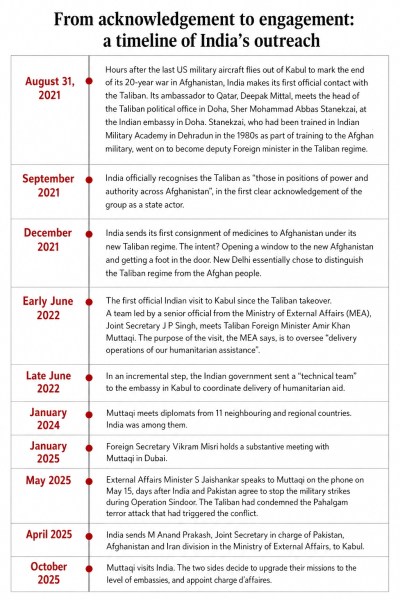 India’s outreach to the Taliban
• New Delhi would be relieved that the report contains no mention of anti-India terror groups, such as Lashkar-e-Taiba and Jaish-e-Mohammad. But it is keeping its fingers crossed.
• So far, New Delhi’s engagement has been “limited” and the Taliban has indicated that they will be “reasonable” in the way they “handle” Indian concerns. The security provided to the Indian diplomats in Kabul has given some confidence to the Indian establishment.
• Since August 2021, India has delivered substantial humanitarian aid to Afghanistan, including 50,000 metric tons of wheat, over 445 tons of essential life-saving medicines, vaccines, and disaster relief materials — including tents and food materials for floods and earthquakes.
• The Islamist group has been eroding the rights of the 22 million women in the country since regaining control — barring access to school for girls over 12, restricting travel without a male chaperone and bringing in a law implying legal approval for child marriage — according to international media reports.
Other Important Articles Covering the same topic:
📍At Afghan embassy, Taliban diplomats mark 5th anniversary of ‘victory day’
Previous year UPSC Prelims Question Covering similar theme:
3) Consider the following countries: (UPSC, CSE, 2022)
1. Azerbaijan
2. Kyrgyzstan
3. Tajikistan
4. Turkmenistan
5. Uzbekistan
Which of the above have borders with Afghanistan?
(a) 1, 2 and 5 only
(b) 1, 2, 3 and 4 only
(c) 3, 4 and 5 only
(d) 1, 2, 3, 4 and 5
Previous year UPSC Mains Question Covering similar theme:
📍The proposed withdrawal of the International Security Assistance Force (ISAF) from Afghanistan in 2014 is fraught with major security implications for the countries of the region. Examine in light of the fact that India is faced with a plethora of challenges and needs to safeguard its own strategic interests. (UPSC, GS2, 2013)
Importance of elephant corridors in reducing conflict
Syllabus:
Preliminary Examination: Current events of national and international importance.
Mains Examination: General Studies III: Conservation, environmental pollution and degradation, environmental impact assessment.
What’s the ongoing story: On August 17, a Supreme Court bench presided by Chief Justice of India Surya Kant directed the Union government to conduct a fresh survey of elephant corridors. It said these corridors cannot be blocked fearing crop damage as elephant herds, by nature, travel long distances.
Key Points to Ponder:
• Distribution and Population of Elephants in India-Know in detail
• Why Elephant Corridors in India is required?
• Have you heard of Project Elephant?
• What Current Data on Elephants says in India’s context?
• What is the Constitutional Provisions for Wildlife in Indian Constitution?
• Why Wildlife (Protection) Act, 1972?
• What are the Salient Features of Wildlife (Protection) Act, 1972?
• How many bodies are established under the Wildlife Protection Act 1972?
• National Board for Wildlife (NBWL)-Know in detail
• National Board for Wildlife-Members, functions and role
• As a “Statutory Organization,” the National Board for Wildlife performs “advisory” functions-True or false?
Key Takeaways:
• The bench was hearing an ongoing writ petition on managing human-elephant conflict. The petition, in the past, had also sought to prevent the use of fireballs, spikes and other such materials to drive away elephants. In its August 17 order, the bench asked the Centre to indicate steps taken to prohibit the use of such methods or any other “coercive measure” to divert the natural movement of elephants.
• Elephant corridors, or movement pathways connecting two natural habitats, have been well defined and identified by the Environment Ministry. They are crucial to facilitating elephant movement, and disrupting them can not only spark human-elephant conflict but pose a threat to the animals themselves. Here’s a look at the role they play.
• The directions given by the CJI-led bench pertained to this specific issue of the blocking or obstruction of elephant corridors passing through different states, and the related issues of human-elephant conflict it creates.
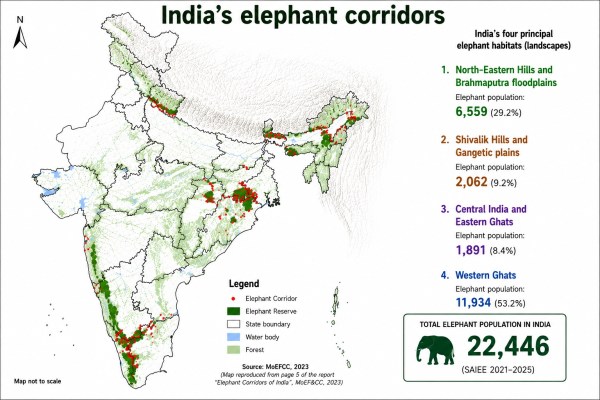 Elephant corridors of India (red dots) as of 2023. Map reproduced using AI from Environment Ministry report.
• Corridors not only provide elephants crucial connectivity between fragmented habitats, but also allow genetic exchange or dispersal which helps in maintaining diversity in their population pool. Well-conserved corridors also provide them access to food and water in natural habitats during seasonal changes, preventing them from entering crop lands.
• The government’s last major elephant corridor mapping exercise in 2023 documented 150 elephant corridors across 15 states in the four major landscapes. The recent report on managing human-elephant conflict in Southern India mapped bottlenecks in corridors, giving an idea of the challenges elephants face.
Do You Know:
• Asian elephants are highly mobile and social mammals. A male elephant’s average home range — the area it typically uses for food, water and shelter — extends between 50 and 300 square kilometres, but can increase depending on the availability of resources. Elephants can move through their range in herds or individually. These home ranges can also vary depending on habitat type, food availability, water sources, population density and human disturbances.
• Elephant movements are strongly influenced by seasonal and spatial distribution of food, water and habitat, according to studies by the National Centre for Biological Sciences and Wildlife Institute of India. For instance, seasonal migrations into Kerala are common during the dry months as elephants seek water and food in the relatively moist forests of the Western Ghats, said a recent Environment Ministry report on human-elephant conflict in South India. Historically, climate change and drought, too, have played a role in forcing migration.
• In all this, corridors play a crucial role, allowing elephants to move for food, for natural dispersal and everyday movement. Now, the migratory routes are also increasingly being influenced by infrastructure construction, mining and farm lands.
• Elephant corridors can get disrupted for a number of reasons. The major issues in recent times are infrastructure construction, and industrial and mining activity. Linear infrastructure — such as highways, existing and new railway lines, canals and power lines — can push elephants towards farmlands and human settlements, triggering conflict.
• India has four principal elephant population landscapes — the Western Ghats; North-Eastern Hills and Brahmaputra floodplains; Shivalik Hills and Gangetic plains; and Central India and Eastern Ghats. More than 50% of India’s 22,446 elephants are distributed in the Western Ghats across Karnataka (6,013), Tamil Nadu (3,136) and Kerala (2,785).
• But the habitat of the once-contiguous Western Ghats population is rapidly getting fragmented owing to changing land use, coffee and tea plantation, invasive plants, and farmland fencing. This was prominently noted in the last all-India elephant population estimation report released last year. Similar disruptions to traditional corridors and fragmentations of habitat were recorded in the Shivalik and Brahmaputra plains area. Chief among the reasons cited were railway lines, roads, power infrastructure and other land-use changes.
• The biggest challenge to elephant conservation, however, lies in the Central India and Eastern Ghats landscape. India’s numbers have risen in this landscape over the years. Starting mid-to-late 1980s, this region has seen a gradual increase in herd movement, initially due to an El Nino-linked drought in erstwhile southern Bihar, and later due to iron ore mining in Jharkhand and Odisha.
• Chhattisgarh has witnessed the arrival of elephants from Jharkhand and Odisha over two decades owing to habitat loss and mining pressures. Subsequently, elephants have also expanded their range into Umaria and Shahdol in Madhya Pradesh, and Gadchiroli in Maharashtra.
Other Important Articles Covering the same topic:
📍States can’t block elephant corridors over crop damage: Supreme Court
Previous year UPSC Prelims Question Covering similar theme:
4) With reference to Indian elephants, consider the following statements: (UPSC CSE, 2020)
1. The leader of an elephant group is a female.
2. The maximum gestation period can be 22 months.
3. An elephant can normally go on calving till the age of 40 years only.
4. Among the States in India, the highest elephant population is in Kerala.
Which of the statements given above is/are correct?
(a) 1 and 2 only
(b) 2 and 4 only
(c) 3 only
(d) 1, 3 and 4 only
AI is transforming cyber-attacks as well as defences: What this means for India
Syllabus:
Preliminary Examination: Current events of national and international importance.
Mains Examination: General Studies III: Awareness in the fields of IT, Space, Computers, robotics, nano-technology, biotechnology and issues relating to intellectual property rights.
What’s the ongoing story: Artificial Intelligence (AI) has reached mass adoption faster than any prior technology — the Internet took 15 years to reach a billion users, while ChatGPT did so in three.
Key Points to Ponder:
• What is changing with AI?
• What is a cyber kill chain?
• Why indigenous AI matters for cybersecurity?
• How Artificial Intelligence is changing from a human-driven domain into an increasingly automated and potentially autonomous battlefield?
• How the convergence of artificial intelligence and cyber warfare has blurred the distinction between conventional crime, espionage and warfare?
Key Takeaways:
• This rapid adoption has major consequences for cybersecurity. AI is amplifying cyber threats at unprecedented speed, scale and sophistication across the cyber kill chain, from automated vulnerability discovery to AI-generated deepfakes and AI-enabled social engineering (using AI to trick/persuade people to take harmful actions). More significantly, AI is developing the ability to act as an autonomous agent that can identify, plan, adapt and carry out offensive cyber operations. Thus, countries with leading AI ecosystems gain a greater ability both to conduct sophisticated cyber campaigns and to defend against them.
• Cybersecurity was already lopsided, with a few countries holding far superior capabilities than the rest. Advances in frontier AI systems have pushed this further.
• Reconnaissance, once dependent on humans gathering information about a target, is now automated and faster: research shows ChatGPT models being used to mine social media for precise details to craft AI-generated spear-phishing emails. AI is also generating real-time deepfakes, deepening confusion about what online content is authentic.
• More dangerous capabilities have emerged at the weaponisation and command-and-control stage. One novel method is LLM-generated polymorphic malware — code that large language models can autonomously generate, modify and restructure to suit the situation, unlike traditional malware, which relies on fixed signatures and predictable patterns. espionage campaign.
• In September 2025, Anthropic claimed a Chinese state-sponsored group, “GTG-1002,” had allegedly used Claude Code as an autonomous cyber agent across multiple stages of an attack — what Anthropic called the first reported case of an AI-orchestrated cyber- espionage campaign.
• Perhaps most consequential is the emerging ability of frontier AI models to autonomously identify software vulnerabilities at scale. Anthropic’s latest frontier model, Claude Mythos Preview, has identified thousands of zero-day vulnerabilities — flaws previously unknown to developers — across major operating systems and browsers, many of them critical, and developed related exploits largely without human intervention.
• It found a 27-year-old vulnerability in OpenBSD, an operating system reputed to be highly security-hardened and widely used to run firewalls and critical infrastructure.
Do You Know:
• Last month, the ransomware group World Leaks claimed to have stolen and posted data related to India’s largest nuclear plant, Kudankulam, including blueprints of facility parts and supplier details. Cyber intelligence firm CloudSEK’s 2024 report placed India as the second-most cyber-attacked nation after the US; its 2025 report placed India sixth.
• During Operation Sindoor, Pakistan-backed threat actors such as APT36 targeted India’s critical sectors, including the Ministry of Defence, Army, Navy and DRDO, and for the first time, Bharat Operating System Solutions (BOSS) Linux. They also disrupted government IT infrastructure such as the National Informatics Centre and targeted state-level educational and government portals — exposing the vulnerability of India’s critical infrastructure to coordinated offensive cyber operations.
• Yet India’s indigenous AI ecosystem remains incremental, lagging well behind the US and China across the AI stack — foundational models, GPUs, chip design and large-scale data-centre infrastructure — leaving it heavily dependent on the US and other technologically advanced countries.
• Indian policymakers are aware of these stakes and have begun taking steps. Agencies like CERT-In have, since 2025, adopted AI-driven threat detection, cyber resilience measures, trusted AI frameworks and citizen-centric malware mitigation. In April, it issued an advisory for organisations to defend against AI-driven cyber risks. Some of the recommendations were about “removing unnecessary internet-facing services” and treating every newly discovered vulnerability as something that “could be exploited within hours, not weeks.”
• At the governance level, the Ministry of Electronics and Information Technology is exploring a consent-based framework for synthetically generated content, alongside curbs on agentic AI autonomy and clearer liability frameworks for AI models.
• India cannot build the AI stack overnight, but its strength lies, as Nitin Pai says, in “agile adoption and efficient diffusion” of AI capabilities — paired with supply-chain scrutiny, security assessments, accountability mechanisms and liability provisions suited to its strategic and developmental interests. India should also earn its place in strategic groupings like Pax Silica.
• AI and cybersecurity can no longer be treated in silos — they must be seen as interconnected strands of policymaking: AI for cyber defence, and cybersecurity for AI.
Other Important Articles Covering the same topic:
📍Expert Explains | AI is reshaping warfare: How India can keep pace
Previous year UPSC Prelims Question Covering similar theme:
5) With the present state of development, Artificial Intelligence can effectively do which of the following? (UPSC CSE, 2020)
1. Bring down electricity consumption in industrial units
2. Create meaningful short stories and songs
3. Disease diagnosis
4. Text-to-Speech Conversion
5. Wireless transmission of electrical energy
Select the correct answer using the code given below:
(a) 1, 2, 3 and 5 only
(b) 1, 3 and 4 only
(c) 2, 4 and 5 only
(d) 1, 2, 3, 4 and 5
Previous year UPSC Mains Question Covering similar theme:
📍What is agentic Artificial Intelligence (AI) ? Explain its working. Describe its applications with suitable examples. Discuss the advantages, risks and challenges associated with agentic AI systems. (UPSC, GS3, 2026)
The Ideas Page
Measuring manufacturing growth afresh: three questions
Syllabus:
Preliminary Examination: Economic and Social Development
Mains Examination: General Studies III: Indian Economy and issues relating to planning, mobilization, of resources, growth, development and employment.
What’s the ongoing story: Abhishek Anand, Josh Felman, Arvind Subramanian Writes- Problems in manufacturing sector data under the previous series were widely recognised, and MoSPI made strenuous efforts to address them.
Key Points to Ponder:
• What is China Squeeze?
• How the Chinese manufacturing export is threatening lower-skill manufacturing in poorer countries?
• The Government of India has set major ambitions for the manufacturing sector-what are those?
• What is the production-linked incentive (PLI) scheme?
• How is Indian manufacturing performing given the Chinese competition?
• What are the three concerns about the measurement of manufacturing growth?
• Why is the manufacturing GVA deflator showing persistent negative growth?
• Why is real manufacturing GVA growing much faster than IIP?
• Why has the historical relationship between IIP and manufacturing GVA weakened?
Key Takeaways:
Abhishek Anand, Josh Felman, Arvind Subramanian Writes-
• The Chinese manufacturing export juggernaut once again moves menacingly across the world, threatening lower-skill manufacturing in poorer countries (the so-called China Squeeze).
• The government has set major ambitions for the manufacturing sector, starting with the flagship Make in India programme in 2014 and, following it up with the production-linked incentive (PLI) scheme several years later. The latter was, in part, a response to the opportunities opened up by the China-pus-one but also to cope with the challenges of aggressive Chinese competition.
• But answering the important question of how Indian manufacturing has performed in the wake of these developments and actions requires confidence in the underlying data. That is especially true now because the economy is sending conflicting signals and understanding the performance of the manufacturing sector may lift some of the confusion.
• Problems in manufacturing sector data under the previous series were widely recognised and the Ministry of Statistics and Planning Implementation (MoSPI) made strenuous efforts to address them.
• When the new GDP series was announced, the Chief Economic Advisor and Secretary MoSPI stressed that the numbers were based on a new methodology, one that solved the measurement problems that had bedeviled the old series, including in manufacturing. Because MoSPI has not yet released the detailed standard document explaining the new calculations, we must examine the numbers themselves to assess their plausibility. When we do so, three questions arise about the manufacturing sector, the focus of much debate in the old series.
Do You Know:
Abhishek Anand, Josh Felman, Arvind Subramanian Writes-
• The manufacturing price deflator. In the new numbers, the manufacturing GVA deflator exhibits negative growth (falling price levels) for nine consecutive quarters between 2023 and 2025 (Figure 1). These numbers are difficult to understand, as there were no signs of deflation in the economy during this period, the core CPI index shows. It is true that the wholesale price index (WPI) was negative for some of this time — but not for nine consecutive quarters; and, in any case, the GVA deflator should not move in line with the WPI, which is overly driven by input prices.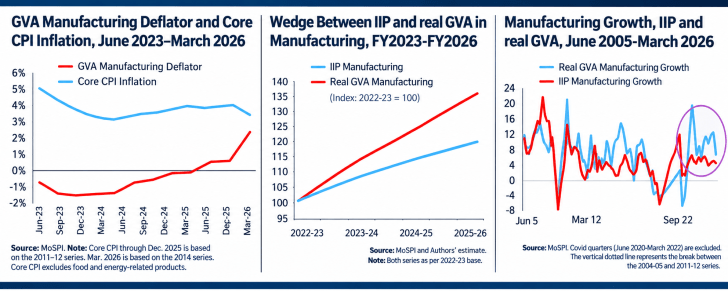
• The divergence between real Gross Value-Added (GVA) and the Index of Industrial Production (IIP). Figure 2 plots the two series for manufacturing in level terms. The difference is substantial. In 2025-26, the level of real GVA exceeded IIP by no less than 15 percentage points, implying that the annual average real growth of manufacturing between 2022-23 and 2025-26 as measured by GVA is about twice that measured by the IIP (11 per cent versus 6 per cent).
• Correlation between the growth rates of real GVA and IIP in manufacturing. Before the 2011-12 methodology changes, GVA and IIP moved closely together, as one would expect and as Figure 3 shows. (The correlation was 0.8.) But afterwards they diverged and that divergence has, if anything, been exacerbated in the new series. Note that since September 2022 the two series move very differently and the real GVA series bounces around a lot while the IIP series is fairly stable (Figure 3, circled segment).
• None of these three issues is dispositive about the quality of the new series. But having plausible explanations for them will not only engender confidence in the new GDP figures but also help assess the state of manufacturing in India and the impact of recent government actions to revive it. Not just on the border but also in the economy, whether and how India has stood up to China is a critical question that reliable data will help us answer.
Other Important Articles Covering the same topic:
📍India’s industrial production index saw strong growth, but it hides weak consumer demand
Previous year UPSC Prelims Question Covering similar theme:
6) What is/are the recent policy initiative(s) of Government of India to promote the growth of manufacturing sector? (UPSC CSE, 2012)
1. Setting up of National Investment and Manufacturing Zones
2. Providing the benefit of ‘single window clearance’
3. Establishing the Technology Acquisition and Development Fund.
Select the correct answer using the codes given below:
(a) 1 only
(b) 2 and 3 only
(c) 1 and 3 only
(d) 1, 2 and 3
Previous year UPSC Mains Question Covering similar theme:
📍Faster economic growth requires increased share of the manufacturing sector in GDP, particularly of MSMEs. Comment on the present policies of the Government in this regard.
(UPSC GS3, 2023)
Economy
Chipflation: Electronics see years of price hikes replicated in 6 mths
Syllabus:
Preliminary Examination: Economic and Social Development
Mains Examination: General Studies III: Indian Economy and issues relating to planning, mobilization, of resources, growth, development and employment.
What’s the ongoing story: The global artificial intelligence (AI) investment boom has created an acute shortage of the memory chips used in the manufacture of everyday consumer electronics. This has led to manufacturers raising rates they charge to such an extent that years of price hikes that occurred in the past for products such as smartphones and TVs have taken place in just six months in 2026.
Key Points to Ponder:
• What is “Chipflation”?
• What is DRAM?
• What are some of the effects of ‘chipflation’?
• How chipflation has raised US producer prices for electronic components, accessories?
• What might it mean for the future of AI?
• Why is Moore’s Law relevant to chipflation?
• Why is semiconductor production strategically important?
• Why chipflation matters for India?
Key Takeaways:
• According to Consumer Price Index (CPI) data from the Ministry of Statistics and Programme Implementation (MoSPI), prices of a variety of consumer electronics goods in July were up 3-5% compared to January.
• The price movements were far more sedate in 2025.
• Back in June, analysts at American investment bank Morgan Stanley had coined the term ‘chipflation’ to describe how “AI’s appetite for memory chips is boosting the cost of everything from data centers to smartphones, with consequences that may reach far beyond the tech industry.”
• What is being sacrificed are DRAM (Dynamic Random Access Memory) and other chips used in everyday electronics goods such as refrigerators, washing machines, ACs, smartphones, laptops, TVs, and earphones.
• The result of the supply shortage of the chips essential to consumer electronics is a massive rise in their prices, with JPMorgan Global Research estimating DRAM prices will have risen more than 400% from the start of 2024 to the end of 2026. This is in stark contrast to the Moore’s Law driven cost reduction seen over the second half of the 20th century and the first 20 or so years of the 21st century: DRAM prices fell 90% every five years over this period.
• According to Kim, the shortfall in memory chips in 2027 is equivalent to what is needed to make 134 million phones. Already, in the April-June quarter, global smartphone exports were down 11% – their second-lowest level since 2013 – as per Counterpoint Research.
Do You Know:
• The global AI boom has led to key chipmakers such as TSMC, Samsung, and SK Hynix making the more in-demand and advanced chips used in data centres sprouting up all over the world.
• According to the World Economic Forum, chipflation is when memory chips stop getting cheaper over time, and become more expensive and even harder to find. Some of the core drivers behind this include:
—AI data centre investment: AI systems and data centres need huge numbers of chips, leading big tech companies to buy more than the industry can easily supply.
—Prioritization of high-margin chips: AI chips can carry significantly higher margins, leaving chip manufacturers to focus on these instead of chips for everyday products, including phones, laptops and cars.
—Long manufacturing lead times: Building and operationalizing new semiconductor fabrication plants takes years and creates a supply bottleneck that cannot be quickly rectified.
—Constrained supply chains: Geopolitical tensions, export restrictions and fragmented supply chains continue to limit availability of components and drive up production costs.
Other Important Articles Covering the same topic:
📍How a tiny electronic component is slowly driving up inflation in India
Previous year UPSC Mains Question Covering similar theme:
📍India aims to become a semiconductor manufacturing hub. What are the challenges faced by the semiconductor industry in India? Mention the salient features of the India Semiconductor Mission. (UPSC, GS3, 2025)
|
PRELIMS ANSWER KEY |
|
1.(c) 2.(d) 3.(c) 4.(a) 5.(d) 6.(d) |
For any queries and feedback, contact priya.shukla@indianexpress.com
Subscribe to our UPSC newsletter. Stay updated with the latest UPSC articles by joining our Telegram channel – IndianExpress UPSC Hub, and follow us on Instagram and X.