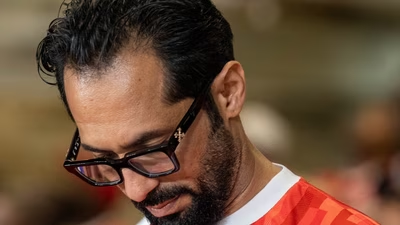
IN SOME WAYS Mo Dewji is an anomaly. The charismatic tycoon is currently the only billionaire in east Africa, and the youngest on the continent. By the reticent standards of Africa’s corporate titans, the 51-year-old is comfortable in the limelight. Mr Dewji readily gives interviews, including recently to The Economist. He posts frequently to over 2m followers on X.
Mr Dewji owns MeTL Group, (X/moodewji)
In other respects Mr Dewji, who owns MeTL Group, a Tanzanian conglomerate founded by his father in the 1970s, is typical. Most large African firms fit this mould of diversified, family-owned businesses. Domestic champions are on the rise. “We are starting to see bigger and bigger conglomerates controlled by Africans,” says Acha Leke, McKinsey’s chairman for Africa. The consultancy says two-thirds of companies on the continent with annual revenues exceeding $1bn are now locally owned and headquartered; the subsidiaries of foreign multinationals that once dominated African business account for barely 30%. Large domestic conglomerates have accompanied industrial growth everywhere from Gilded Age America to post-war South Korea and contemporary India. So the shift could prove transformative.
For many outsiders the rise of corporate Africa has one face: Aliko Dangote, Africa’s richest man. The Nigerian industrialist, whose interests range from cement to fertiliser across 17 African countries, opened the continent’s largest oil refinery in 2023. He has plans for a second, in Kenya. By 2030 he wants the Dangote Group to be Africa’s first $100bn firm.
Others are snapping at his heels. In Nigeria he faces a rival in Abdul Samad Rabiu, the founder of BUA Group and scion of another industrial dynasty from the northern city of Kano. Mr Rabiu, who like Mr Dangote made his fortune in cement, as well as sugar and other consumer goods, was named Africa’s second richest person in May, when Bloomberg valued his net worth at around $19bn. (That has since fallen to about $14bn.) He too has ambitious expansion plans, for instance turning his subsidiary, BUA Foods, into Nigeria’s biggest food manufacturer by 2027. In Tanzania Mr Dewji seeks to grow MeTL into a $10bn venture by 2030, in part by pushing into mining and mineral processing. In the longer run, he tells The Economist, he wants to turn it into an e-commerce company.
The attention paid to Mr Dangote reflects the fact that big industrial firms like his are still a rarity in Africa. In 2022 McKinsey counted 345 companies with revenues over $1bn. (There are only 26 more today.) According to the latest Africa Wealth Report, an annual overview of the continent’s private wealth, 25 of Africa’s 28 billionaires today hail from four of its five biggest economies. “It is very hard to build a billion-dollar business if you are not in Nigeria, South Africa or Egypt,” says Mr Leke. (The fourth is Morocco.)
Even fewer such firms are owned by black Africans. In east Africa many of the biggest firms are owned by families of Asian origin, like Mr Dewji’s in Tanzania. In west Africa some of the wealthiest industrialists have Lebanese roots, among them the Lebanese-Nigerian billionaire Gilbert Chagoury. “Africans came very late to the capital accumulation party,” notes John Ngumi, a Kenyan investment banker. Trading networks built by Asian and Lebanese families under colonial rule gave them a headstart. In Tanzania, which was run by socialists until the 1980s, black Africans are only now catching up.
Many hope to follow Mr Dangote. The continent’s leading industrial firms often began as traders before branching into manufacturing and other sectors. The need to diversify stems in part from Africa’s patchwork of small, fragmented markets. “When you’re dealing with an economy that is not big enough, you end up doing a multitude of businesses,” says Mr Dewji. He cites milling as a common example of vertical integration in the region: “If you do wheat milling or maize milling or rice milling, you need polypropylene bags. So you backward-integrate into polypropylene bags.”
Success often hinges on cosy relationships with officials. “I can’t think of any major industrialist that doesn’t have access to government and policy,” says Freda Yawson of the Africa Centre for Economic Transformation, a think-tank in Ghana. Mr Dangote’s rise was aided by ties to Nigeria’s former president, Olusegun Obasanjo, whose government introduced policies that favoured his cement, sugar and rice businesses over foreign competitors. Mr Rabiu is known to be close to the current president, Bola Tinubu. Mr Dewji used to be an MP for Tanzania’s ruling party.
To avoid friction with political leaders many opt to stay out of the limelight. The media-shy Mr Rabiu perhaps learnt from the example of his father, who was arrested following a coup in Nigeria in 1983. Though Mr Dangote is comparatively outspoken, he has, says Ken Opalo of Georgetown University, clearly “picked a lane”—meaning he keeps his nose out of politics.
Another way to spread political risk is to expand abroad. Many aspiring Dangotes are doing just that. Rostam Azizi, another Tanzanian magnate who was named the country’s first dollar billionaire in 2013, is building in Kenya what he says will be Africa’s largest liquefied-petroleum-gas terminal. Over the next decade he says he will extend his gas-distribution business “from Ethiopia to South Africa”. He will be helped by the fact that, thanks to the East African Community, the most successful of Africa’s regional blocs, governments are increasingly “comfortable with companies from the other side of the border”, notes Mr Opalo.
Even so, challenges linger. One is the high cost of capital. In the 2000s Tanzania’s banking sector was so small Mr Dewji had to go to South Africa for loans to expand the business. Today, he notes, “we have local banks and access to capital locally.” Credit is getting cheaper. But even a larger group like MeTL, which can tap banks from South Africa and Mauritius for big syndicated loans, still struggles to secure affordable long-term finance.
Initial public offerings remain rare, even if a few are beginning to happen even outside of South Africa. Mr Dangote is relatively unusual in having listed parts of his empire on Nigeria’s stock exchange. Africa’s total listed market capitalisation is about a third of the region’s total GDP, compared with 113% globally and 61% in emerging markets on average.
Partly, that is because African capital markets remain shallow, giving firms little incentive to list. But family owners are also often reluctant to cede control or open their books to scrutiny. Nitin Madhvani of the Madhvani Group, a Ugandan conglomerate, notes that his family lost control of their businesses in the 1970s when Idi Amin expelled Asians. “We don’t want to do that again,” he says. Conversely, foreign investors may be wary of African firms seen as too close to the state. “Mo Dewji has been an MP,” says an executive at a rival Tanzanian conglomerate. “There are very few private-equity firms that would invest with those kinds of things.”
Politics remains the biggest challenge. In a new book on Rwanda’s economic development, Pritish Behuria of the University of Manchester argues that the government’s distrust of homegrown capitalists helps explain why the country has produced so few big firms of its own. Foreign capital, he says, is seen as the politically safer bet.
Whether it is a smart economic bet is less clear. For all Mr Dangote’s corporate achievements, in Nigeria his firms have yet to kickstart broad-based industrialisation. And Mr Behuria notes that most African conglomerates still invest little in upgrading technological know-how, leaving them ill-equipped to compete globally. Still, a bit more competition for Africa’s super-tycoon is unlikely to hurt, says David Olurin of Cardinal Torch, a new Nigerian agricultural conglomerate: “You can’t have just one person and expect phenomenal growth to happen.”