President Donald Trump has never seemed particularly concerned with building public support for the war in Iran. Although the president and his administration have offered a succession of rationales for why the United States is now six months into a conflict that has cost at least $35 billion (likely much, much more) and has no end in sight, they have devoted little sustained effort to making the case with the U.S. public. What began as a mission to eliminate Iran’s nuclear capabilities has evolved into a campaign to keep the Strait of Hormuz open, even though the waterway—which is crucial for global trade—was open before the war began.
Historically, most presidents take seriously the task of building public support for military action and all the related challenges that come with mobilizing. Even when wars prove extraordinarily controversial or problematic—and sometimes when they are justified on the basis of false information—presidents have understood the need to articulate a clear theory of the case so that the public knows why U.S. blood and money are being spent.
President Donald Trump has never seemed particularly concerned with building public support for the war in Iran. Although the president and his administration have offered a succession of rationales for why the United States is now six months into a conflict that has cost at least $35 billion (likely much, much more) and has no end in sight, they have devoted little sustained effort to making the case with the U.S. public. What began as a mission to eliminate Iran’s nuclear capabilities has evolved into a campaign to keep the Strait of Hormuz open, even though the waterway—which is crucial for global trade—was open before the war began.
Historically, most presidents take seriously the task of building public support for military action and all the related challenges that come with mobilizing. Even when wars prove extraordinarily controversial or problematic—and sometimes when they are justified on the basis of false information—presidents have understood the need to articulate a clear theory of the case so that the public knows why U.S. blood and money are being spent.
When presidents fail to do this, as is the case with Trump, and conditions on the ground deteriorate, as is the case with Iran, they often find themselves in political trouble. If the public never feels invested in the operation, the war effort will quickly lose support. Under the best circumstances, wars are extraordinarily difficult and costly, not only in terms of money and human lives but also because they divert resources and attention from other major challenges facing the nation. With Iran, the efforts overseas have actually worsened one of Americans’ biggest concerns: affordability.
President Franklin Roosevelt, who served from 1933 until his death in 1945, understood that success in the court of public opinion was an essential component of waging war effectively. Even in a conflict whose moral purpose seemed clear to most Americans—defeating imperialistic fascism—Roosevelt and his administration went to great lengths to explain why sacrifice at all levels was necessary and to continually make the case for the war effort to the public. They even enlisted Donald Duck.
The commitment to justifying World War II was evident in the Roosevelt administration’s approach to taxes and bonds. To finance the massive mobilization required for the war against Germany and Japan, the government needed to raise millions of dollars to pay for munitions, troops, and countless other expenses. Roosevelt understood that Americans were often reluctant to support prolonged military engagements, having spent much of the 1930s working to overcome the isolationist sentiment that was strong in Congress. After all the tensions that surrounded World War I and its messy outcome, Americans, who lived in a country protected by two oceans, needed to believe that another massive mobilization was worthwhile.
Roosevelt, the Office of War Information (established in 1942), and other relevant agencies used resources to persuade the public on multiple components of the war effort: the draft, wartime factory work, rations and price controls, and more. Paying for the war was one major area of concern. Before World War II, only a small number of Americans paid income taxes. While the Department of the Treasury sold war bonds, Congress created a system of withholding at the source to make it easier for the government to collect taxes and substantially expand the number of Americans paying: The U.S. income tax system was created in 1913, but didn’t become a mass income tax system until World War II. The numbers of taxpayers increased from 4 million in 1939 to 43 million by 1945. Monthly federal spending on the war reached $7.7 billion by June 1943.
To sell war bonds and build support for putting into place a mass income tax system, Secretary of the Treasury Henry Morgenthau Jr. turned to popular culture. At a time when Americans relied primarily on radio and movies for much of their entertainment, Morgenthau authorized a sweeping public relations campaign to generate support for the administration’s fiscal strategy. As the legal scholar Carolyn Jones demonstrated in her work on this effort, the Treasury Department worked closely with the Office of War Information to coordinate with movie producers and advertising agencies to create short films and advertisements designed to appeal to ordinary Americans.
The campaign enlisted prominent entertainers such as Irving Berlin, who wrote a tax-themed jingle for the government entitled “I Paid My Income Tax Today.” Broadcast on radio stations and performed in nightclubs by the legendary singer Danny Kaye, audiences heard: “I said to my Uncle Sam/ ‘Old Man Taxes, here I am’ … I paid my income tax today/ I never felt so proud before/ To be right there with millions more.” The Burns and Allen Show, a popular radio program starring married couple George Burns and Gracie Allen, devoted episodes in which paying taxes and buying bonds were woven into the story.
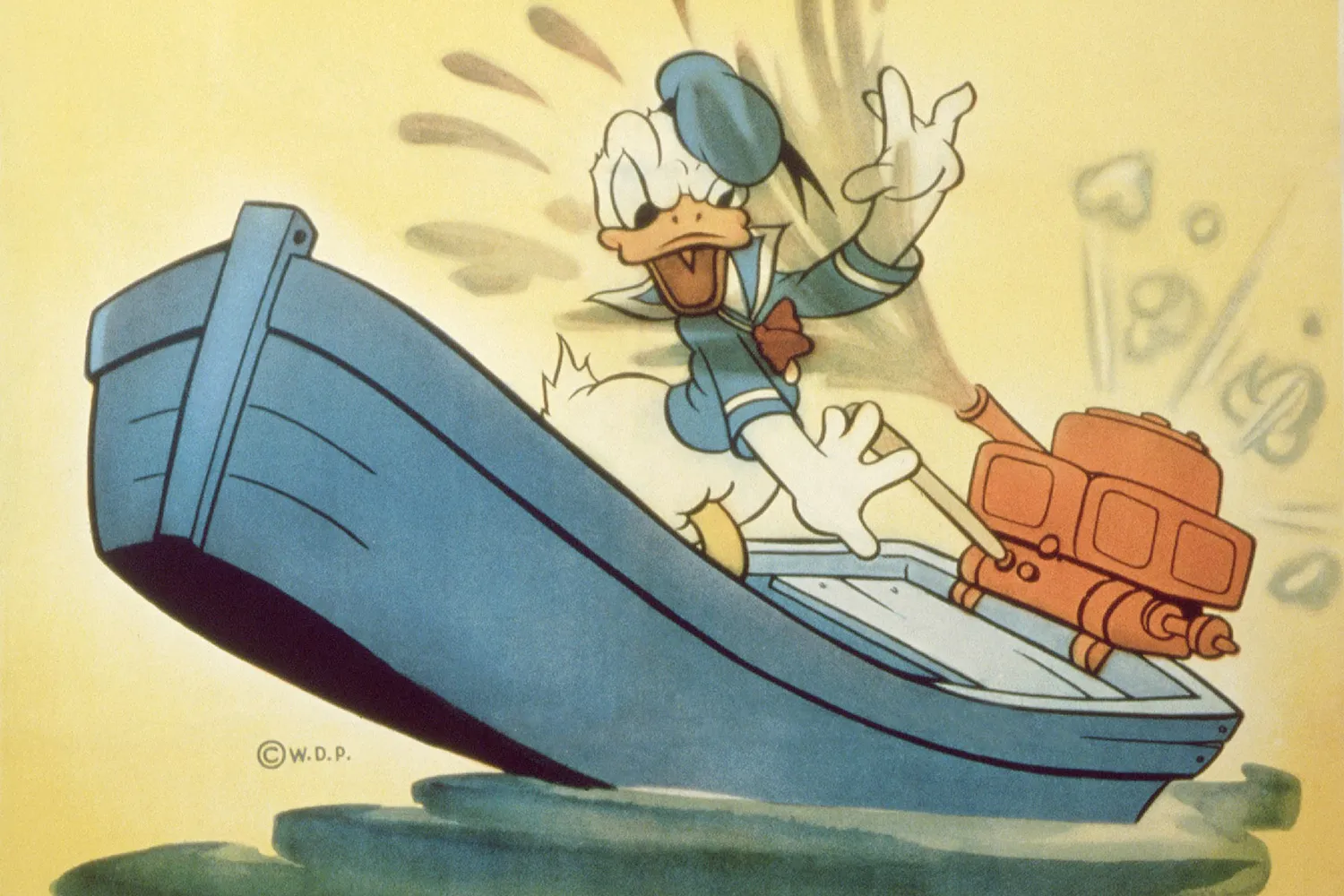
The campaign’s most famous production featured the beloved cartoon character Donald Duck. As early as 1940, Walt Disney had approached the Association of Motion Picture Producers and National Defense Advisory Commission to discuss producing films in support of a war effort that, as the 1942 film The New Spirit put it, aimed to “stamp tyranny from the earth.” The film was one of a series of animated Disney shorts, which also included The Spirit of ’43.
In The New Spirit, which was produced in just four weeks and played in over 12,000 movie theaters in 1942, a talking radio explains to Donald it is his “privilege, not just [his] duty” to pay taxes. The radio warns that he won’t receive any kind of medal for doing so but makes clear that the money is vital to success. After walking Donald through how to fill out the forms, including the fact that he can deduct his dependents—nephews Huey, Dewey, and Louie—Donald takes a journey from California to Washington, showing how tax dollars were being transformed into weapons and equipment needed to defeat Nazi Germany. “Taxes will keep democracy on the march,” the narration declares, insisting on the need of working citizens to pay “taxes for democracy, taxes to beat the Axis.” The films defined patriotism and taxpaying as individual sacrifice.
Taxes were not the only issue for which the government enlisted entertainers in the war effort. During World War II, Disney released dozens of films, including one called Education for Death, a dire short that depicted how German children were brainwashed by the murderous Nazi regime. The Andrews Sisters sang “Boogie Woogie Bugle Boy,” a song written by Don Raye and Hughie Prince, that celebrated the wartime draft. Comic strips and comic books such as Superman featured wartime themes in their weekly storylines. The first issue of Captain America, published in 1941, showed the superhero punching Hitler while Nazi storm troopers fire at him.
The Treasury’s public relations campaign was not the only reason Americans were willing to make enormous sacrifices during the war. By the early 1940s, a majority of citizens had come to recognize the existential threat that Germany and Japan posed to international stability, national security, and the future of humanity. As a result of the draft, support for a successful outcome felt very immediate to most families who had sons, husbands, brothers, and fathers fighting overseas. Families who had emigrated to the U.S. in the early 20th century from Eastern Europe watched as the war ravaged the lands they left behind.
But the campaign to promote war bonds and taxation was important as well. As Jones argues, it was part of a much larger concerted effort by the Roosevelt administration to ensure that Americans never lost sight of what was at stake in Europe and Asia. Refusing to take public support for granted, the administration assured citizens that their sacrifices were necessary, whether through paying taxes, working in factories, or fighting in the battlefield, and that their resources were being put to meaningful use. In his own small way, Donald Duck helped Roosevelt build and maintain public support in a brutal war that claimed millions of lives.
There is always a fine line between dangerous, misleading propaganda designed to persuade the public to support a bad cause—like that pushed by President George W. Bush and his administration regarding weapons of mass destruction as a pretext for invading Iraq in 2003—and legitimate, even virtuous, propaganda intended to build support for a just one, as many Americans continue to regard World War II. But the most effective presidents find ways to make their case to the public and explain why the government has decided to do what it is doing.
What is most remarkable about the current president is how little attention he has devoted to this aspect of leadership. Nothing comparable has accompanied the war in Iran. Trump has approached the operation like a one-man show, offering neither a coherent plan nor a consistent justification, and showing little concern for securing public support. That the United States used force without any precipitating military attack has made this decision especially problematic. It represents an extraordinarily expansive view of presidential power: Because the president does it, it is right. Congressional and public support, in this view, are not a priority.
The results have been predicable: Public support was never high and has eroded; the president’s approval ratings have declined significantly; and pressure has mounted on members of Congress to bring the conflict to an end. The “tough on national security” Republicans in Congress have thus far been reluctant to sign the check that the administration is asking them to. Even without the deployment of a large number of ground troops, as in Vietnam or Iraq, the war has claimed lives, created a highly unstable situation in the Middle East, and resulted in economic consequences that have literally imposed significant costs on the nation. Every time an American pays more to fill up their gas tank or finds it difficult to purchase food for their family, they can rationally scratch their heads, wondering why Iran should require them to make these kinds of sacrifices.
Trump has often been dismissive of the history of the presidency, giving the impression that he can achieve what no other leader has and that he need not follow the conventions that previous commanders-in-chief have considered essential. Yet history frequently teaches enduring lessons about the obstacles leaders will face. In this case, Trump ignored these lessons, and his transactional approach to foreign policy has left both his administration and the nation caught in a costly and confusing quagmire of his own making.