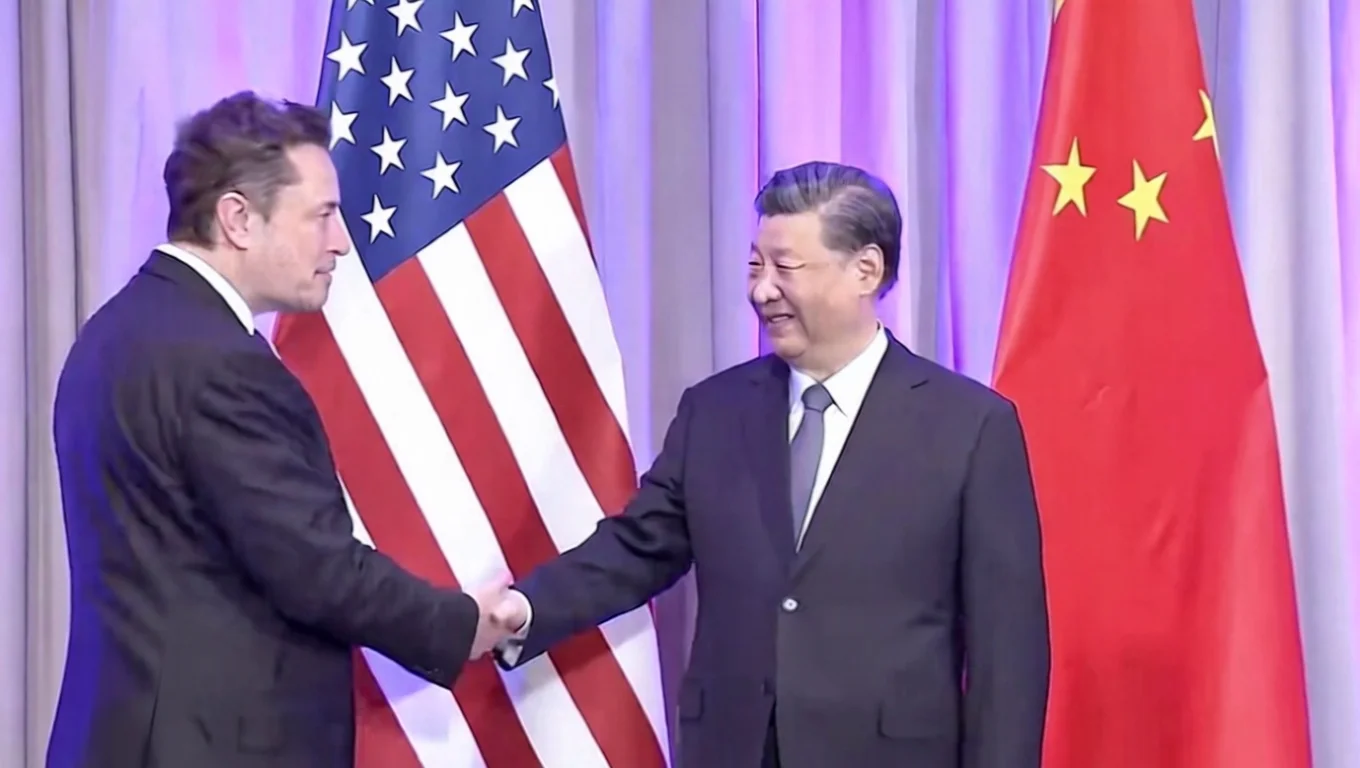
A self-interview on Elon Musk’s bizarre praise of China. There are 21 billion good reasons for it.
by Kok Bayraq
Question: Elon Musk praised China on X as an “awesome” country. What do you think?
Answer: I am not surprised. Among the 3 million people who have been held in camps and prisons in East Turkistan, none are his relatives. None of his 14 children are among the 143,000 children separated from their parents and placed in boarding institutions.
Among the nearly 1.5 billion people whose right to freely elect and be elected has been taken away by the Chinese Communist Party, his own rights are not at stake. When Xi Jinping opened the way to remaining president indefinitely and trampled the dignity of more than a billion citizens, it was not Musk’s dignity that was being violated.
Question: The United Nations has issued reports. Experts have published studies about genocide. Governments and parliaments, including the United States, have described the Uyghur situation as genocide. Could Elon Musk somehow have missed all of this?
Answer: Whether he has seen it or not hardly matters.
Look through his eyes, and China is no longer a country. It is an electric-vehicle market.
Every citizen looks like an electric car. Every small child looks like a component for an electric car.
Those who are dying, being tortured, or crying are, from that perspective, simply people who cannot afford to buy an electric car.
Nothing more.
Question: This isn’t the first time Musk has praised China. He has done so repeatedly—at least ten times. Is there perhaps genuine love behind all this praise?
Answer: That would be perfectly natural.
History shows that many of the world’s beauties have ended up in the arms of famous rich men. Wealth has a way of inspiring affection.
Tesla generated roughly $21 billion in revenue from China in 2025 alone. With a figure like that in mind, it would hardly be surprising if Musk had fallen in love with China.
Question: Have you ever seen signs that he really is in love?
Answer: Yes.
People say love is blind.
A couple of years ago, Musk praised workers at Tesla’s Shanghai factory, describing Chinese workers in highly complimentary terms and saying “Super Talented ”
But consider the working conditions that have been reported: extremely long hours and demanding schedules.
Is working extraordinarily long hours really “talent”?
Surely that is not talent. It might be misfortune. It might be lack of alternatives. It might be economic necessity. If we want to describe it positively, we could call it extraordinary diligence.
But talent? No. And yet Musk sees talent. There you have it: Love is blind.
Question: Many countries, organizations, and individuals believe they have suffered because of the Chinese government. A Tibetan recently set himself on fire outside the United Nations. Many Americans also complain about the challenge China poses to the United States. Even if only out of respect for their feelings, shouldn’t Musk keep his admiration and affection for China somewhat more private?
Answer: Love has to work both ways.
And if love is to survive and grow, sometimes it needs to be expressed aloud. Actions alone are not always enough. When both sides are reassured that the relationship remains satisfying, love grows stronger.
Musk would naturally like Tesla’s business in China to grow many times over.
In loving families, nobody finds it strange when the words “I love you” are repeated from time to time.
Why should this romance be different?
Question: But why did Musk specifically recommend that people visit China? Why didn’t he encourage them to invest in China or buy Chinese products instead?
Answer: When you love someone, you try to give them what they need most—what would make them happiest.
What China needs most today is relief from international accusations over its treatment of Uyghurs. For years, Chinese authorities have spent large sums organizing guided visits and inviting foreign guests to see Xinjiang, later using favorable impressions from such visits to support their own narrative.
Seen through the language of romance, Musk’s invitation to visit China could be considered a little gift to his beloved.
A token of affection.
Question: Suppose a man falls in love with a beautiful but morally questionable woman. Out of concern for his own reputation, he might avoid walking hand-in-hand with her in public and keep the relationship discreet. Why, then, is Musk so carefree—and so bold—in publicly declaring his affection?
Answer: I wouldn’t call it courage.
I would call it fear.
A beautiful but powerful lover can be demanding.
And an authoritarian state can be even more demanding.
In a free market, consumers and competition largely determine business fortunes. Under an authoritarian system, however, a political decision by the central government can dramatically alter a company’s fate.
Musk knows that his enormous business interests in China could be affected by political decisions. That gives him a reason to make his affection visible.
In this relationship, private love may not be enough. It has to be declared publicly.
So one day, if Elon Musk decides that preserving—or dramatically expanding—Tesla’s business in China requires something more, and he posts a marriage proposal to Xi Jinping on X, I won’t be surprised.
After all, when a love affair has already gone this far, marriage is only the next logical step.

Uses a pseudonym for security reasons.