Image: Rawpixel.com / Shutterstock
President Donald Trump’s latest threat of “economic warfare and isolation” against any country providing Iran with a lifeline has made one thing increasingly clear: the nearly six-month Iran war is no longer only a Middle Eastern conflict. It is becoming a direct factor in US–China relations and, potentially, in Chinese President Xi Jinping’s planned September 24 visit to Washington.
Trump has strong political incentives to end the war. His approval rating has fallen to 33 percent in a recent Reuters/Ipsos poll, while fuel costs and inflationary pressures have risen as traffic through the Strait of Hormuz remains severely disrupted. Iran has discovered that it does not need to defeat the United States militarily. By threatening shipping through a waterway that carried roughly one-fifth of the world’s traded oil before the war, Tehran can transmit battlefield pressure into higher energy prices, inflation, and American voter dissatisfaction.
Washington’s options are unattractive. Iran has lived under intensive sanctions for decades and has developed institutions and networks for operating under economic siege. The Trump administration has imposed and coordinated numerous sanctions on Iran since the start of its second term, most recently including measures that led the UAE to halt trade and financial activities with Iran, yet this pressure has not forced Tehran back to the negotiating table. Air power has inflicted serious damage, but it has not eliminated Iran’s nuclear capacity or secured the highly enriched uranium believed to have survived earlier strikes. A ground operation could offer more direct access to buried facilities and stockpiles, but it would risk American casualties and a wider war—precisely the kind of open-ended commitment that Trump’s MAGA coalition has long opposed.
That leaves Washington looking for leverage held by others, and no country matters more than China. Reuters estimates that China buys more than 80 percent of Iran’s shipped oil. The United States could sanction Chinese ‘teapot’ refiners, target larger Chinese banks, continue a ‘whack-a-mole’ campaign against intermediaries, or seek new authority for secondary tariffs. Yet every stronger option creates a China problem. Sanctions on major Chinese financial institutions could invite retaliation, while Washington remains dependent on Chinese supplies of critical minerals.
This creates a paradox. The country with the greatest potential economic leverage over Tehran is also the country Washington can least afford to alienate before the September summit. A campaign designed to pressure Iran could therefore destabilize the “constructive strategic stability” Trump and Xi endorsed in Beijing in May.
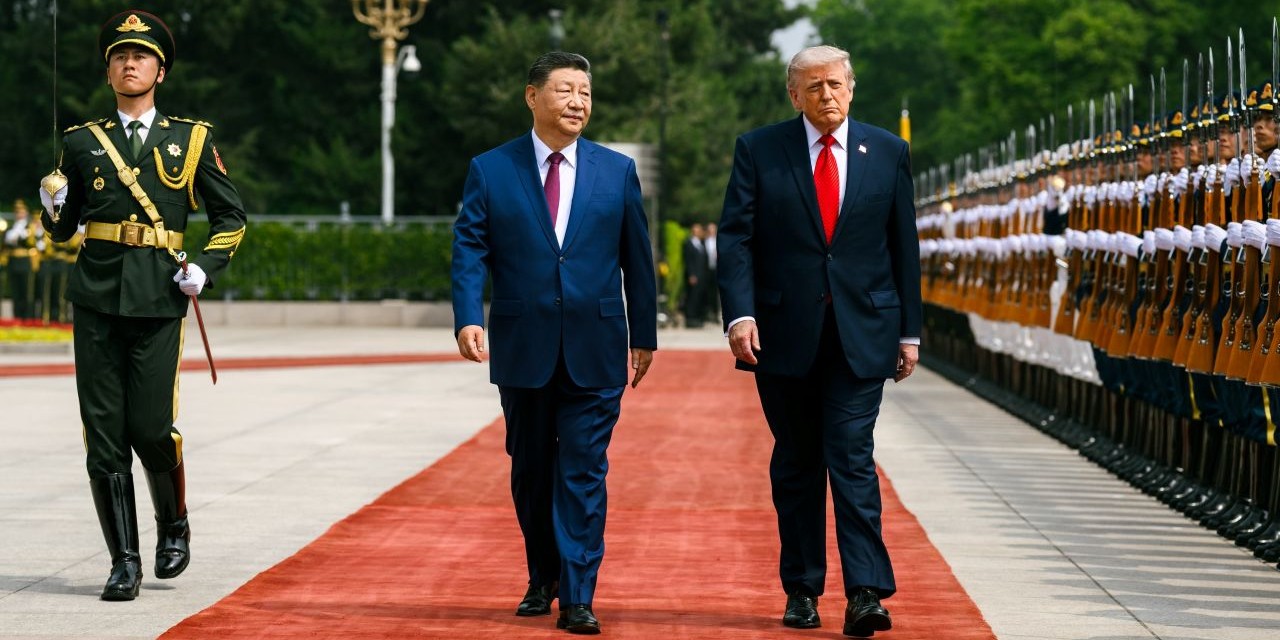
Protocol is the second challenge. Trump received unmistakably state-level treatment in Beijing: a red carpet, a 21-gun salute, a People’s Liberation Army honour guard, a state banquet, and a carefully choreographed visit with Xi to the Temple of Heaven. Trump publicly promised that Xi’s return visit would be “reciprocal.” Beijing then announced that Xi would make a state visit to the United States in the fall.
Yet Trump has publicly confirmed the September 24 visit without, so far, laying out the full ceremonial package. The distinction matters. The visit comes about six weeks before the November midterm elections. An elaborate state visit could draw criticism from China hawks in both parties. But anything visibly below the treatment Trump received in Beijing could be interpreted in China as a deliberate diplomatic slight. Deferring fuller ceremonial reciprocity until the December G20 summit in Florida and treating Xi’s September visit only as a regular official visit might look convenient from Washington’s perspective, but Beijing would gain little from such an arrangement other than doing Trump a favour.
The stakes extend beyond September. China will host the APEC leaders’ meeting in Shenzhen on November 18–19, while the United States will host the G20 summit in Florida on December 14–15. In May, the White House said the two countries would support each other as hosts. The September visit is therefore the hinge connecting a possible sequence of leader-level encounters through the end of the year.
That sequence also intersects with North Korea. Trump is openly pushing for another meeting with Kim Jong Un, potentially during an Asia trip in November. He has already ordered the annual US–South Korean Ulchi Freedom Shield exercises cut from eleven days to five, explicitly invoking his relationship with Kim. No summit is formally scheduled. A more theatrical step, such as becoming the first sitting US president to visit Pyongyang, remains speculative, but it would fit Trump’s preference for symbolic diplomatic ‘firsts’ at a moment when Iran has denied him an easy victory.
This is why September matters even if it produces no grand bargain. At the macro level, China and the United States remain constrained by what I call Mutually Assured Economic Destruction, or MAED: each possesses economic weapons capable of seriously harming the other, but using them at full force would also impose major costs on itself. At the micro level, anticipated presidential diplomacy disciplines bureaucracies. Officials know that a provocative sanction, export control, arms decision, or retaliatory measure can disrupt an imminent summit. If expectations of repeated Trump–Xi meetings disappear, that restraint weakens, and harder-line actors on both sides gain room to move.
The immediate task, therefore, is not to overload September 24 with ambitions. Washington and Beijing should settle protocol early, insulate Iran-related bargaining from the broader economic relationship as much as possible, and complete one or two concrete deliverables before the leaders meet. The preparatory process already runs through multiple channels—Bessent and Greer on trade, planned AI talks; Rubio and Wang on diplomacy; and Senator Steve Daines as an informal backchannel. The problem is not a lack of contact, but the risk of fragmentation without a clear hierarchy.
September 24 should be treated as a stabilizing checkpoint, not a stage for maximalist bargaining. If it succeeds, it can preserve political space for APEC, the G20, and perhaps renewed diplomacy with North Korea. If it fails, the consequences will not end with one cancelled ceremony in Washington. It could unravel the diplomatic calendar that currently gives both governments a reason to keep competition within guardrails.
Related articles:
China–US Relations After Trump’s Beijing Visit: Shifting Stabilizers in an Era of Great Power Competition (10-minute read)
Does the US Deserve Allies’ Trust? (3-minute read)
Why China Insists on the “Existing International Order”: The Politics of UN Centrality and Reform (3-minute read)