Key Points
When the Tesla (NASDAQ:TSLA) Semi was announced in 2017, expectations were high. The global freight trucking market is currently valued at $2.2 trillion. Diesel is one of the industry’s highest costs of doing business. Labor is also pricey, with 3.5 million drivers employed in the U.S. alone.
Tesla’s Semi trucking platform, of course, is powered by batteries and electricity. And the company’s autonomous driving technology can further reduce trucking costs. In short, many analysts believed the Tesla Semi was destined for success.
Missed Nvidia in 2009? This Rare Signal Is Flashing Again. In 2009, a “Double Down” signal flashed for a little-known chipmaker called Nvidia. For the first time in years, that same “Total Conviction” signal is flashing for a company 1/100th the size of Nvidia. Continue »
In 2018, CEO Elon Musk announced that Tesla would begin production of the Semi by sometime in 2019. Analysts were aggressive in their forecasts, with many expecting run rate production of around 25,000 per year at the start.
“We believe this could set off competition for intelligent trucks in the industry,” an analyst for Morgan Stanley predicted at the time. “If the order books fill up quickly, any carrier that holds back placing its order could potentially have to wait several years to get its hands on a Tesla truck — years during which its competitors could be running with up to a ~70% cost advantage.”
That analyst viewed the Tesla Semi launch as a key catalyst for the company’s stock price. “A rush by truck carriers to place Tesla truck orders and other OEMs to launch similar trucks could also be viewed by the market/investors as a key catalyst to the intelligent trucking thesis becoming ‘real,'” he stressed.
Production did not actually begin until 2022. This time last year, only a couple of hundred units had been sold since inception. Despite the slow start, Tesla’s Semi ambitions may finally be turning a corner.
Tesla Semi sales are beginning to heat up
On Aug. 18, Einride AB (NASDAQ:ENRD), a Swedish autonomous transport company, placed an order for 500 Tesla Semis. The company believes that the move will help it reach cash-flow breakeven by 2028. At that point, Einride management believes the company should be operating 1,500 to 2,000 self-driving trucks, many of which should be Tesla Semis.
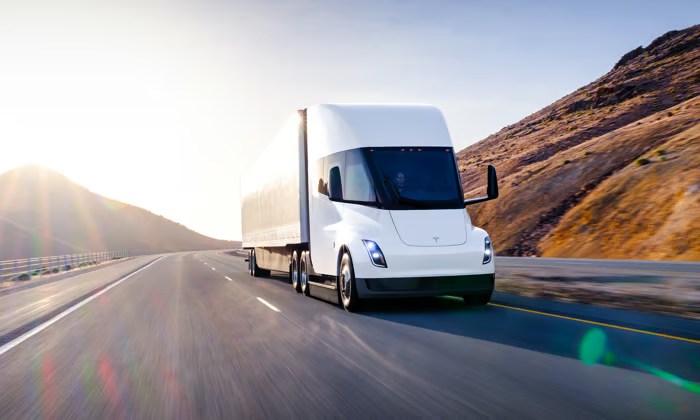
Image source: Tesla
Einride isn’t the first company to place a major Semi order this year. WattEV, a California-based trucking company, ordered 370 units in May. So while overall demand for Tesla Semis remains well below initial analyst projections, adoption potential is clearly heating up.
Higher demand likely stems from higher fuel prices and the relative economic advantage of operating an electric semitruck. But the biggest catalyst may be advances in Tesla’s self-driving technology platform. “[F]ully autonomous trucking is expected to reach viability by 2032,” concludes a survey of experts conducted by McKinsey & Co. Further technology advancements, however, are still necessary before mass adoption. “[A]utonomous trucks are expected to need more than $3 billion in investments in software to achieve market readiness,” McKinsey & Co. observes.
With a market cap of roughly $1 trillion, Tesla has greater access to capital than nearly all of its trucking competitors. It’s no wonder that Enride, a company that has invested heavily in developing its own autonomous trucking technology, opted to simply buy Tesla Semis as its hardware backend. Tesla has the capital and investment capacity needed to bring not only electric semitrucks to market but also autonomous trucking to the finish line.
Autonomous trucking is still years away from reaching mass adoption. And Tesla’s Semi sales remain a drop in the bucket for the company. But rising demand should be seen not only as a vote of confidence in Tesla’s Semi platform but also in its autonomous driving roadmap.
Don’t miss this second chance at a potentially lucrative opportunity
Ever feel like you missed the boat in buying the most successful stocks? Then you’ll want to hear this.
On rare occasions, our expert team of analysts issues a “Double Down” stock recommendation for companies that they think are about to pop. If you’re worried you’ve already missed your chance to invest, now is the best time to buy before it’s too late. And the numbers speak for themselves:
- Nvidia: if you invested $1,000 when we doubled down in 2009, you’d have $584,326!*
- Apple: if you invested $1,000 when we doubled down in 2008, you’d have $58,294!*
- Netflix: if you invested $1,000 when we doubled down in 2004, you’d have $409,970!*
Right now, we’re issuing “Double Down” alerts for three incredible companies, available when you join Stock Advisor, and there may not be another chance like this anytime soon.
*Stock Advisor returns as of August 19, 2026.
Ryan Vanzo has no position in any of the stocks mentioned. The Motley Fool has positions in and recommends Tesla. The Motley Fool has a disclosure policy.