There has been something almost absurd about Ferran Torres’ summer.
On July 19, he came off the bench in a World Cup final, scored the winning goal in the 106th minute and became a Spanish football hero.
Spain celebrated him. Barcelona celebrated him, too. At the trophy parade held in Madrid following the team’s return, inflatable sharks could be seen among the crowds — referencing the nickname he cultivated at Barca (tiburon, shark) as a way to deal with pressure.
Now, a month on from Torres’ strike in that 1-0 win over Argentina, some Barcelona supporters are celebrating his departure in a €50million (£42.7m; $57.9m) transfer to Paris Saint-Germain.
It’s not the ending you would expect for a World Cup hero.
Torres, 26, is not leaving Barcelona as a unanimously hated player, nor is he departing on bad terms with the club or the people inside it.
But many fans have been upset or annoyed by his behaviour over the past month — and the widely held theory is that his winning goal for Spain was the catalyst.
First of all, we need to talk about the hat.
During Spain’s World Cup celebrations in Madrid, Torres wore a red baseball cap bearing the words ‘Make Spain Great Again’. You don’t need to be a politics junkie to recognise the echoes with U.S. President Donald Trump’s ‘Make America Great Again’ slogan.
The White House reacted to the image through its official account on X, posting a video of Torres wearing the cap with the line: “Everyone wants in on the movement.”
Torres later insisted that it had nothing to do with politics, that it was simply about celebrating Spain being back at the top of world football.
SEE IT: Spain World Cup champion Ferran Torres gives fans a front-row look at the national team’s championship parade, sharing a POV video from the celebration on his Instagram Story while wearing a “Make Spain Great Again” hat.
The championship-winning forward rides through the… pic.twitter.com/BcwG8BIxqr
— Fox News (@FoxNews) July 21, 2026
Then there was the bracelet.
At the celebrations, Torres was also spotted wearing a rubber bracelet with a Spain flag that carried branding from the Guardia Civil — one of the country’s two national law enforcement agencies (the other being the Policia Nacional).
It would be unfair to assume that Torres was wearing that as some kind of political statement, but Catalonia’s recent history means some people saw one regardless.
In 2017, at the peak of the region’s now considerably weaker pro-independence movement, a referendum on the issue was organised by local authorities — without the permission of the Spanish government, who deemed it illegal. It brought huge crowds into Barcelona’s streets and was met with a heavy police crackdown.
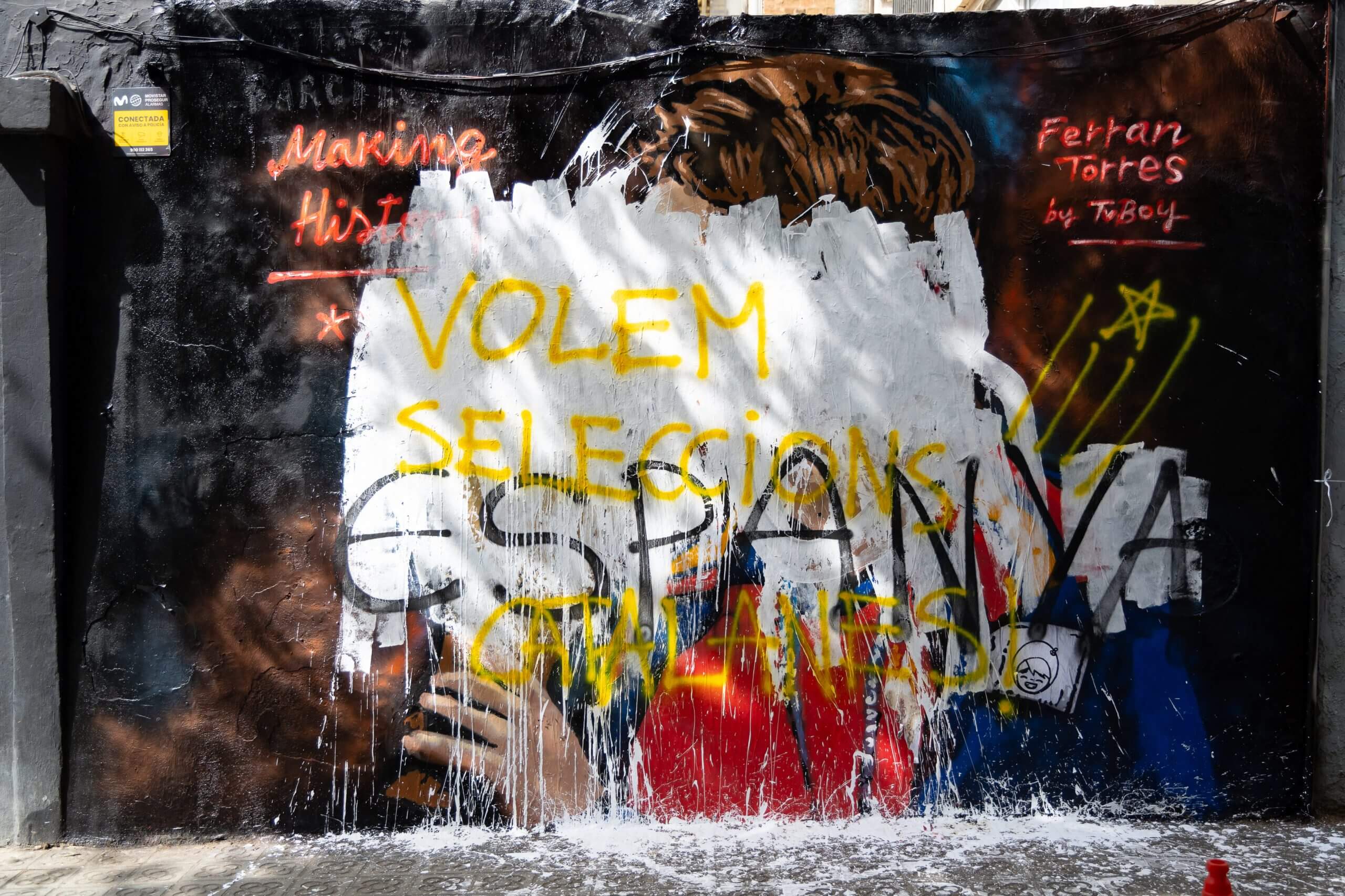
Perhaps Torres was simply expressing his Spanish identity. But in Catalonia, even a seemingly harmless gesture can take on political significance. In Barcelona, a mural of Torres by Italian street artist TVBoy was defaced with the slogan: “We want Catalan national teams”, Another message scrawled on top simply read: “Spain”. Both were written in Catalan.
The mural of Ferran Torres by TVBoy as seen in Barcelona on July 22 (Josep Lago/AFP via Getty Images)
Torres responded to the situation in an interview with Radio Play Valencia a few weeks later.
“I am Valencian, a Valencianista (a proud supporter of the Valencia region) and Spanish,” he said. “If someone doesn’t like that, that’s their problem.”
Torres made those comments on August 7. By that time, he had already caused a bigger stir with several interviews in the United States.
After the World Cup final, Torres and the other seven Barca players in Spain’s squad had holidays before returning for pre-season training. Torres travelled to the U.S., where he took Barca by surprise with a round of media appearances on August 3.
“I have a contract at Barcelona, but in football you never know,” he said on NBC when asked where he would be playing this season, his Barca contract due to expire in June 2027. “I am just waiting to make the right decision, but I don’t know it yet.”
Later, speaking to Sportico, he also addressed reported interest from PSG.
“Every time these teams want you it’s a good thing,” Torres said. “In football you never know what can happen, but the good thing is that, as I have a contract, I can wait and decide on my own.
“What do Barca need to do to keep me? They have to show me they want me, come to negotiate, and in the end it’s all about talking.”

Spain held a trophy parade and celebrations in Madrid the day after the World Cup final (Diego Souto/Getty Images)
Torres is not a player who set the world alight at Barca. It would be fair to say he struggled overall to live up to the expectations following his €55million arrival from Manchester City in January 2022.
He also struggled with the mental side of the game and consulted psychologists to help get the best out of himself. This is where that nickname comes in again. The ‘shark’ reference comes via UFC fighter Ilia Topuria. Torres heard an interview with the Georgian-Spanish athlete in which he said of his rivals: “There’s only one shark here; the rest are sardines.”
He found it funny and told his Barcelona team-mates about it while they were eating. After an upturn in his goalscoring form for Barca at the beginning of 2023-24, the team started calling him ‘El Tiburon’. His goal celebrations reflected a player who felt he was proving doubters wrong.
But Torres has still never quite managed to deliver consistently, and that feeling of it being him against the world has not disappeared.

Ferran Torres’ goal sealed the second World Cup in Spain’s history (Justin Setterfield/Getty Images)
At the start of 2025-26, Hansi Flick’s idea was for the season to mark a transition from Robert Lewandowski to Torres as Barcelona’s leading No 9, but the reality was different. Torres struggled and ended the campaign with 21 goals and three assists in 49 appearances, going 14 games without scoring between late January and mid-April. After the season ended, there were no advances on a contract renewal, a situation complicated by the deal that took him from City four years ago.
Barca would have had to pay City about €8million if they had renewed Torres’ contract, while club sources — speaking anonymously as they did not have permission to comment — also said another clause meant selling him for anything over €55m would have forced them to pay City €10m.
The Spanish club ended up seeing him as a top-class substitute rather than a regular starter. Further to this, they have been trying to sign Atletico Madrid’s Julian Alvarez all summer.
Barca’s pursuit of Alvarez reinforced a perception that had been building around Torres. He felt he had been treated harshly for some time, and he wanted to respond to that. Every goal had become an answer to his critics, every good performance a rebuttal.

Ferran Torres joins up with former Spain manager Luis Enrique at PSG (Lou Benoist/AFP via Getty Images)
The critics were real, of course. So was the pressure. Barcelona is an unforgiving place for any player, and Torres has received his share of criticism. No one can blame him for carrying it as he has. But at times he seemed to be fighting a version of his critics that was larger, louder and more permanent than the one that actually existed. Many Barcelona supporters saw a betrayal of some kind in those U.S. media interviews — as they felt the club’s fanbase had rallied behind him in important moments.
Did Torres receive more criticism than he deserved? Did he receive more support than he remembers? The truth probably lies somewhere in between. Then, he scored the winning goal in a World Cup final.
The comparisons with Andres Iniesta’s extra-time strike in the 2010 final against the Netherlands (another 1-0 win for Spain) were obvious. The logical next step, in Torres’ eyes, might well have been to get out there and say, as the new hero of the nation, I told you so.
But in the end, there is perhaps nothing more Spanish than emulating Don Quixote — fighting battles against giants that may have been much smaller than they seemed.

