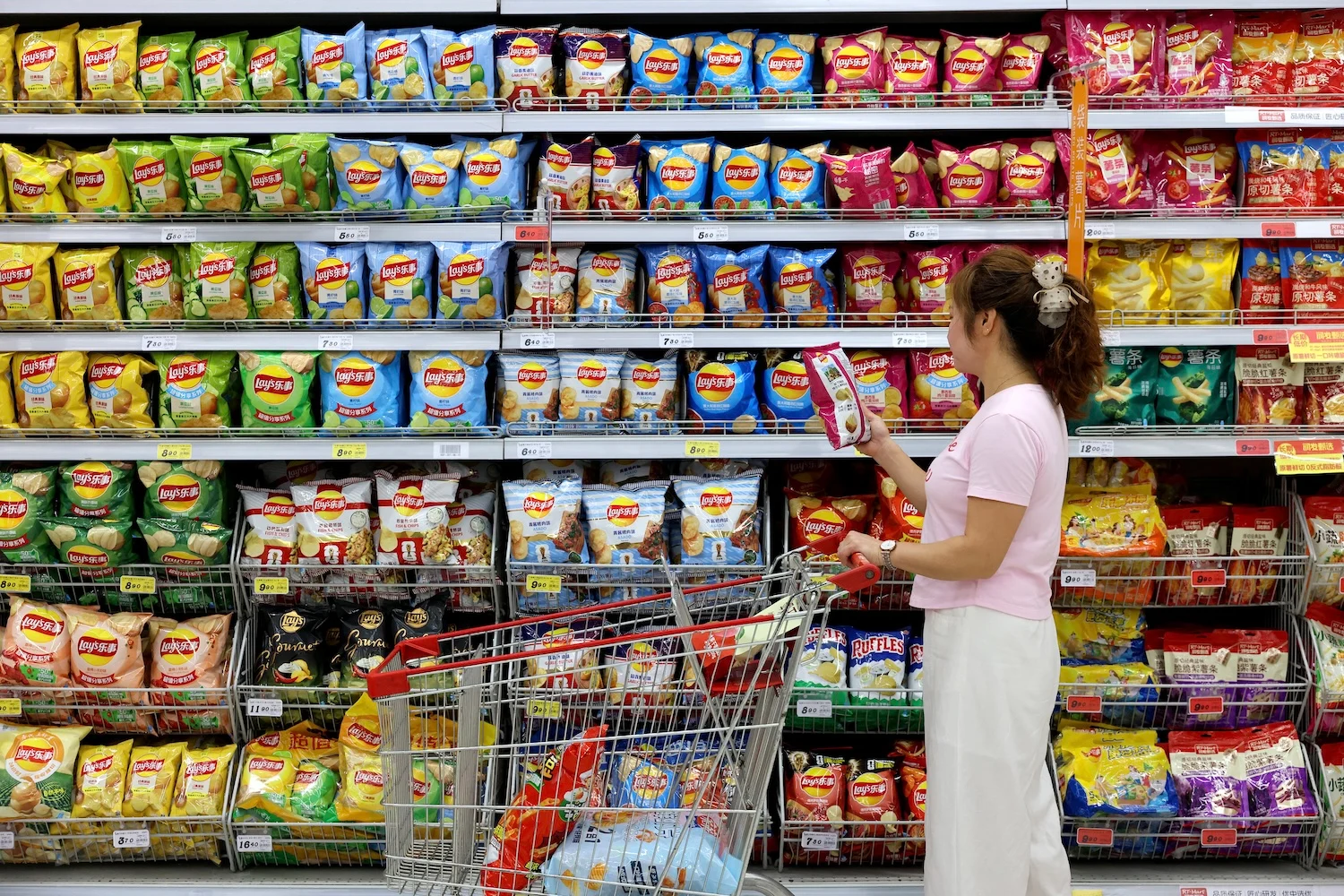
When China’s Politburo met on July 30 to set economic policy for the second half of 2026, the numbers in front of it were not good. In the first half of the year, retail sales grew just 1.3 percent from a year earlier, while the economy grew 4.7 percent. Consumer prices were up just 1 percent, about where they have been since February. A technology rally carried the stock market through the spring, but it broke in mid-July and was falling again as the Politburo convened.
The solution that the Politburo settled on is to double down on the strategy that Chinese President Xi Jinping had already set: deepening the “AI plus” initiative, developing new forms of the intelligent economy, pushing for breakthroughs in frontier technology, building new pillar industries, and pressing ahead with six national networks—from computing power to logistics—which the National Development and Reform Commission estimated in May would take more than 7 trillion yuan of investment this year alone.
When China’s Politburo met on July 30 to set economic policy for the second half of 2026, the numbers in front of it were not good. In the first half of the year, retail sales grew just 1.3 percent from a year earlier, while the economy grew 4.7 percent. Consumer prices were up just 1 percent, about where they have been since February. A technology rally carried the stock market through the spring, but it broke in mid-July and was falling again as the Politburo convened.
The solution that the Politburo settled on is to double down on the strategy that Chinese President Xi Jinping had already set: deepening the “AI plus” initiative, developing new forms of the intelligent economy, pushing for breakthroughs in frontier technology, building new pillar industries, and pressing ahead with six national networks—from computing power to logistics—which the National Development and Reform Commission estimated in May would take more than 7 trillion yuan of investment this year alone.
Missing from the Politburo’s strategy this year, however, are the “special initiatives to boost consumption” that anchored the July 2025 statement. The 2026 report instead tells officials to expand domestic demand by providing better supply tailored to different consumer groups and by boosting service consumption—echoing the prescriptions of the Politburo’s April statement. The original 2025 program instead survives one level down: The State Council’s five-year consumption plan, approved on July 13, tells officials to press ahead with it.
The usual description of the Chinese economy as K-shaped—tech and exports sail upward while consumption stalls—suggests an imbalance to be managed. Some analysts push the diagnosis further, describing China as a “slow tech dragon,” whose misallocation of resources produces both real breakthroughs and enough waste to slow the whole economy. In effect, both descriptions treat the household side as a casualty of error. The July statement points to another possibility. The neglect of the household is a top-down decision, a cost that the Chinese leadership has determined is worth paying for the sectors it counts on for national power.
The choice was made against a good deal of advice. In its 2024 review of China’s economy, the International Monetary Fund (IMF) proposed that Beijing spend roughly a trillion dollars finishing the country’s unfinished presold apartments or compensating the buyers; it repeated the advice in February. In China, most new homes are sold before they are built. Buyers pay upfront, often with a mortgage, while the developer puts the cash into its next project. When the bubble burst in 2021, millions of paid apartments were left unfinished, and their owners are still repaying loans on homes that may never arrive. Beijing said that it planned no additional spending to complete presold housing and that social spending would have to wait on fiscal sustainability.
Some Chinese economists have argued for years for direct transfers, cash, or vouchers put into consumers’ hands. Xi’s 2021 essay on common prosperity, which still governs policy, warned that the state must never fall into the trap of a welfarism that raises lazy people. Existing subsidies follow that dictum. The 250 billion yuan of special treasury bonds behind this year’s consumer program goes through a trade-in scheme for cars and appliances, released in planned batches, and paid only when a household buys an approved product, which is almost always Chinese-made. This year’s five-year plan sees the scheme carried forward. In effect, the state has cast the household as the channel through which the money passes on its way to the manufacturer, not as an end of its own.
There is a permanent, cheap, and fast channel for putting state money into the capital market but no household equivalent. Take the stock market in mid-July, which shows what Beijing can do when it feels the urgency. Moonshot AI released its Kimi K3 model on July 16, landing on a global semiconductor rally already up 105 percent since March. The ChiNext board fell 7.2 percent the next day, and Shanghai’s STAR Market, home to the chipmakers, dropped more than 8 percent. Two days later, two central state-capital operators announced that they were buying around 60 billion yuan (approximately $8 billion) of stocks, aimed at technology shares and the funds holding them. Behind them, there is a relending facility that the central bank set up in October 2024 for the sole purpose of financing share purchases, which opened at 300 billion yuan at a 1.75 percent interest rate. By early July, the facility had disbursed roughly 155 billion yuan to more than 600 listed companies.
Even so, this mechanism does not seem to have worked very well. On the morning of the Politburo meeting, the STAR 50 index fell more than 5 percent, with the ChiNext down more than 4 percent. Even counting a rebound on July 31, the month closed with the ChiNext board down 23 percent and the STAR composite down almost 28 percent, with the state’s buyers in the market the whole time. The technology trade is heading down, and the state is trying to slow the fall, so far without much success. The drive behind the boom has the character of a campaign—capital ordered into one corridor of the economy on a scale recalling the backyard steel furnaces of the Great Leap Forward.
Whether the state can pay for all of this is a fair question, and it is an increasingly urgent one. The official deficit ratio is 4 percent of GDP, the highest on record, with 1.3 trillion yuan of ultra-long special treasury bonds and 4.4 trillion yuan of local special bonds on top of it; a 10 trillion yuan program is moving hidden local debt onto public books. The revenue that local governments used to subsist on has fallen hard. Land sales brought in 8.7 trillion yuan at the 2021 peak and 4.2 trillion by 2025; in the first half of this year, they came to 978 billion yuan, down 31.5 percent from a year earlier.
None of this points to an inevitable fiscal crisis. It does mean, though, that one balance sheet is financing the technology drive, backstopping the stock market, covering the localities, and propping up small banks, while the land revenue underneath it keeps shrinking. A budget this stretched cannot turn around and fund households. That locks the economy onto exports, and exports depend on the exchange rate.
China ran a goods trade surplus of 3.99 trillion yuan in the first half of this year, with exports up 17.6 percent in dollar terms. A surplus that size should have pushed the yuan up hard. The yuan has been climbing, albeit slowly, to around 6.79 to the dollar, its strongest in almost three years. That pace is what Beijing’s policymakers want to see. The April statement told officials to keep the exchange rate basically stable at a reasonable and balanced level, and in late February, the central bank cut the risk reserve on forward dollar purchases to zero, a move framed at home as a brake on the yuan’s one-way rise.
The same day the Politburo met in July, the IMF released its new External Sector Report, which put the yuan around 20 percent undervalued and noted that state banks appear to have been intervening to slow its rise. China’s motivations go back to the household. An economy holding down domestic consumption needs foreign buyers for what its factories make; a cheap currency is what keeps those buyers. The whole arrangement, then, comes down to the exchange rate.
Suppose Beijing did the opposite and spent heavily to lift household incomes. Chinese factories would sell more at home, imports would rise, and the trade surplus would shrink. A smaller surplus would ease the pressure on the yuan, and the cheap currency would lose its purpose. Weak household demand and the undervalued yuan keep China’s output flowing abroad. A serious boost to household consumption would work against the rest of this model and undermine the leverage that Beijing has built from its trade surplus.
The Europeans have noticed first, likely because tariffs have narrowed the door for Chinese exports to the United States. German Chancellor Friedrich Merz told the G-7 in June that the yuan is undervalued by 20 to 30 percent, and he has since called several times for coordinated currency talks with Beijing, referring to the Plaza Accord which revalued the yen in 1985. French President Emmanuel Macron has joined him, urging dialogue with Beijing on exchange rates and the opening of financial markets. Berlin and Paris are drawing up a joint roadmap on their trade imbalances with China.
For Washington, this realization should change where it finds its leverage against Beijing. The strategy of tariffs and export controls assumes that pressure gets to China through consumer pain. But if the household is the constituency that Beijing has already decided it can disappoint, then these pressures are moot. This latest Politburo statement confirms that decision for the second half of the year, and the five-year plan extends it to 2030. Export controls reach China’s technology sector, and tariffs have mostly rerouted the surplus toward Europe. When shareholders flee, state funds can take their place; when households retrench, the state can wait them out. Foreign demand is the one input that Beijing cannot supply from within. The surplus absorbs its overcapacity, and the managed exchange rate keeps the surplus coming.
A currency front built with Europe and led by the United States would put real pressure on Beijing. It need not begin with a second Plaza Accord. Following the IMF’s report that the yuan sits far below fair value, the G-7’s finance ministries should state plainly that the exchange rate lies at the center of the imbalance. Washington also holds tools it has used before. The U.S. Treasury reviews the currency practices of trading partners twice a year, and it designated China as a currency manipulator as recently as 2019. That designation drew no concession from China, and the label came off five months later in the Phase One trade deal with the United States. When the G-7 pressured China to let its currency appreciate a decade earlier, Beijing ceded only some limited ground.
Europe and the United States should expect a similar sequence where Beijing holds out at first and then concedes just enough to ease the pressure and not shrink the surplus. Beijing may also try to split the front, likely starting in Europe, where factories going up in Hungary and Spain and rare-earth licensing are already showing European industry what a standoff could cost.
Whether Washington pivots is a harder question. A tariff-first administration would first have to concede that tariffs rerouted the surplus without shrinking it. The likelier path is addition, with tariffs supplying the pressure and a currency front giving it a target that Beijing cannot buy off at home. Beijing can send the national team, as Chinese investors call the state funds, into the stock market, and it can count on its households for patience, since they have little choice. It can intervene in its currency, too. But the exchange rate sustains the surplus itself, and it is the one lever that Beijing cannot work alone.