Key Points
-
Tesla and SpaceX announced a $16.8 billion first phase for the Terafab chip plant in Grimes County, Texas, on Aug. 6.
-
Tesla’s trailing-12-month net income is about $3.8 billion.
-
The companies haven’t disclosed how the $16.8 billion splits between them.
- These 10 stocks could mint the next wave of millionaires ›
Tesla (NASDAQ: TSLA) and SpaceX (NASDAQ: SPCX) said on Aug. 6 that they will spend $16.8 billion on the first phase of Terafab, a semiconductor plant in Grimes County, Texas. Tesla’s net income over the past 12 months was about $3.8 billion — so the two companies’ opening commitment alone is more than four times what Tesla currently earns in a year.
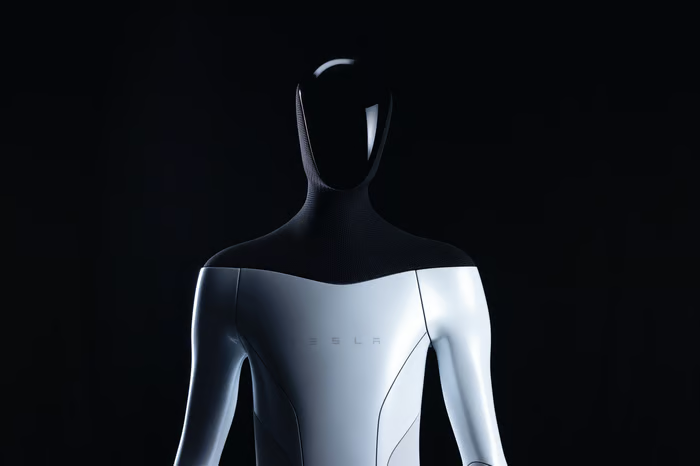
Image source: Tesla.
Missed Nvidia in 2009? This Rare Signal Is Flashing Again. In 2009, a “Double Down” signal flashed for a little-known chipmaker called Nvidia. For the first time in years, that same “Total Conviction” signal is flashing for a company 1/100th the size of Nvidia. Continue »
The plan is enormous even by chip-industry standards. Terafab is designed to put logic, memory, packaging, and testing under one roof, across more than 100 million square feet, about an hour northwest of Houston. The companies say the site will draw water from the Gibbons Creek Reservoir rather than local groundwater.
The chips are meant for Tesla‘s Optimus robots and its Cybercab, plus the high-power processors SpaceX wants for space-based data centers. Elon Musk is CEO of both companies, and Tesla said on X that it and SpaceX will need far more chips than current and future global production can supply.
What neither company has said is how the bill divides. The announcement attributes the $16.8 billion to the two companies jointly. And the first phase is only the start — the project has been described in SpaceX‘s Texas tax-incentive filings as a multiphase plan that could reach $119 billion.
But even a half share would be a large number against Tesla’s current results. For perspective, Tesla spent about $12.9 billion on capital expenditures over the past 12 months, generated $5.8 billion of free cash flow, and earned $3.8 billion of net income.
An $8.4 billion share of phase one would equal about two-thirds of a full year’s capital spending, layered on top of the vehicle programs and artificial intelligence (AI) infrastructure that spending already covers.
Tesla can write the check. The company finished the second quarter with about $43.5 billion of cash and investments on hand, so the balance sheet can absorb a project like this. The strain shows up first in cash flow, and only later in earnings, as depreciation on a plant that size runs through an already thin profit base.
And the chips Terafab is built to make are mostly for products that don’t ship at scale yet: Optimus and Cybercab on Tesla’s side, orbital data centers on SpaceX’s. The plant is a bet that those businesses grow large enough to absorb its output.
Tesla’s market capitalization is about $1.3 trillion, roughly 340 times its trailing earnings. The stock, in other words, already assumes those businesses arrive. In that sense, the commitment is consistent — a company priced for a robot-and-autonomy future is now spending like one.
Tesla can afford phase one. The earnings that would justify it, however, are still ahead.
Don’t miss this second chance at a potentially lucrative opportunity
Ever feel like you missed the boat in buying the most successful stocks? Then you’ll want to hear this.
On rare occasions, our expert team of analysts issues a “Double Down” stock recommendation for companies that they think are about to pop. If you’re worried you’ve already missed your chance to invest, now is the best time to buy before it’s too late. And the numbers speak for themselves:
- Nvidia: if you invested $1,000 when we doubled down in 2009, you’d have $581,599!*
- Apple: if you invested $1,000 when we doubled down in 2008, you’d have $59,719!*
- Netflix: if you invested $1,000 when we doubled down in 2004, you’d have $399,832!*
Right now, we’re issuing “Double Down” alerts for three incredible companies, available when you join Stock Advisor, and there may not be another chance like this anytime soon.
*Stock Advisor returns as of August 11, 2026.
Daniel Sparks has clients with positions in Tesla. The Motley Fool has positions in and recommends Tesla. The Motley Fool has a disclosure policy.
The views and opinions expressed herein are the views and opinions of the author and do not necessarily reflect those of Nasdaq, Inc.