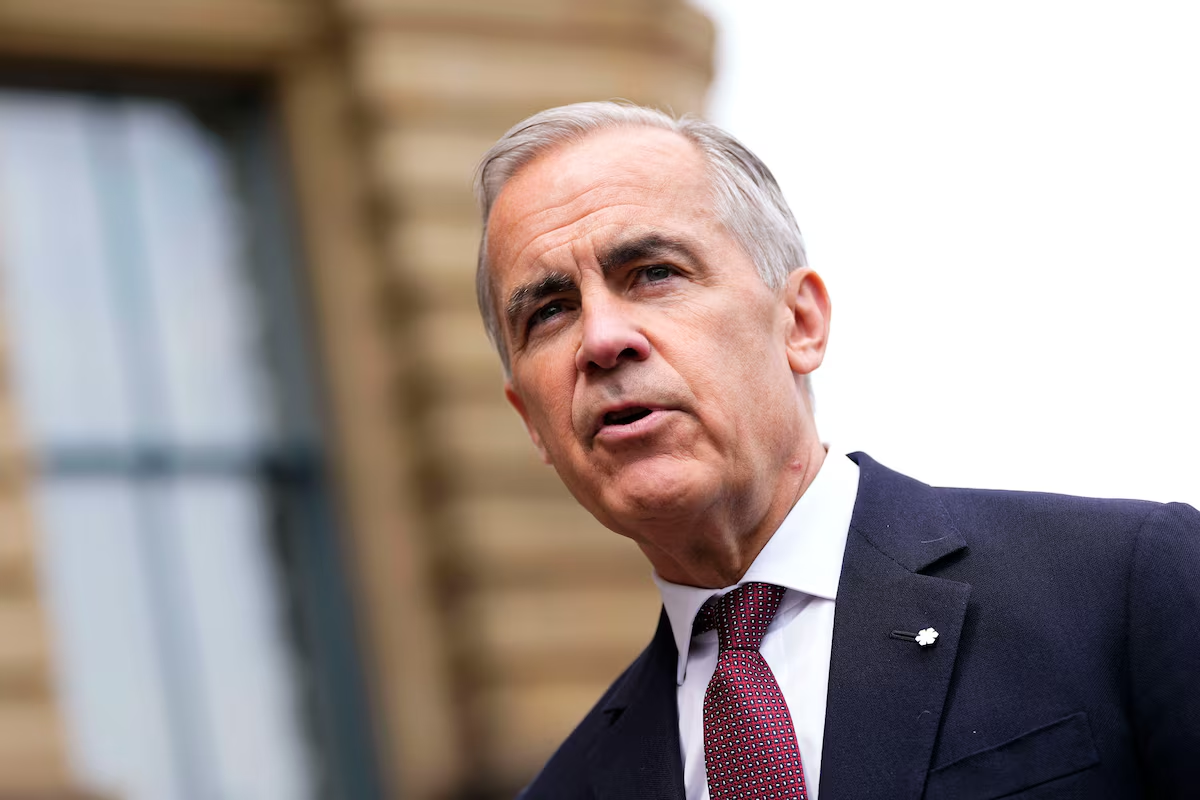
Prime Minister Mark Carney is seen outside the Office of the Prime Minister and Privy Council in Ottawa on July 21.Justin Tang/The Canadian Press
Lead the way
Re “Making concessions to get a trade deal when the public’s in a fighting mood” (Aug. 10): The role of the Prime Minister at times of crises, such as the present one, is not to please the public, but to do the right thing for Canada.
I firmly believe that Mark Carney is doing just that.
Baily Seshagiri Ottawa
It seems the current position of the United States, if it got its way, is that Canada will drop all provincial booze bans, allow unlimited access to our dairy markets, drop all tariffs on U.S. goods, ramp up military spending by purchasing U.S. jets and join the Golden Shield program at the cost of hundreds of billions of dollars.
In return, the U.S. will continue tariffs on aluminum, steel, lumber and automobiles, but at somewhat lower levels and with no guarantees they won’t be raised again at any time.
No wonder Canadians are in a fighting mood. Making these concessions would be economic suicide.
T.S. Ramsay Guelph, Ont.
My response to the critics currently piling on Mark Carney: Consider the alternative.
Ken Cory Oshawa, Ont.
Target age
Re “Canadian murder rate has biggest year-over-year decline in 40 years, Statscan says” (Aug. 10) and “The case of the misleading fall in crime rates” (The Sunday Editorial, Aug. 9): It’s worth looking at the demographics. It’s a sad fact that a disproportionate amount of crime is committed by young men between the ages of 15 and 25.
When this cohort is reduced, you should expect crime to decline. We should be looking at increasing productive occupations for young men, as well as investing more in sports and other community activities.
A system of national service is worth considering.
Julia Bass Toronto
Price check
Re “Clean up in aisle 3! Zohran Mamdani’s misguided recipe for cheaper groceries” (Report on Business, Aug. 7): The affordability crisis has been one of the dominant political issues for years, yet governments have been frequently relying on targeted subsidies, rebates and initiatives that provide relief to relatively small groups, rather than addressing the actual drivers of high costs.
What amounts to a “pilot project” of five grocery stores in New York could be the start of a change in how governments can provide meaningful relief. There are no alternate solutions offered here other than suggesting companies such as Walmart be allowed to create a “more competitive and efficient marketplace” to bring down costs for everyone. This project could create long-term price reductions by providing price competition, at least for essential goods.
Arguably, the marketplace and higher levels of government are partially to blame for this crisis, so let’s see where this goes.
Tanner Desrosiers Airdrie, Alta.
The happier countries of the world focus on the dignity of the individual and the common good. Most have, or are moving toward, universal basic services.
In addressing the societal enemies of want, disease, ignorance and squalor and also the evil of excessive inequality, housing is often the first priority followed by basic income, nutrition and access to education or counselling as required.
Mayor Zohran Mamdani is doing his best for less well-off New Yorkers. We should applaud his efforts.
Sure, society is paying for this program, but it is society – all of us – that benefits.
Michael Wiggin Ottawa
Piece of the pie
Re “Realtor fees need to come down to earth” (Editorial, Aug. 7): In Britain, the typical realtor fees range between 1 to 1.8 per cent.
There are elements in the British real estate system that are dysfunctional, but their fees are much more appropriate, especially at a time when house prices remain high by historical standards and in relation to incomes.
Richard Harris Hamilton
There is also the influence of bidding wars.
Buyers often pay thousands of dollars more than sellers are willing to accept because agents conceal bids. Not knowing what other offers have been submitted serves to drive up house prices.
There is no incentive for real estate agents to keep prices down. When home prices rise, agent commissions rise.
Section 74.05 of the Competition Act prohibits the sale or rent of a product at a price higher than its advertised price, but the law also includes exemptions that apply to agents selling on behalf of homeowners. I believe the solution to this inflationary law is to repeal Section 74.05.
If agents get more than one offer above a home’s published asking price, the law should require them to conduct a lottery to decide the winning bid.
Marc Zwelling Toronto
As a real estate broker for more than 50 years, at last retired, I could write an essay with comments about the state of affairs in my former industry. For now, may I make just one: the consolidation of smaller enterprises into large franchises.
Conglomerates setting fees has been most obvious recently in veterinary, dental and medical services. What has not been so obvious is how real estate brokerage franchises, which now dominate real estate sales, may control them.
The most common practice now is that large brokerages take a percentage of every employed salesperson’s commission. They may insist that a certain percentage be charged, with penalties to any agent who negotiates a lesser one.
I would submit this as one factor in commission rates staying high.
James Palmer Ottawa
ROI
Re “Staging my home for showings is exhausting me” (First Person, Aug. 6): As empty nesters, we realized we could not stay in the large house we had shared with our boys and pets for more than 25 years. We put it on the market, transformed into something befitting the pages of a glossy magazine, after a lengthy and emotional process of decluttering and updating.
What followed was the constant vacuuming and mopping of dog hair left behind by our two golden retrievers on new hardwood floors. The anticipation of showings, and subsequent disappointment when offers failed to materialize, was utterly exhausting. The whole experience nearly drove me insane.
It took a very long time, and it was very hard, but the right buyer finally came along. We are now enjoying retirement in a small bungalow, confident that we made the right decision.
No pain, no gain, as they say.
Lisa Simpson Ottawa
………………………………………………………………………………………………………………….
Letters to the Editor should be exclusive to The Globe and Mail. Include your name, address and daytime phone number. Keep letters to 150 words or fewer. Letters may be edited for length and clarity. To submit a letter by e-mail, click here: letters@globeandmail.com