

(Any views expressed here are the personal views of the author and should not form the basis for making investment decisions, nor be construed as a recommendation or advice to engage in investment transactions.)
Want More? Follow the Author on Instagram, LinkedIn and X
Access the Korean language version here: Naver
Subscribe to see the latest Events: Calendar
My internal dialogue in early March 2011:
What’s my costume going to be for sevens this year?
Can my body handle another back-to-back, Taiwan Spring Scream?[1]
Back to reality. I’m sitting at my desk at Deutsche Bank in Hong Kong’s ICC tower, market making a bunch of ETFs on the Hong Kong and Singapore stock exchanges. I hear someone shout across the floor that there has been a mega earthquake in Japan. Immediately, the tv’s in the office switch to a live feed from the Tokyo office, and it’s shaking. Then we turn on some news channel and witness the tsunami roll tide roll through northeast Honshu live. It’s fucking INSANE!. And to top it all off, Fukushima is smoldering. We would find out later; the nuclear fallout almost caused the evacuation of Tokyo.
The Nikkei immediately dives and is down almost 20% by mid-morning. At the same time, dollar-yen ricochets lower towards 70, the yen trades at one of the strongest levels in post-WW2 history. I fucking hate a strong yen. Last winter I discovered Niseko but it was crushingly expensive at 80 dollar-yen. It didn’t help that my boy’s girlfriend, who is a tycoon’s kid, booked all the restaurants. She had no concept of money, and we went to every tasting menu in town. I never made that mistake again. In subsequent years, I slept at the hostel and ate only ramen in bodybuilder sized quantities. Back to trading.
I’m market making a plethora of MSCI Japan ETFs priced in dollars, which means there is embedded yen exposure.[2] The yen is moving so quickly and wildly, I can’t hedge my FX fast enough. Fuck it, I’m just going to wear the long dollar-yen exposure due to my book is getting longer and longer ETFs as traders smack my bids. I remember hearing one senior trader explain that when natural disasters hit Japan, which is more frequent than other locations due to its position on the ring of fire, domestic institutions (especially insurers) rush to repatriate capital from abroad. That entails selling foreign stocks and bonds, mostly in the US – this will be important later in this essay, the yen comes home and produces a stronger currency.
The next day the Nikkei opens down again, the main fear is of Chernobyl round dos. The yen keeps strengthening. I’m making money because of my bet on the FX, and how wide I’m quoting. And then the market rebounds, I forget exactly why but things calmed down. To rebuild the country and financial markets, Prime Minister Abe launched his aptly named economic program “Abenomics” in 2012 with an explicit goal of weakening the yen by encouraging the BOJ to conduct unlimited bond purchases under its YCC (yield curve control) program, aggressive fiscal expansion, and ultimately changing the managers at the nation’s largest pension fund GPIF to increase holdings of foreign stocks and bonds over domestic securities.[3] The result which still afflicts the world today:
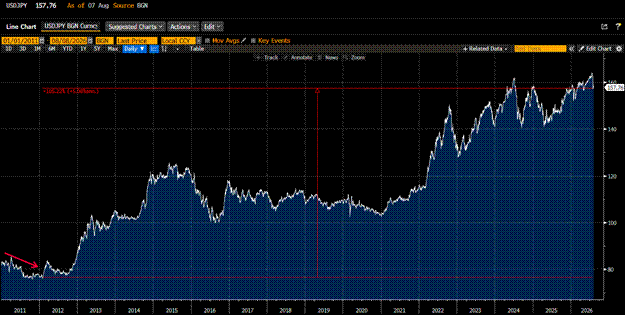
The yen lost over half its value.
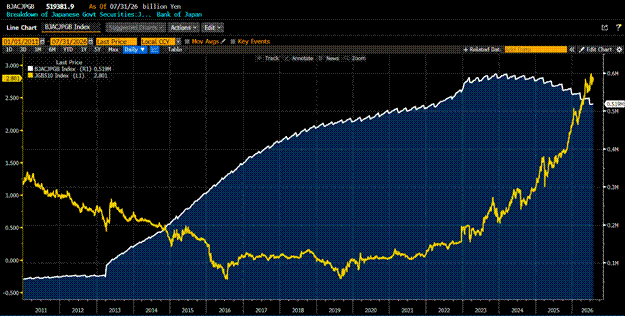
The BOJ’s holdings of government bonds (white) went vertical as it smothered the yield on the 10-year bond (gold).
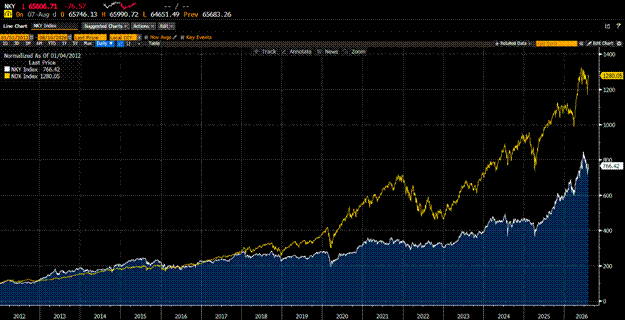
Destroying the international purchasing power of the yen was a resounding success for global asset markets as yen became the de facto funding currency for corporates and speculators. However, there are consequences. One being that the populace is seething with rage. There is no outright connection, but when you destroy the dignity of work by perverting the currency, strange things happen. Japanese people are docile and obedient based on their outward behavior. But in 2022 an attacker wielding a homemade gun murdered the same Prime Minister, Abe, who kicked off the yen depreciation jamboree, in cold blood at a campaign rally. The fuck around and find out inflation edition.
Destroying a currency also creates xenophobia. Last ski season at a resort where we like to ski in the back bowls off-piste, some Japanese yahoo chirped at me about how I wasn’t supposed to skin on the resort without purchasing a lift pass. As a backcountry guide, who didn’t actually work at the resort, he obviously didn’t know the rules because the huge sign board posted in the lodge explicitly allowed us to skin off the resort without purchasing a lift pass, and when I got in his face he started spewing some nonsense about how all the foreigners brought trouble to the ski fields in Japan. He didn’t realize that the resort was actually owned by a Chinese conglomerate … talk about irony in Japan. He was angry at the explosion of foreigners skiing in Japan, and I saw it too. There were more Americans than Chinese in Hokkaido sampling the succulent Jay pow because at 160 dollar-yen skiing in Japan, even after paying for an international flight, was more than half off what it would cost at a North American ski resort. My favorite ski volcano, which is powder heaven and in past seasons was always empty, to my chagrin was positively rammo last season. But don’t you worry, I got some secret pow stashes up my sleeve …
While a weak, weaker, and weakest yen propelled global asset markets higher over the past decade, like all good things for wealthy financial asset holders, it must end. The yen is the most undervalued currency globally, and it is a bone of contention for both major powers, the US and China, and critically, the ordinary Japanese voters. There are three ways to cut the yen Gordian knot, but the US Treasury and Japanese politicians prefer only one.
I will explain the mechanics of each method to strengthen the yen and then conclude with why the final one is the preferred option. Then I will talk about politically how to execute the third option. Finally, which is why you read my human slop, I will detail why Bitcoin and crypto will moon as dollar liquidity surges higher.
The three options:
-
The BOJ raises rates aggressively so that the dollar-yen interest rate differential, at least at the short end, evaporates.
-
The government cajoles domestic and public institutions like the GPIF to change their investment mandate to sell foreign and buy local assets.
-
[PREFERRED OPTION] The MOF repos its holdings of US treasuries to the Fed in exchange for dollars. Then sells dollars to purchase yen in the forex market.
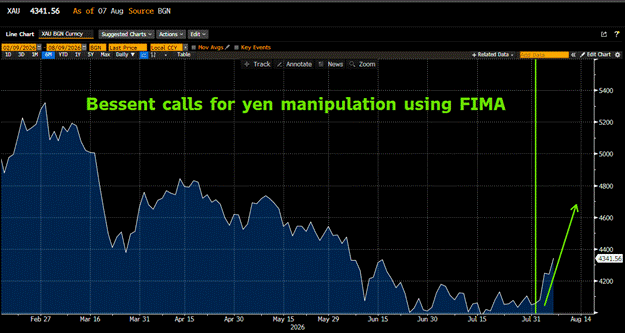
Before I get into the details, degens should ask themselves why talk about the yen strengthening now. So many folks over the previous decades proclaimed now is the time that the yen must strengthen and unwind the global carry trade. Two weeks ago, the US and Japan’s monetary mandarins carried out a joint currency manipulation, euphemistically called an intervention. Collusion and conspiracy confer different nomenclature when you are a plebe versus the state. US Treasury secretary Buffalo Bill Bessent proclaimed he wants the Fed to raise the FIMA Repo Facility’s counterparty limit so that the MOF can use its massive stash of assets to defend the yen.[4] The MOF also proclaimed that it is working hand in hand with the Americans to slam dollar-yen lower.[5] The authorities are telling us they are on board with a change in global currency relations; therefore, we must listen.
The Terrible Two Step
Options one and two are non-starters because the loser cannot accept the political and economic consequences of a change in policy from the 2010s.
Option One: The BOJ Raises Rates
Currencies trade on interest rate differentials, and dollars yield 2.75% more than yen. Borrowing yen, exchanging them for dollars, and buying a T-bill has positive carry.[6] Therefore, the no-arbitrage principle states that the dollar-yen exchange rate must rise, meaning the yen weakens vs. the dollar, to compensate for this interest rate differential. The easiest way to cause the yen to strengthen versus the dollar is for the BOJ to raise rates to match the levels of every other major central bank that hiked rates coming out of the COVID pandemic.
To understand the problem with raising rates for the BOJ, remember that the BOJ is the largest holder of dog-shit JGBs because of over a decade of YCC where they capped yields on the 10-year JGB by printing yen to buy bonds. What happens when rates rise? Bond prices fall. The lower bond prices fall, the larger the BOJ’s unrealized loss. Unlike you readers, the BOJ can lose an infinite amount of yen because it can print them at will. However, at a certain point, the world loses confidence in the yen as a currency because of the massive BOJ money printing and will no longer accept yen for oil, food, medicine, etc. We aren’t there yet, but the BOJ must acknowledge that potential disastrous future state. This fear of recognizing the loss on their balance sheet causes them to dither and conduct only minor interest rate raises while watching the market sell off the long-end of the JGB curve, anyway. The yen still weakens, and imported energy inflation destroys the fabric of society.
The politicians don’t want the BOJ to raise rates because they must fund the deficit with JGB borrowing. If yields rise, debt service costs rise, which hampers their ability to bribe the plebes with this or that government handout, which typically takes the form of consumption tax cuts.
Finally, if the BOJ quickly raises rates and the yen strengthens, causing a rise in dollar-yen volatility, it will force anyone who financed global stocks and or bonds with yen to cover their positions. Remember July 2024 when the yen suddenly strengthened from 160 to 140 over a few trading days. I wrote two essays on the topics entitled Spirited Away (6 August 2024) and Water, Water, Everywhere (12 August). They are great in-depth primers on the issues at hand but described in much more detail than I will provide in this essay. In short, newly appointed BOJ governor Ueda-domo surprised the market with a hike and promised more to come. The market freaked out, and speculators who were short yen and long other financial assets covered their positions. There were rumors at the time of several hedge fund pod PMs getting the tap on the shoulder. In a similar way to how Kenny G deaded Leopold, but unlike Leopold, when you work for one of these masters of the universe, the tap on the shoulder is a corporate death sentence. The yen hit 140, the Nasdaq 100 and Nikkei dropped +10%. The BOJ panicked, and by August 12th, announced they would take “market conditions” into consideration when evaluating their path of future rate hikes, which meant future rate hikes were off the table. Following the announcement, the yen weakened, and stonks bottomed and resumed Up Only!
The BOJ has no stomach for acute market stress because of an accelerated pace of interest rate normalization versus their other major central banking peers.
Option Two: Japan Inc. Sells Foreign Assets to Repatriate Yen
I define Japan Inc. as the corporate and public sectors that own financial assets. There is an interesting anecdote in “The House of Nomura: The Inside Story of the Legendary Japanese Financial Dynasty” by Albert J. Alletzhauser, which describes a directive by the MOF to Nomura to buy US stocks after the 1987 crash to prop up the market. Nomura, as a private company, had no obligation to follow this directive, but Japan is a conformist society that does things together. Many times, shareholder returns are not the highest goal of a corporation but full employment and the glory of the nation, however that is defined. If the government suggests that private companies and individuals should dump foreign assets, which are mostly US stocks and bonds, sell the dollar proceeds, buy yen, and repatriate that money, Japan Inc. will follow orders.
The clearest way to signal that it is time to bring the money back home is the actions of the nation’s largest pension fund, GPIF. A board of bureaucrats, appointed by various government ministries, rules GPIF. In 2014, to bolster his Abenomics money-printing orgy, the Prime Minister endeavored over many years to replace the GPIF governors such that they would vote to increase the allocation of foreign stocks and bonds in its portfolio. This is a big deal because the GPIF manages a $1 to $2 trillion portfolio. When their mandate changed in October 2014, it set in motion an unstoppable train whereby they exchanged yen for dollars and bought US stocks and bonds. This created a structural yen seller, which then comforted speculators to finance any financial asset in cheap yen, and had no fear of it being stronger when it came time to roll or repay their loan.
I brought up the impact of GPIF because Katayama-domo, head of the MOF, recently proclaimed that in his opinion it’s time for the GPIF’s mandate to change such that they favor domestic over foreign securities. The GPIF paper pushers disagree and stated publicly that they will follow what’s best for their policyholders. Obviously, given they are Abenomics adherents, they would not be in favor of changing the mandate to favor Japanese securities. In the same way Abe stacked the deck between 2012 and 2014, Prime Minister Takaichi must do the same. For us investors, the signpost is clear: the GPIF’s mandate will change and force the sale of hundreds of billions of dollars’ worth of foreign securities, and the repatriation of that capital will strengthen the yen. This will take years to occur, but it is worrying for Buffalo Bill Bessent because it means that Japan Inc. as one of the largest holders of US securities, will switch from a buyer to seller. It will destroy the stock and treasury markets that Pax Americana depends on to finance its profligate empire. And because Pax Americana underwrites Japan’s national security, for this reason, Japan Inc. cannot sell its US assets.
Nothing I have just written is new information. Everyone acknowledges the yen’s cheapness. Both the US and Japan want the dollar to strengthen against the yen. But neither side can stomach the loss should dollar-yen go from 160 to 90 (fairly valued according to purchasing power parity). Option three was green-lit the moment Trump’s buddy Warsh the Weasel (he kinda looks like one, right? He surely is duplicitous like one…) became Fed chairperson. The Treasury-Fed Accord of 2026 is alive and well; besides directly financing Bessent’s issue of T-bills using the RMP and below nominal growth policy rates, Warsh has the power to effectuate option three and once and for all put dollar-yen at the level needed to rebalance the global economic system.[7]
Option Three: Boxes and Arrows Bitches
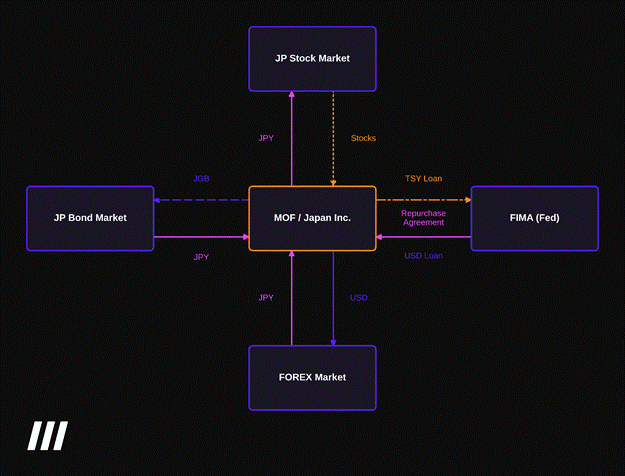
When Buffalo Bill Bessent speaks, listen the fuck up lest you get dat hose again. And don’t let him hear no back talk neither!
Bessent laid it out in plain fucking English that the MOF and Japan Inc. should not sell US securities to generate the funds need to pump the yen, but they should repo their treasury holdings at the Fed using the FIMA program, get a dollar loan, and use said dollars to buy yen. I’ll come back to the one hiccup in his plan later, but that is what the above boxes and arrows represent.
Let’s go through the flow again:
-
MOF repos a treasury security and receives a dollar loan from the FIMA program at the Fed.
-
MOF sells dollars and buys yen in the global forex market.
-
MOF reinvests the yen domestically by purchasing JGBs and stocks.
The major implications of this policy:
-
The Fed prints money to create the dollars provided through FIMA. Its balance sheet will grow in lockstep with the national of FIMA repos outstanding.
-
Dollar-yen exchange rate falls, which means the yen strengthens.
-
Japanese bond yields dropped because of yen bond purchases.
-
Japanese stocks rose because of yen stock purchases.
Who is the sucker?
-
Japan owes the American taxpayer money, which for political reasons will never be repaid. This is pure money printing, which will cause financial and goods inflation. America cannot force its forward staging base against China and Russia in the Asia Pacific theatre to pay back this loan and impair its ability to remilitarize.
-
Anyone short yen. They must cover immediately once the direction of travel is clear. This isn’t too big a problem because USDJPY vol will fall and allow an orderly unwind of the yen carry trade over many years.
Why hasn’t this already happened?
As it stands, the FIMA facility has a per-counterparty outstanding loan cap of $60 billion. The Treasury and MOF splunked over $100 billion in the most recent dollar-yen manipulation caper and only pushed the yen higher by 5% with a half-life of a few trading days. To use the FIMA facility, the cap needs to be removed entirely, and the number of eligible counterparties increased to include large Japanese corporate and quasi-public investment vehicles like the GPIF. Who administers the FIMA facility?
During the COVID pandemic hoax, the FOMC delegated the authority to change the contours of the FIMA program to the Foreign Currency Subcommittee. The voting members are Warsh (FOMC Chair), Williams (FOMC Vice Chair and NY Fed President), and Jefferson (Board of Governors Vice Chair). Convening the committee happens whenever they see fit. There are no minutes or voting roles published. We just hear about the outcome of their decisions. Will the committee do Bessent’s bidding?
Absolutely. Trump and Warsh regularly speak. Given that Bessent laid out exactly what he needs to rebalance the global economy vis-à-vis the dollar-yen exchange rate, Trump is definitely on board. So, Trump and Bessent will inform Warsh of his marching orders. Warsh already proved he is a weasel and a paper tiger. The balance sheet continues to expand by the RMP, which William’s NY Fed Branch administers. The market, which Warsh said he listens to when deciding policy, clearly demands a rate hike because the two-year yield is over 0.5% above the effective fed funds rate; but Warsh refused to hike at the July meeting. Instead of immediate sweeping and dramatic change to how the Fed operates, Warsh created five task forces to opine on how and why the Fed should change. Godot shall appear before these task forces publish any recommendations. Therefore, Warsh in a brief span of time, definitely proved he is just another party hack and will do what his boss requires. Just like his predecessor, beta cuck towel bitch boy Powell, and his predecessor Grandma Garden Gnome Yellen (she became a Bad Gurl once promoted to Treasury secretary).
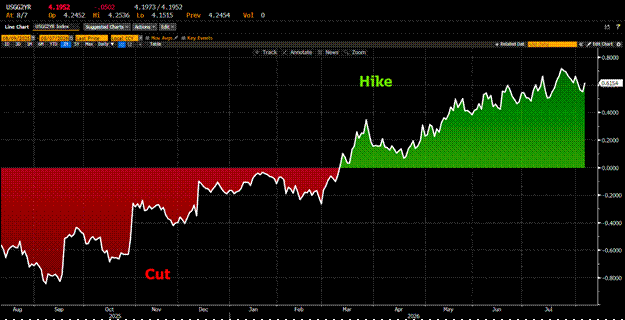
2-year treasury yields minus the effective fed funds rate
I don’t know when Warsh will call the subcommittee and announce changes to the FIMA program that allow the unfettered money printing to manipulate the dollar-yen rate lower. But I wouldn’t bet against it happening. In fact, I’m betting it will happen and continue to increase our exposure to instruments that will reveal the impact of a resumption of massive Fed balance sheet growth. Those assets are Bitcoin, physical gold, and gold miners.
How Big?
The more they print, the higher Bitcoin goes. Therefore, is this whole FIMA ruse enough of a spigot to shove trillions of dollars’ worth of wampum through and pump our bags?
Right now, we only care about holdings of treasuries because they are the only type of FIMA-eligible collateral. That might change in the future, but let’s stick to the assets currently allowed in the facility. The two largest entities that hold treasuries are the Japanese government and the GPIF.
Japanese Government US Treasury Holdings: $1.143 trillion
GPIF US Treasury Holdings: $230 billion
Total: $1.373 trillion
That’s not a bad haul. To put this into context, during COVID the Fed printed ~$4 trillion, as evidenced by the rise in the size of its balance sheet from 2020 to the end of 2021.
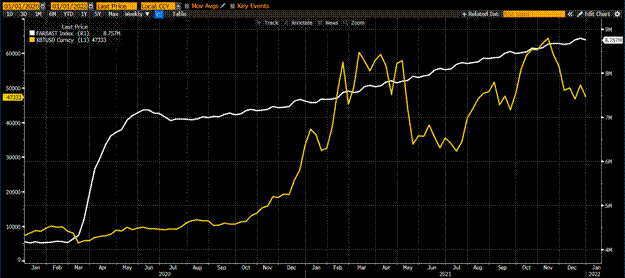
There is a very clear linkage between the growth in the Fed’s balance sheet (white) and Bitcoin’s price pump (gold). In my previous essay, I hypothesized the AI build out is entering the capital wastage phase. This is important because the Trump administration wants this liquidity to fuel AI CAPEX spending in America, not pump crypto. But I argue that handing credit to AI companies now that cannot earn a positive return on capital, show me a hyperscaler that actually makes money on the capital spent or a US AI lab that can earn money at the China price of tokens, is wasteful and Bitcoin’s price rise will reflect this unproductive use of capital. The recent spike off the local lows in gold tells me the market would rather funnel the approaching dollar fiat tsunami into monetary financial assets rather than hand money to Sam Altman’s money incinerator Open AI or Elon’s mythical space data centers.
Shitcoin Season
I know y’all just want to know what we are doing at Maelstrom. But the context matters to determine conviction. As I stated above, when Buffalo Bill Bessent speaks, I listen. If there is anything he knows how to do, it is to manipulate a currency. Just google his illustrious career with George Soros, the man who broke the Bank of England in the GBP forex markets. The decision to implement this monetary chicanery doesn’t require any approval from a popularly elected politician or someone whose appointed term is up for renewal and thus faces a public senate confirmation hearing. All that is required is to convene the sleepy Foreign Currency Subcommittee to change the rules of the game and produce a gusher of printed dollars.
When I read the headline about Bessent’s call for the FIMA program’s reform, I immediately got that bullish feeling. Every one of the macro analysts I follow believes this heralds a momentous change in the dollar-yen’s direction. You must pre-position because they ain’t fucking around. Money printing is a political decision to solve an untenable economic reality. Politics is very messy, but in this case the Trump administration wants you to log in to your online broker and buy financial assets. That is why Bessent is clearly telegraphing to all who will listen exactly from where the printed money shall metastasize. I’m listening, and will do my duty … buy financial assets.
We are already long as fuck Bitcoin, so the next question is: what is the fastest horse? This isn’t an AI stonk investment blog, but if that’s your jam, bang that Geronimo’s drum harder. The Leopold low gave you an excellent entry into all things AI. Turning to crypto, the large cap sleeper is Ether. The narrative is the one major shitcoin that didn’t eclipse its all-time high in 2025; in addition, Ethereum will be the security layer for RWAs. That fucks.
Next up is a down-and-out shitter that can do an easy 5-10x. That is Ethena (symbol: $ENA). The one issue with Ethena is the lack of buy-backs; however, I’m willing to overlook that because it still is the 6th largest stablecoin by dollar units in circulation. The problem with $ENA is that the lack of Bitcoin basis yield because of a falling price means that the yield to hold USDe is barely higher than a T-bill. It makes no sense to take CEX counterparty risk and smart contract risk holding your synthetic dollars in staked USDe. That is why the circulating supply is down 75% from the highs and the $ENA token price is down over 90%. Even a modest dollar liquidity growth enabled Bitcoin pump will shock the basis yield higher and lead to massive inflows into USDe. It won’t take much to levitate $ENA out of the doldrums, and that’s why it’s cheeky pick for a quick 5x over the next few months.
I have not backed up the truck yet and taken our dollar balances down to minimal levels. We must wait for Warsh to convene the subcommittee and change the FIMA rules. Be on the lookout; it might happen when no one is looking. But gold and dollar-yen should begin moving before the announced changes. If for no other reason than someone with a big stack connected to the Trump administration front runs the announcement. It’s happened in every other asset class, why not in gold and forex.
The days of cheap yen are over. Hip Hip Hooray. There were too many gaijins for my liking trampling over my traverses in the magical volcanoes of Hokkaido. And to all you snowboarders, go fuck yourselves, get a split board when you come in the backcountry.
Want More? Follow the Author on Instagram, LinkedIn and X
Access the Korean language version here: Naver
Subscribe to see the latest Events: Calendar
[1] This is the best under the radar music festival in Asia. I fucking love Taiwan.
[2] Long ETF = Short USD, long JPY; Short ETF = Long USD, short JPY
[3] BOJ – Bank of Japan; GPIF – Government Pension Investment Fund
[4] FIMA – Foreign and International Monetary Authorities
[5] MOF – Ministry of Finance (Japan)
[6] A T-bill is a treasury with a maturity of less than one year.
[7] RMP – Reserve Management Purchases aka money printing