Who will win La Liga in 2026-27? Who will secure Champions League football? And who will suffer relegation? We answer all the key questions with our La Liga 2026-27 season predictions via the Opta supercomputer.
Top-flight football returns this weekend as La Liga 2026-27 gets under way.
Barcelona go into the campaign as reigning champions, but a familiar nemesis has taken over their rivals Real Madrid in a move that will surely add even more spice to Clásico battles and their inevitable title tussle.
Meanwhile, three familiar clubs are back in Spain’s top tier following lengthy absences that have seen all three drop as low as the third level of Spanish football.
But how do we see the title battle, Champions League race and relegation scrap all panning out? Well, we asked the Opta supercomputer to simulate the season 10,000 times; here are its results…
The Title Battle
Will Barcelona make it three league titles on the bounce? The Opta supercomputer certainly thinks they will.
The Blaugrana took full advantage of Madrid’s rather chaotic 2025-26 campaign to successfully defend their crown, doing so in the ideal manner as well.
Barcelona beat Real Madrid 2-0 in El Clásico at Camp Nou on 10 May to secure the title with three matches to spare, ultimately finishing eight points clear of their bitter rivals to be crowned Spanish champions for the 29th time.
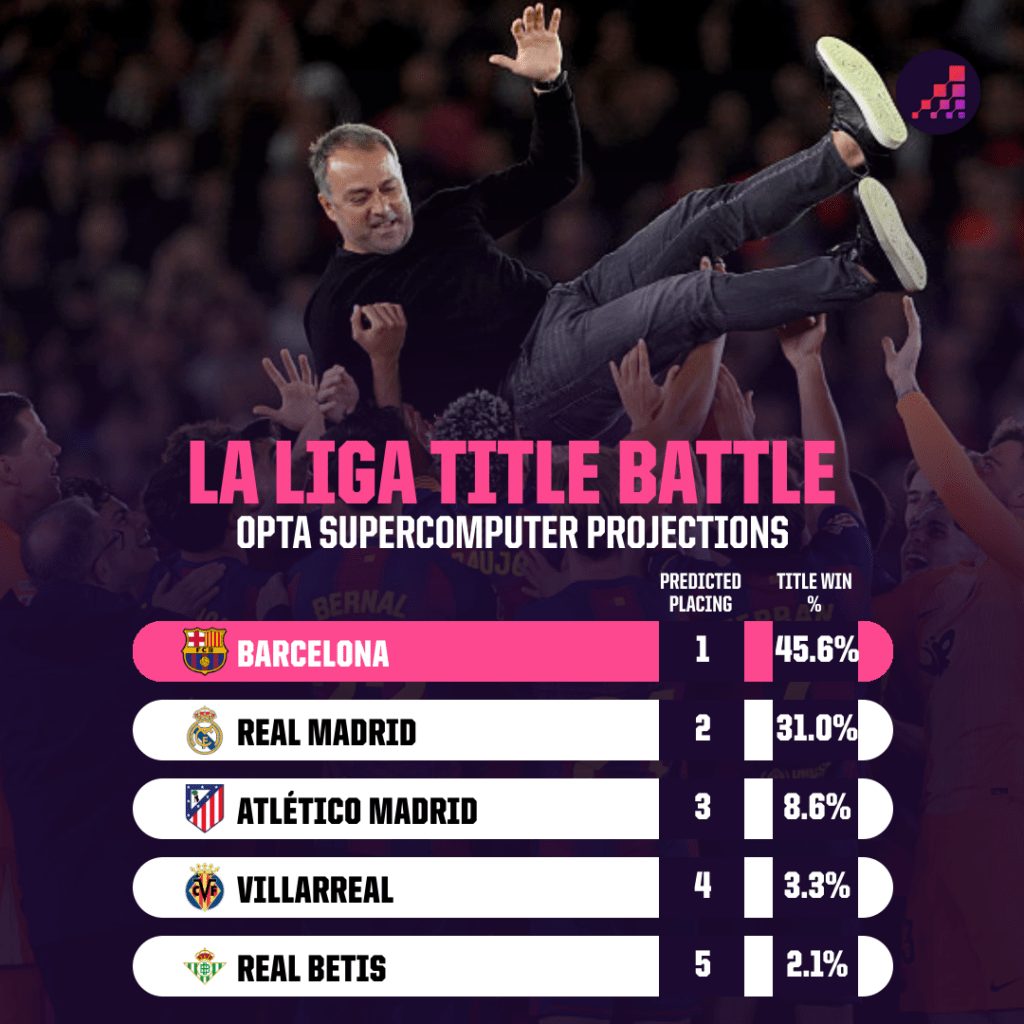
Making it three on the bounce in 2026-27 would of course give Barcelona their 30th La Liga title as they continue to chase down Los Blancos’ 36, and they managed it in 45.6% of the supercomputer’s 10,000 season simulations.
Real Madrid have been working hard to put things right this summer. Having plumped for the hot new thing in Xabi Alonso last year, this time around they’ve gone the more “tried and trusted” direction after hiring José Mourinho for a second stint in charge.
The Portuguese coach is a managerial titan but has been away from the very top of the game for a little while, with his last three roles being at Roma, Fenerbache and Benfica. While big clubs in their own regard, Real Madrid are in another league (literally and figuratively).
But the hope, presumably, is that someone as experienced as Mourinho will be able to command the big egos in the Madrid changing room and won’t try to implement anything revolutionary from a playing-style perspective. His pragmatism might ultimately be a better fit for the team’s superstars.
There were several reported flashpoints internally at the club last season, and so it’s understandable that decision makers felt it necessary to hire an authoritative and highly respected coach rather than someone known for being a tactical whiz. This approach worked for Madrid under Carlo Ancelotti; might the ‘Special One’ have a comparable impact?
Well, it’s certainly not incomprehensible. In the Opta supercomputer’s simulations, Madrid did win the title 31.0% of the time.
Barcelona will probably have as much of a say in that as Mourinho himself, though.
They strolled to the title last season, and may even be about to add Rodri to their ranks. While his best hasn’t been seen at club level since returning from his 2024 ACL injury, he deservedly won the Golden Ball award for the best player at this summer’s World Cup after guiding Spain to success.
He’s the closest thing football has produced to prime Sergio Busquets, and it seems Barcelona will be installing him into the heart of Hansi Flick’s midfield after he reportedly decided to prioritise their interest over that of Real Madrid.
The supercomputer’s figures can’t take players transfers into account, but many will find it difficult to look beyond Barcelona if they do get Rodri through the door.
No other team even won the title 10% of the time in the supercomputer’s sims.
The Champions League Race
We are probably quite safe to assume two of the Champions League spots will be taken up by Barcelona and Real Madrid, each of whom finished in the top four in over 81% of the latest simulations – and that is before you consider the possibility of fifth again providing a route into the UCL.
Unsurprisingly, Atlético Madrid qualified for the Champions League via a top-four finish in the next most sims, doing so in 48.6%. After all, they’ve not finished outside the top four since 2011-12.
After that, the picture is far less clear.

The supercomputer does favour Villarreal (29.5%) and Real Betis (23.0%), both of whom will be in the Champions League this term thanks to their third- and fifth-place finishes, respectively, last season.
However, it’s worth noting that Villarreal will be undergoing something of a transition. The Yellow Submarine saw Marcelino depart at the end of 2025-26, and although his successor, Iñigo Pérez, is extremely well regarded in Spain after doing a stellar job with Rayo Vallecano, there’s no guarantee everything goes smoothly.
As for Betis, they’ve not competed in the Champions League since 2004-05; how they’ll cope with balancing a league campaign and a UCL adventure is anyone’s guess.
There are then five teams given at least a 10% likelihood of qualifying for the Champions League via a top-four finish.
Valencia (17.7%) are next, perhaps surprisingly to some. Since coming fourth in 2018-19, they have alternated between ninth-place and bottom-half finishes every season; in 2025-26, they came ninth, so according to that sequence they are set to finish in the bottom half in 2026-27 – but perhaps that’s a trend they can finally break.
After them come Rayo Vallecano (16.7%), who of course reached the 2025-26 UEFA Conference League final, losing 1-0 to Crystal Palace. But as alluded to before, they did lose their coach, Pérez, to Villarreal over the summer, and there’s currently some uncertainty about where they’ll be playing their home matches.
Last month, local authorities in Madrid provisionally suspended Rayo’s tenancy at their Vallecas stadium after an audit yielded “disheartening results regarding stadium maintenance”. While initial talk of the stadium being closed for two to six months (a situation that the club’s president thinks would doom them to relegation) seems to have cooled after Rayo opened the stadium to allow for a clean-up operation to begin, it also appears unlikely Vallecas will be able to host their first home game of the season on 20 August because of those issues and concerns relating to the pitch’s condition.
Any time away from the stadium will surely impact Rayo’s ability to pick up points, but the supercomputer won’t have been able to take this into account.
In reality, the likes of Celta Vigo (16.7%), who finished sixth last season, Athletic Club (11.7%) and Real Sociedad (10.9%) might have more realistic European hopes than Rayo when looking beyond data-led simulations.
The Relegation Battle
The relegation battle has been tense in each of the past two La Liga seasons. In 2024-25, five teams finished no more than two points clear of the bottom three; in 2025-26, 13th-placed Sevilla finished just one point clear of Mallorca in the last relegation spot.
Mallorca went down despite accumulating 42 points; only once before in a 38-game La Liga season had a team been relegated with more points than that (excluding teams relegated via a play-off).
It’s obviously a bit early to suggest we’ll see a repeat of that, but a third tight relegation battle in a row wouldn’t be surprising given what the past two campaigns have produced.
And the Opta supercomputer thinks there could be a high-profile casualty.
Sevilla were embroiled in each of the last two relegation dogfights. In 2024-25, they survived by the skin of their teeth with 41 points, ahead of Leganés on 40. Had Leganés beaten Sevilla at the Ramón Sánchez-Pizjuán on MD34 of that season, and they should have, they would’ve swapped places.
Sevilla then appeared to be sleepwalking towards relegation in the second half of last season, but a run of four wins in six matches from 11 April onwards meant they could just about afford to lose their final two matches.
The supercomputer thinks they might not escape this time, however. They were relegated in 27.7% of the simulations, making them the third-likeliest team to go down. When you also consider their immense financial problems (they had the second-lowest La Liga salary limit as of the most recent data in March 2026), turmoil at board level and the fact they may have to promote a significant number of youngsters from their B team, who were relegated (to the fourth tier) last term, their outlook is even bleaker.

One club who know all about bleak outlooks following golden periods are Deportivo La Coruña – or Deportivo A Coruña as they are now known in reference to the city’s name in the local Galician language.
Deportivo are back in La Liga for the first time since 2017-18. Since then they’ve even spent four years in the third tier of Spanish football.
They earned promotion last season thanks to a second-place finish in the Segunda, or La Liga 2, though they are the supercomputer’s favourites for relegation, going down in 29.2% of the sims.
Depor finished behind Segunda champions Racing Santander, who’d been absent from the top flight for even longer.
Racing last played La Liga football in 2011-12. The season after that they were relegated again to the third tier.
In fact, since Racing’s relegation from La Liga 14 years ago, they’ve spent as much time in the third tier (seven seasons) as in the Segunda (seven seasons).
The supercomputer considers Racing (26.9%) to be slightly less likely to go down than Sevilla, Depor and Elche (28.4%). But the fact they are deemed the fourth likeliest to suffer relegation means they are expected to be in a bit of a scrap.
Málaga were the third and final team to earn promotion, going up thanks to success over Almería in the play-offs. They have also ended a long top-flight absence, having last played in La Liga when suffering relegation alongside Depor in 2017-18. They were playing third-tier football as recently as 2023-24.
In the supercomputer’s simulations, Málaga went down the least often out of the three promoted teams (25.3%). Espanyol (26.5%) also suffered relegation slightly more frequently that Los Boquerones.
Every team won the title at least 140 times out of the 10,000 simulations, though. So yes, we are saying there’s a chance…
Enjoy this? Add Opta Analyst as a preferred source by clicking here.
Subscribe to our football newsletter to receive exclusive weekly content. You should also follow our social accounts over on X, Instagram, TikTok and Facebook.