One of the key reasons smartwatches are making traditional watches obsolete is their accuracy, as they constantly synchronize with atomic clocks. Currently deployed atomic clocks using cesium atoms to absorb microwaves can measure time accurately to within one second over a 300-million-year period. However, recently announced discoveries by Chinese scientists may make that level of precision obsolete. The Chinese scientists are using atomic clock technology that is able to run for 30 billion years with only one second of deviation. This means the Chinese technology could run 100 times longer than the technology using cesium atoms while matching its accuracy. Considering the universe is estimated to be 13.8 billion years old, the Chinese technology’s expected accuracy is beyond impressive.
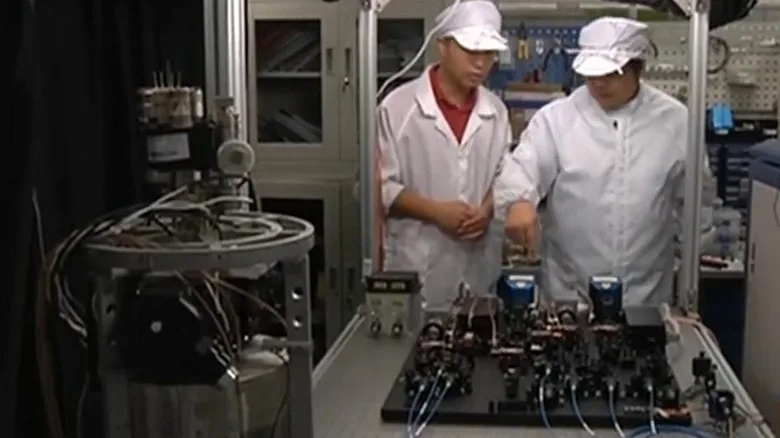
Creating precise timekeeping is a complicated process that has relied on atomic clocks since the 1960s, technology that measures the quantum characteristics of the nuclei of atoms. The researchers at the University of Science and Technology of China are pushing the precision of timekeeping forward by creating a device that uses 19 decimal places to accurately measure fractions of a second. They’re using a device called a strontium optical lattice clock to measure time, which many researchers believe represents the best path forward for the next major step in accurate time measurement. The technology uses lasers to create a lattice that traps strontium atoms in a vacuum while cooling them to a temperature near absolute zero.
Read more: How Long Should You Use The Same Towel Before Washing It?
How the ultra-precise atomic clock could redefine a second
Hi China CCTV News / YouTube
The Chinese technology, which was detailed in a paper published in Metrologia, uses the same basic principles as other optical clocks by measuring the amount of light emitted as electrons transition from one state of energy to another, but it uses strontium atoms and lasers. The researchers use a stable laser light that forces the electrons to move from one state to another. The transition occurs 430 trillion times per second, which allows for the precise measurement of time. The electrons move from high to low energy states (and back) when the laser strikes them, which creates a highly stable system for measuring time to within 19 decimal places. The older microwave laser atomic clock using cesium atoms caused about 9.19 billion transitions per second, which is far less accurate (but still better than your Casio).
Advertisement
Advertisement
To create it, the researchers dropped temperature of the strontium atoms to near absolute zero using a 657 nanometer laser. The researchers the use intersecting 1560 nanometer laser beams to place the near motionless atoms in an optical lattice that can hold thousands of strontium atoms in place in a vacuum. Using a lattice and keeping the atoms at low temperatures reduces instability and improves signal-to-noise ratios required to accurately measure time. With more precise time measurements, the Consultative Committee for Time and Frequency (CCTF) is hoping to redefine the definition of one second by 2030 to reflect the improved accuracy.
Applications that the new ultra-precise clock could serve
The CCTF is prepared to redefine the measurement of a second because using the older clock designs based on cesium atoms limits the accuracy of measurements and may limit scientific and technological advancements. Advanced precision in measuring time is important for managing low-orbit satellites, as their navigation relies on precise time measurements. Time and navigation work together to ensure satellites are in the exact position expected. Eventually, the ultra-precise atomic clock could be used in the search for dark matter in the universe by aiding in the detection of gravitational waves.
On Earth, the ultra-precise clock design may enable highly accurate measurements of changes in groundwater and volcanic activity. It could help with geoid mapping, which is the process of measuring items below the Earth’s surface, such as the location of earthquake origins. It should improve the results gained in physics research and the study of general relativity, as well. GPS technology used in helping the environment can benefit from even more accurate atomic clocks. Using ultra-precise measurements of time could even lead to advantages in national defense.
The same technologies behind the development of the ultra-precise clock may have applications in quantum computing. The ability to trap the atoms in a lattice and greatly limit their movement that’s been shown with the new atomic clock design can potentially be used to perform computations with a quantum computer.
Advertisement
Advertisement
Enjoyed this article? Sign up to BGR’s free newsletter and add us as a preferred search source or follow us on Google for the latest in tech and entertainment, plus tips and advice you’ll actually use.
Read the original article on BGR.