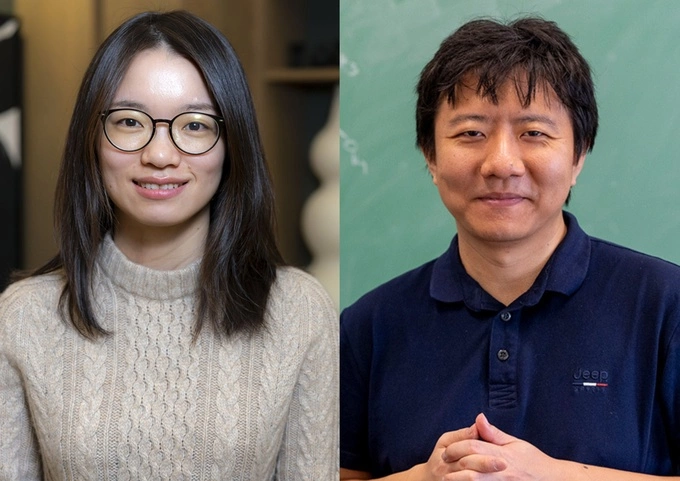
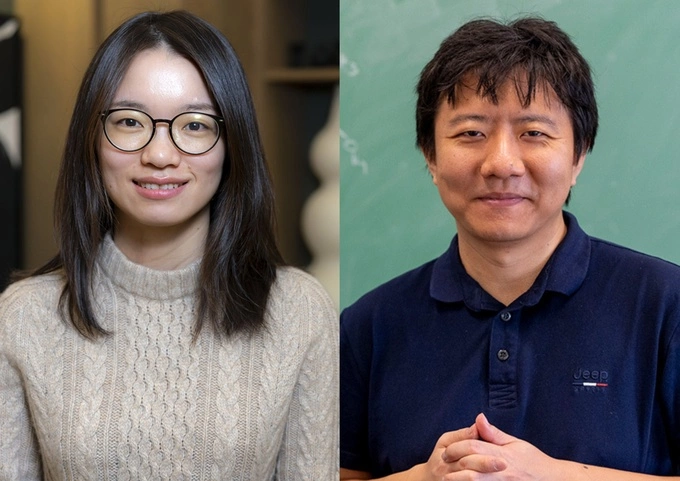
Chinese mathematicians Wang Hong, 35, and Yu Deng, 37, became the first Chinese nationals to receive the Fields Medal, widely regarded as mathematics’ highest honor, at the International Congress of Mathematicians in Philadelphia, Pennsylvania, on July 23.
Their success reflects a broader rise of Chinese talent across mathematics, artificial intelligence and biomedical science. Chinese academics say the trend has been decades in the making, supported by sustained investment in education, talent development and fundamental research.
 |
|
Chinese mathematician Hong Wang and Yu Deng. Photo courtesy of IMU |
Both Wang and Deng began their academic careers at Peking University’s School of Mathematical Sciences before continuing graduate studies at leading U.S. universities.
Wang earned her doctorate at the Massachusetts Institute of Technology and now holds professorships at New York University and France’s Institute of Advanced Scientific Studies. Deng completed his PhD at Princeton University and is now a professor at the University of Chicago.
Tian Gang, director of Peking University’s Beijing International Center for Mathematical Research, said Wang and Deng’s foundational education and undergraduate training in China laid the groundwork for the landmark achievements they later made overseas.
“Their breakthroughs reflect the growing strength of China’s maths education system, not just personal success,” the South China Morning Post quoted Tian as saying. “The emergence of talent is not a sudden spike but the result of a long‑nurtured training ecosystem.”
According to Tian, that talent pipeline stretches back more than two decades through successive generations of mathematicians at Peking University and other leading institutions.
Mathematician Cai Tianxin, a distinguished professor at Zhejiang University, said China’s mathematics research has steadily narrowed the gap with the West. Cai added that today’s researchers have benefited from opportunities to study under leading mathematicians in Europe and the U.S. before returning to increasingly competitive research environments in China.
“The difference today is that maths research at China’s leading universities is approaching world-class standards, with compensation and facilities that rival those of top Western institutions,” he said.
The progress is also reflected in international rankings. In the latest U.S. News Best Global Universities subject rankings, Peking University ranked sixth worldwide for mathematics, while Tsinghua University placed 12th in the latest QS World University Rankings by Subject.
The same pattern is evident in China’s rapidly expanding AI sector.
Moonshot AI founder Yang Zhilin, 34, graduated from Tsinghua University before earning his doctorate at Carnegie Mellon University in the U.S. Rather than remain in Silicon Valley, he returned to China to co-found Moonshot AI, whose open-source Kimi K3 model drew international attention after achieving performance comparable to leading global AI systems.
DeepSeek founder Liang Wenfeng has followed a different path but reached similar prominence.
A Zhejiang University graduate, Liang founded DeepSeek in 2023. The company’s open-source reasoning models gained worldwide attention for delivering competitive performance at comparatively low development costs, helping establish DeepSeek as one of China’s best-known AI companies.
The 41-year-old is now the world’s richest AI founder, with an estimated net worth of $36 billion after DeepSeek’s June fundraising valued the company at $50 billion. Time magazine included him on its 2025 list of the world’s 100 most influential people.
 |
|
Founder of Moonshot AIYangZhilindelivers a speech at a conference of 2026 Zhongguancun forum, in Beijing, China March 25, 2026. Photo by Reuters |
Decades of investment bear fruit
Chinese academics and commentators say the achievements of researchers such as Wang and Deng and entrepreneurs including Yang and Liang are part of a much broader shift in China’s scientific and technological landscape.
“Their achievements across different fields point to a broader trend: China’s young scientists and innovators are becoming increasingly active participants in shaping the future of global technology and research,” Ming Jinwei, a former journalist and media commentator told the Global Times.
Xiang Ligang, director-general of the Zhongguancun Modern Information Consumer Application Industry Technology Alliance, said last week that China’s innovation capacity now rests on strong research infrastructure, industrial supply chains and a mature innovation ecosystem.
“These advantages are not confined to one field but provide broad support for breakthroughs across emerging technologies and new areas of development.”
Shing-Tung Yau, the first Chinese-born mathematician to win the Fields Medal in 1982, said China’s sustained support for basic science has transformed its research landscape.
“Over the past decade or so, Chinese maths has made remarkable progress, with some disciplines joining the world’s top ranks, and an increasing number of scholars are making strides towards world-class work,” Yau said. “Currently, China’s support for basic sciences, including maths, is unprecedented and surpasses that of any other country in the world. I believe that China has become a hotbed for basic research.”