The company is boosting component exports and expanding into the finished vehicle market.
In mid-July, the Vietnam subsidiary of Taiwanese contract electronics manufacturer Hon Hai Precision Industry Co. (known outside of Taiwan as Foxconn) entered the Southeast Asian country’s EV charging station infrastructure market and boosted its registered capital by US$16 million.
That move came during the same week that Foxconn displayed its Model A and Model B electric vehicles in Tokyo at the Japan Taiwan Expo. That was the Taiwanese manufacturer’s first public showing of its passenger vehicles in Japan as part of its strategy to enter the Japanese EV and taxi markets.
As the world’s largest contract electronics manufacturer, Foxconn is best known for its preeminent role in Apple’s supply chains. It has been the top assembler of the iPhone since its release in 2007.
Yet with the plateauing of the global smartphone market, Foxconn has been aggressively developing new revenue sources. One of those is artificial intelligence, and AI server manufacturing recently overtook iPhone assembly as its top source of sales.
Foxconn is betting that EVs can become another major revenue driver. Following its 100% acquisition of local automaker Luxgen in December 2025, Foxtron (Foxconn’s joint venture with Yulon Motors) successfully integrated the brand’s existing sales and maintenance service networks, notes Caroline Chen, an analyst at Taipei-based research firm TrendForce. “This strategic move completes Foxconn Group’s full lifecycle capabilities — extending from vehicle design and manufacturing to front-end sales and back-end aftersales,” she says.

In emailed responses to TOPICS, Foxconn says its core EV strategy is to establish itself as a Contract Design and Manufacturing Service (CDMS) provider for the global mobility industry, instead of competing as a consumer-facing branded automaker. “Foxconn positions itself as the core manufacturing and technology backbone of the EV ecosystem, enabling customers to scale faster without building everything in-house,” the company says.
Foxconn adds that it is currently “advancing multiple initiatives to localize production and partnerships across key markets,” including Australia, the United States, and Europe.
Production in Poland
Europe, particularly Poland, will play a leading role in Foxconn’s production of finished EVs. In May, the Taiwanese manufacturer announced plans to establish a production hub in Jaworzno, Poland, in partnership with state-backed ElectroMobility Poland (EMP). Backed by a 4.5 billion złoty (about €1 billion, or US$1.2 billion) government investment, the facility aims to produce 400,000 midsize electric SUVs annually. Mass production is slated to begin in 2029.
For comparison, Foxtron sold about 7,100 Model C (N7) passenger EVs in Taiwan in 2024 and expects annual sales to exceed 10,000 vehicles as production ramps up.
In a news release, Cyprian Gronkiewicz, CEO of ElectroMobility Poland, said that the project has been designed “around the need for a partner that combines industrial scale with technological depth.” Foxconn meets those requirements, “which are now integral to the automotive sector and will remain a key source of competitive advantage,” he says.
“We will be the center not only of production, but also of distribution of these cars to the entire European market,” Minister of State Assets Wojciech Balczun said at an event announcing the partnership.
The partnership between Foxconn and EMP is an important example of a fundamental shift in Taiwan’s EV supply chain away from a traditional contract manufacturing role. “Instead, it is moving toward exporting vehicle platforms, key technologies, R&D capabilities, and manufacturing management expertise,” Yueh Chun-hao and Hsieh Lu-lin, division director and senior research manager, respectively, at the semigovernmental Industrial Technology Research Institute, said in written communication with TOPICS. The endgame is to “upgrade from a standard OEM model to a pivotal role in technology licensing and ecosystem-based collaboration.”
Yueh and Hsieh say that Foxconn’s decision to jointly establish an EV industrial cluster with Poland will allow it to quickly familiarize itself with EU certifications and regulatory requirements, lower market entry barriers, and expand collaborative opportunities within Europe.
Launching the Bria and Cavira
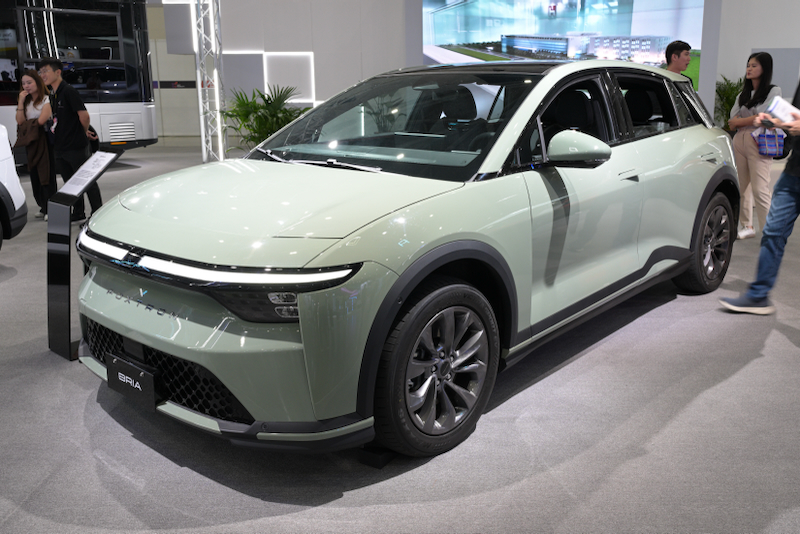
While Poland will be one of Foxconn’s largest EV production hubs, the company has already started manufacturing electric cars in Taiwan. In December 2025, the company launched the Bria under its subsidiary Foxtron, the first EV manufactured in Taiwan for global export, which will be sold by Mitsubishi Motors in Australia and New Zealand.
“Guided by Detroit-based industry veteran Kip Ewing, the vehicle is designed to meet global standards and the expectations of international consumers — an achievement already recognized by Japanese partners,” Foxtron said in a news release.
On June 17, Foxtron launched what it describes as its second main model, the Cavira, a midsize SUV that is built at a Yulon Group factory in Miaoli County. With an 82.7 kWh LFP battery, a range of up to 359 miles, and a starting price of NT$1.24 million (about US$38,000), the Cavira is likely to compete with the hugely popular Tesla Model Y.

Unlike conventional completely built-up vehicle exports, the Cavira possesses greater cross-border export potential as a reference design, explains TrendForce’s Chen. “It serves as a flagship blueprint for Foxconn to showcase its high cost-effectiveness and rapid time-to-market capabilities to global B2B clients,” she says.
She expects that the Cavira will target three niche markets: B2B operational scenarios such as car rentals and ride-hailing fleets, emerging regional markets where EV adoption is in its infancy, and lastly, second-tier legacy automakers that lack in-house R&D capabilities but are eager to launch new models quickly to counter fierce market competition.
Market challenges
While Foxconn has many factors working in its favor for its entry into the EV market, it still faces some formidable challenges. Global Fleet, a Belgium-based media platform that focuses on automotive fleet management, noted in a March 2025 analysis that Foxconn has struggled to gain traction in the international auto sector, despite its successful rollout of electric buses and passenger vehicles in Taiwan. Many of the U.S.-based EV startups Foxconn previously targeted as customers have struggled or collapsed.
At the same time, the Trump administration’s mercurial tariff policy has further hindered Foxconn’s plans to enter the U.S. EV market.
“To overcome these obstacles, Foxconn is actively courting established Japanese automakers — pursuing potential partnerships and production deals with brands like Nissan, Honda, and Mitsubishi to provide the necessary scale and credibility,” Global Fleet said.
Thus far, only a partnership with Mitsubishi has come to fruition, but Foxconn continues to engage in discussions with Nissan. According to Japan’s Nikkei Asia, Foxconn might use Nissan’s underutilized Oppama Plant in Yokosuka to produce EVs of its own.
Ultimately, partnering with Japanese automakers — who benefit from strong brands and deep knowledge of consumer preferences — and focusing on developed economies in Europe, Asia, and Oceania could be the best way for Foxconn to establish itself as a credible EV manufacturer in the short to medium term.
In the long term, the company could still sell vehicles in the U.S. market, but not until market conditions become more favorable to foreign manufacturers.