The humanoid robot wars are kicking off, but the robots aren’t fighting each other — at least for now. Instead, we’re looking at a war fought on paper by governments competing to dominate a new, fast-growing market in which AI and mechanical bodies meet.
On Tuesday, the Federal Communications Commission announced a ban on robots — including the humanoid and quadruped varieties — originating from companies based outside the US. Such foreign-made products “pose unacceptable risks to the national security of the United States or the safety and security of United States persons,” the FCC said.
The restrictions will see new robots from foreign countries added to the FCC’s Covered List, unless they’re granted exemptions, but the sale and import of existing models already allowed by the FCC won’t be impacted.
The ban encompasses robots from all countries but is being widely interpreted as the US taking yet another swing against the Chinese tech industry. (The US already bans many Chinese products or shuts them out with steep tariffs, including phones, drones and electric vehicles.)
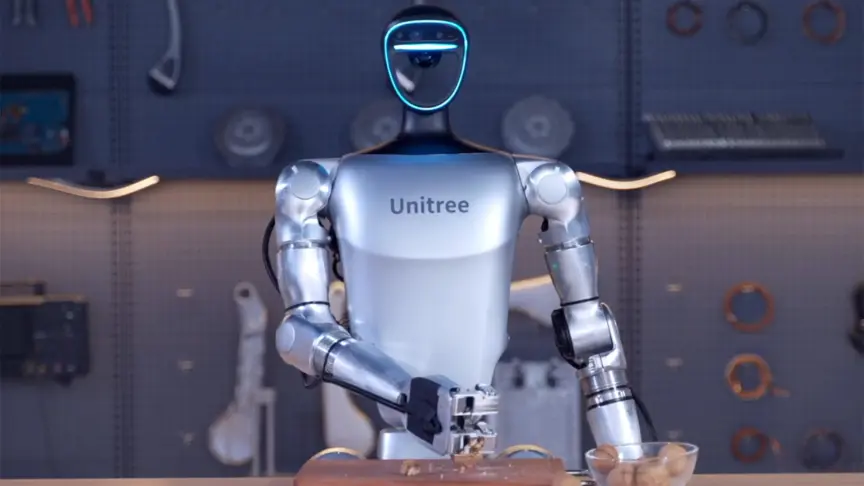
A massive boom is currently underway in the global robotics industry, fueled by advances in AI, but China is leading the way by a huge margin. According to tech research firm Omdia, China accounted for 90% of the 13,000 humanoid robots shipped last year. The country is also home to the three biggest humanoid robot makers: Agibot, Unitree and UBTech.
Meanwhile, under President Donald Trump, the US has put more emphasis on homegrown technology, and American companies like Tesla and Boston Dynamics are currently building humanoid robots of their own. Throughout the same period, the US has emerged as one of the two biggest players in the AI space — along with China.
The US frequently paints China as a threat to national security, but it’s also the country’s biggest competition, both in terms of economics and technological innovation. The US has accused Chinese AI companies of stealing the intellectual property of its AI companies in order to build their models — a claim China refutes. The nations have very different attitudes and approaches to developing AI but are seen to be engaged in a trillion-dollar arms race.
And so as the US imposes increasing trade restrictions on its rival, the lingering question is which of these factors — national security or competition — is the dominant driving force behind the decision to keep Chinese tech out of the US market.
“The US government is keen to support its domestic robot industry, shielding it from cheaper overseas competitors so that it can become established,” said Paul Miller, vice president and principal analyst at Forrester.
But, according to Miller, the US government “is also concerned about the national security implications of foreign connected mobile sensor platforms wandering near domestic critical infrastructure.” (In the age of physical AI, mobile sensor platforms are exactly what these humanoids and quadrupeds are.)
In the update to the Covered List that the FCC issued this week, it detailed its concerns about the potential for robots to be used against US citizens.
“Advanced robotic devices collect data that could be leveraged by malign actors to surveil Americans, enhance the capabilities of foreign intelligence services, or to remotely commandeer the robots,” it said.
But that doesn’t mean the US doesn’t harbor dual motivations.
Will China retaliate?
Meanwhile, China is not taking the ban lying down.
In a statement given to reporters on Tuesday (and translated by Google), a spokesperson for the country’s Minister for Commerce said that the decision taken by the FCC was an attempt to discriminate against Chinese companies and products “under the guise of ‘non-discrimination.’”
The US was “overstretching the concept of national security,” the spokesperson added, urging the US to revoke the decision or face countermeasures.
If China follows through on countermeasures, the US’s decision could come back to bite. It could end up blocking US robotics companies from access to key components.
Supply chains for robots are complex and international, and unpacking them would be a costly undertaking, Miller says. He added that, at least in the short term, keeping international companies from selling in the US and “barring American companies from using some of the most advanced robotic components risks dramatically slowing their pace of innovation and raising the price of their products for consumers.”
Beyond robotics companies building competitor products, the ban could also hit university researchers and tech companies that rely on affordable Chinese robots.

Kyle Chan, a research fellow at Brookings Institution, said in a post on X that he agreed “with the intent but not the approach.” While it was necessary to keep Chinese robots away from sensitive industries and critical infrastructure, the ban was too “sweeping,” Chan said.
Many US companies developing AI rely on robots made by companies like Unitree to experiment on and build out their software, Chan said. “Cutting them off would slow down American innovation.”
Even US robotics companies are being restrained with their praise. Oregon-based Agility Robotics said in a post on X that while the decision was an “important step” in the right direction, it advocated for continued policy discussion with Washington.
“Agility’s academic roots and continued commitment to innovation give us a deep appreciation for maintaining access to all of the tools and technologies that advance robotics research,” the robotics company said. “We will continue to advocate for policies that simultaneously protect US security and privacy and enable continued US technology leadership.”
It’s still early days for the humanoid robotics market, and this is just the beginning of a much bigger conversation. Which country will shout the loudest about safety and policy, and which will win the robot war? They might not be one and the same.