Australia no longer makes cars, but it is still shaped by the countries that do. That matters more than ever as the global car industry is reordered by electrification.
The clearest lesson from the data is that the future winners are not being decided first in export markets. They are being decided at home, in the domestic markets where manufacturers learn how to build, sell and improve electric vehicles at scale.
China is the clearest example. Its carbon-peaking action plan sets a target for new energy vehicles to make up 30% of the entire national vehicle fleet by 2030, not just 30% of annual sales. By the end of June 2026, China already had 48.97 million NEVs on the road, equal to 13.2% of its total fleet.
That domestic momentum is feeding directly into export strength – and it has just passed a milestone. In June 2026 China exported more than one million vehicles in a single month for the first time, up 75% year on year, and 523,000 of them were new energy vehicles – the first month in which NEVs were the majority of China’s vehicle exports.
Beijing is confident enough in that trajectory to now be winding support back rather than propping it up, scrapping vehicle tax breaks for plug-in hybrids and electric commercial vehicles from 2027.
Thailand is following a similar path on a smaller but highly relevant scale for Australia. Chinese brands have rapidly captured the Thai EV market, and Thailand has revised its EV incentives to encourage exports as well as local sales.
The policy change matters because Thailand is one of Australia’s most important vehicle suppliers. If Thailand’s factories electrify quickly, Australia will get more EVs, sooner and at more competitive prices. If Thailand stayed locked into petrol and diesel, Australia would feel that drag in its own market — or (a warning for Thailand) simply buy an even greater share of electric vehicles from China.
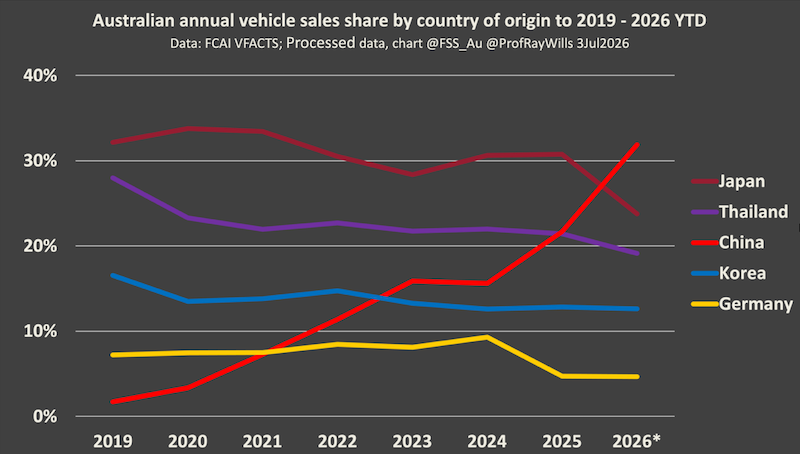
FIGURE Australia’s annual vehicle sales share by country of origin
That warning is no longer hypothetical. In June 2026, China overtook Japan as Australia’s largest source of new vehicles for the fifth consecutive month. More than 80% of the EVs sold in Australia are now made in China.
This is the key pattern emerging from the domestic market charts.
Countries that electrify quickly at home are also the countries building momentum in EV exports. China and Thailand sit in that leading group.
Japan and the United States sit well behind on battery-electric share in their home markets, with South Korea also slower than the leaders. Germany is improving, but Europe as a whole is still moving more cautiously than its climate and industrial rhetoric suggests.
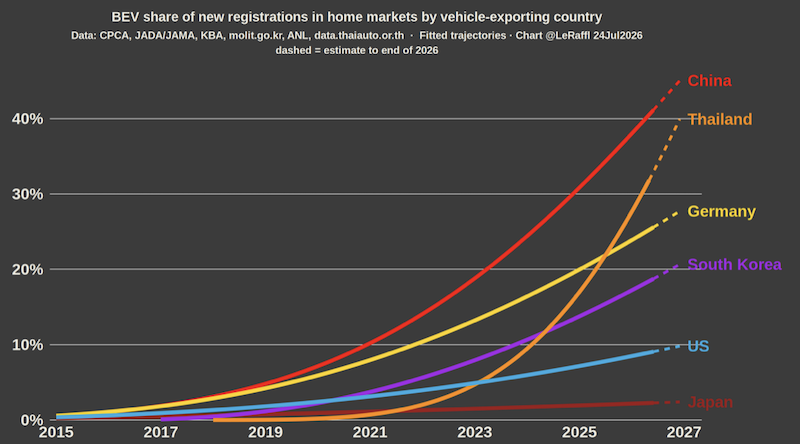
FIGURE Vehicle exporting countries BEV share of new registrations in home markets to 2027
That matters for Australia because Australia is a vehicle taker, not a vehicle maker. With no domestic manufacturing, Australians buy what global manufacturers choose to build and what exporting countries decide to make. Which is also why we think Australia must be more engaged in standards development in our suppliers’ domains.
The June numbers show how fast the taking is happening. Australians bought a record 32,570 battery electric vehicles in June — 23.3% of all new car sales, up from 8.4% in January.
Counting plug-in hybrids, electrified vehicles reached 35.8% of the new passenger market. The Tesla Model Y was Australia’s best-selling vehicle of any fuel type for the second month running, and BYD finished 243 sales short of Toyota. Every one of the seven best-selling electric models in June was built in China.
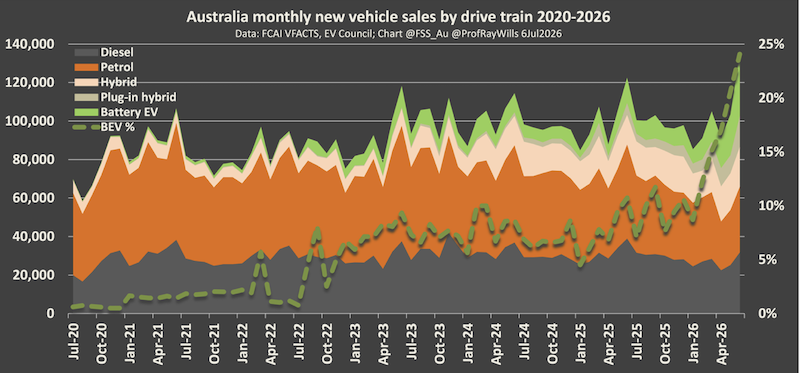
FIGURE Australian monthly new vehicle sales by drivetrain
The reverse side of that ledger is just as instructive. Brands that did not electrify at home are not merely losing share in Australia — some are leaving.
For years, Australia was also slow on policy. The New Vehicle Efficiency Standard only began recently, after long delays that left Australia as one of the last advanced economies without mandatory fuel-efficiency standards.
That is now changing, but the transition will still be shaped heavily by what happens in China, Thailand and, to a lesser degree, Europe.
Singapore offers another lesson. Singapore has no domestic car industry to protect, and that has made decisive policy easier. The country stopped new diesel car and taxi registrations from 2025 and is pushing toward a fully cleaner new-vehicle market.
In June 2026 battery electrics hit a record 70.1% of new registrations, with pure petrol and diesel cars down to under 4%. Plug-in hybrids managed just 2.6% – in Singapore that transition step never happened at all – and conventional hybrids have been declining for 21 months since peaking at 49% of the market in September 2024.
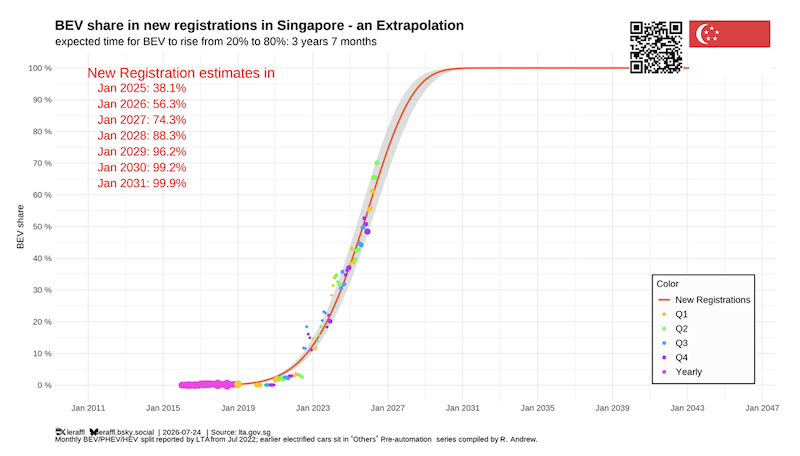
FIGURE Singapore BEV, PHEV and ICE share of new registrations @LeRaffl
That is the deeper point of the Singapore chart: where policy is unambiguous, the trajectory arrives with almost no fluctuation. Industry and consumers know battery electric is the destination, so charging, servicing and grid investment can be planned rather than guessed at.
Australia is not Singapore, but the comparison is still useful: where there is no local industry to defend, governments can move more directly to phase down internal combustion engines. The cars available here over the next five to ten years will increasingly reflect the domestic policy choices of our major suppliers.
China’s NEV push – dominated by BEVs – will keep producing cheaper, better EVs. Thailand’s new export-oriented EV strategy will reshape the vehicles Australia imports from Southeast Asia.
Europe’s slower, hybrid-heavy transition will matter, but less than it once did. Japan’s hesitation will increasingly look like a problem for Japanese brands, not a stable foundation for Australian consumers.
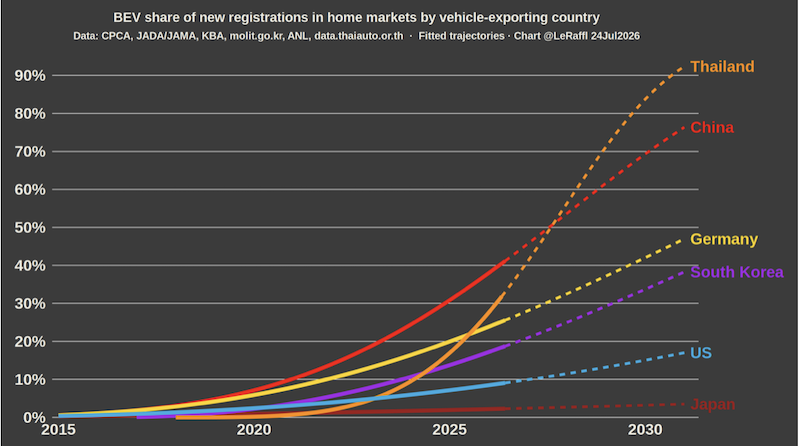
FIGURE BEV share of new registrations in home markets to 2031
There is now a second, harder-edged reason for Australia to care. Months of disruption to oil shipping through the Strait of Hormuz have exposed this country as one of the developed world’s most fuel-import-dependent economies.
The half a million battery electric vehicles now on Australian roads are measurably reducing petrol demand, and continued uptake should leave Australia less exposed to the next shortage.
Electrification has stopped being only a climate policy and become a fuel-security policy – and, as one of us has argued, diesel is the larger and still-unaddressed half of that problem.
That makes the NVES much more important than a narrow compliance debate suggests. It is not just a carbon policy. It is Australia’s main signal to global manufacturers that this market is serious about electrification.
If the standard tightens as intended, suppliers will send more efficient and electric models. If it is weakened or politically delayed, Australia risks becoming a dumping ground for vehicles that more advanced markets no longer want.
The wider lesson is that electrification is not only a climate transition. It is an industrial and market transition. Countries that move first at home build the industrial capability to lead abroad. Countries that delay at home lose that edge.
Australia isn’t in the world’s club of car makers anymore, but it can decide which future it chooses and imports. Right now, the evidence from China and Thailand suggests the future arriving at Australian docks will be electric.
The real question is whether Australian policy will keep up.
Professor Ray Wills is Managing Director of Future Smart Strategies and an adjunct professor at The University of Western Australia, and breathes clean energy, sustainability, and technology.
Professor Peter Newman AO is Professor of Sustainability at Curtin University and a Coordinating Lead Author for transport with the IPCC.
Raphael Wellmann is a data analyst specialising in electric-vehicle markets across Europe, North America, China and emerging regions.