Partnerships with China, not protectionism, will determine affordable, interoperable and equitable global decarbonisation and energy security.
The global net zero transition has a supply chain, and it runs through China.
This is not a geopolitical talking point — it is the operating reality of the fastest energy shift in human history.
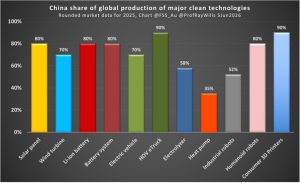
China now produces around 80 percent of the world’s solar panels, 80 percent of lithium-ion battery cells, 70 percent of EVs, and more than 90 percent of heavy electric trucks as well as other green tech. This acceleration in clean tech is following Wrights Law, with dramatic global impact as shown below.

Between 2019 and 2025, Chinese companies accounted for 55 percent of the world’s total US$1.1 trillion in clean energy manufacturing investment. In March 2026 alone, China’s exports of solar, batteries and EVs reached a record US$26 billion — up 70 percent on the same month the year before — as attacks on Iran and closure of the Strait of Hormuz triggered the world’s fourth oil crisis and drove a global scramble for energy alternatives.
The global EV fleet displaced 1.8 million barrels of oil per day in 2025, equivalent to 13 percent of US crude production.

The world is already deeply, irreversibly dependent on Chinese clean technology for the net zero transition. The only question is whether that dependency is managed through antagonism and trade barriers — raising costs and slowing deployment — or through purposeful partnerships that accelerate the transition while ensuring equipment is fit for purpose and is working well everywhere it is used.
Clean tech sources
Technology standards have mostly been created by the country that dominates the new technologies, before they become part of a global process. China is now taking on the key role of setting standards as part of their production responsibilities. China is not just making clean technology, it is increasingly writing the rules for how it works.
In January 2026, China introduced the world’s first mandatory energy consumption standard for battery-electric passenger vehicles — a hard cap on kilowatt-hours per 100 kilometres, differentiated by vehicle weight and 11 percent stricter than previous recommended guidelines. In July 2026, its mandatory battery safety standard took effect, requiring no fire or explosion from EV power batteries — the first time such criteria have been defined as binding national requirements.
Carbon footprint reporting for EV batteries is now mandatory in China for these products, with lifecycle tracking from raw material extraction through recycling. China has also implemented strict battery recycling rules, establishing a national information platform to trace every battery from production to end-of-life.
The net zero transition needs such leadership in standards, and the world’s standard setting is beginning to respond as nations take up the new clean tech. These standards are suggested for every country they export to, but they can only be required if the countries involved agree to support them.
In 2025 alone, China took the lead in formulating 285 international standards under the ISO and IEC — up 27 percent year on year — in areas including new energy, electric vehicles and lithium-ion batteries. It signed 130 standardisation cooperation agreements with 75 countries and organisations. China’s role in global standard-setting has shifted, as documented by the Clingendael Institute, from adopting international standards to actively shaping them.
This is not a threat. It is an opportunity — if the rest of the world engages rather than retreats.
What partnerships are needed?
The alternative to partnership is not independence. It is irrelevance and some countries are actively trying to prevent these imports.
The US and EU have erected tariffs of 25 to 100 percent on Chinese EVs and clean technology. The result is higher costs for their own consumers and slower decarbonisation — while China’s export machine continues to supply the rest of the world at record levels.
A genuine global partnership for net zero would work differently.
It would begin by embracing the new technology with its low costs instead of imposing tariffs. Then it would need to engage in China’s standard-setting processes — ensuring that the mandatory rules being written for the world’s largest clean technology market are interoperable with the grids, vehicles and infrastructure of importing nations.
It would mean reciprocal transparency on performance data, so that battery chemistries, thermal management systems, and vehicle-to-grid protocols are understood and plannable by utilities and regulators outside China.
And it would mean building the trade and investment frameworks that allow minerals, technology and skills to flow efficiently between complementary economies — not just in one direction. Such flows can enable all regions of the world to gain from the clean tech revolution.
The IEA, the UN, and the Paris Agreement all envisage a global transition and recognise the need for new standards to be set that enable all parts of the world to gain benefit. These organisations did not anticipate the scale of China’s manufacturing dominance in clean tech and hence have been slow to help establish global standards that recognise the Chinese standards. The gap between global climate ambition and global industrial reality is filled, right now, by Chinese factories.
Closing that gap requires engaging China as the central actor it already is, not as a peripheral partner to be managed. New partnerships with Chinese clean tech production need to be established so that the net zero transition can be properly and equitably managed across the world.
The path forward involves three commitments that importing nations and international institutions should make explicitly.
- Engage in China’s standard-setting — not to block or slow it, but to ensure mandatory Chinese standards for EVs, batteries and green tech are interoperable with the grids, vehicles and regulatory systems of importing countries.
- Build reciprocal data transparency — requiring shared, comparable performance, safety and lifecycle data on batteries, EVs and clean tech, so utilities, regulators and repairers outside China can plan with confidence rather than guess.
- Fund the trade and investment architecture for two-way flows — channelling green minerals, capital and skills into China’s production system, while building local integration, servicing and demonstration capacity in return, rather than treating clean tech purely as an import line.
None of these steps requires trusting China unconditionally. They require treating China as the central industrial actor it already is — and building the rules, data and institutions that make partnership more useful, more equitable and more sustainable, rather than antipathy.
Peter Newman AO is John Curtin Distinguished Professor of Sustainability at Curtin University and a Coordinating Lead Author for the IPCC’s 2022 Mitigation Report on Transport. He has spent five decades providing arguments and evidence why electric wheels are rewriting the world’s transport story as part of the clean tech transition.
Ray Wills is Adjunct Professor at The University of Western Australia and Managing Director of Future Smart Strategies, where he tracks the data proving that China’s clean technology surge is the defining industrial story of our era.
Originally published under Creative Commons by 360info™.