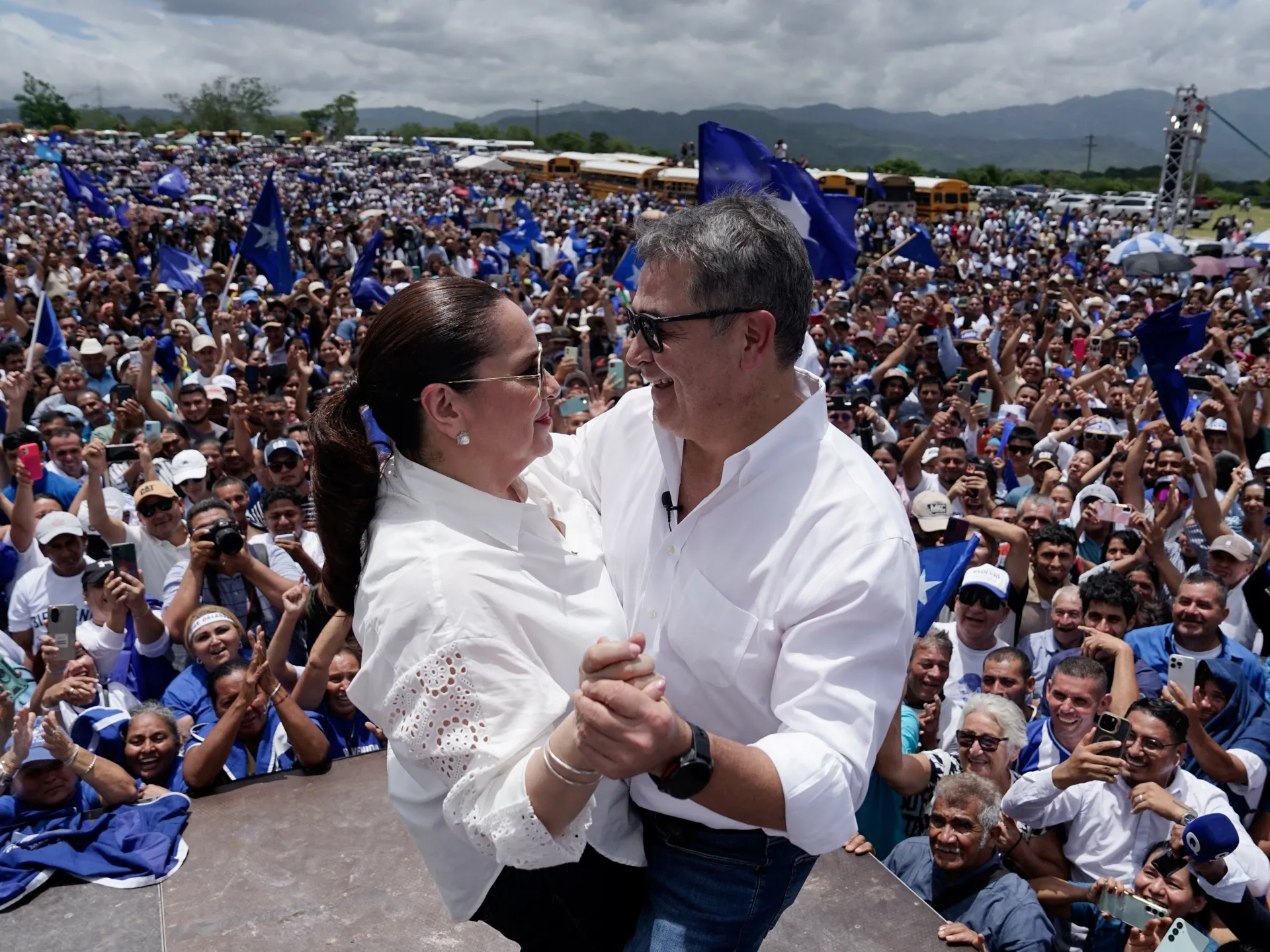
Nearly four years after being extradited to the United States for a drug-trafficking trial, former Honduran President Juan Orlando Hernandez returned home after a pardon by US President Donald Trump at the end of last year.
Trump claimed the trial was a “set up” orchestrated by former President Joe Biden’s administration.
Hernandez still faces corruption charges in Honduras but returned on Sunday after an arrest warrant against him was cancelled.
Human rights activists and lawyers fear a trial on home soil, where his party holds the presidency, would be a sham.
So why did Trump pardon and release the former president of Honduras despite abducting and arresting Venezuela’s Nicolas Maduro on drug and gun charges in January?

Why did Hernandez return to Honduras?
Hernandez was able to return after being pardoned by Trump, released from a US prison and then having an arrest warrant against him suspended last month.
He arrived at Palmerola International Airport, where he was greeted by his family and supporters of his National Party.
Hernandez led his country from 2014 to 2022, during which, according to US prosecutors, he once boasted he would “shove the drugs right up the noses of the gringos”, referring to Americans.
Shortly after leaving office, he was extradited to the US, where he was found guilty by a federal jury and sentenced to 45 years in prison for involvement in a scheme to export cocaine to the US.
Prosecutors described the scheme as “one of the largest and most violent drug trafficking conspiracies in the world”. He was convicted of accepting millions of dollars in bribes from violent drug-trafficking organisations over 18 years, which he was alleged to have used to fuel his rise in politics.
“During his political career, Hernandez abused his powerful positions and authority in Honduras to facilitate the importation of over 400 tons of cocaine into the US,” the US Department of Justice said after he was sentenced last year.
During his trial, Hernandez denied taking bribes from drug dealers, arguing he in fact cracked down on the narcotics trade and citing his administration’s cooperation with the US military.
“I cannot deny the profound emotion and joy I feel in my heart to be returning home,” Hernandez wrote on social media earlier this month, saying he was counting down the days to see his family.
“It wasn’t easy. The process has been extremely difficult … and what I experienced in prison, I truly wouldn’t wish on anyone,” he added.
Hernandez is expected to appear in court on August 3 to face the Honduran corruption charges.
Why did Trump pardon him?
Under the US Constitution, a president may offer two types of clemency for federal crimes: pardons, which forgive defendants their federal charges and restore their civil liberties, and commutations, which reduce people’s punishment without addressing their convictions.
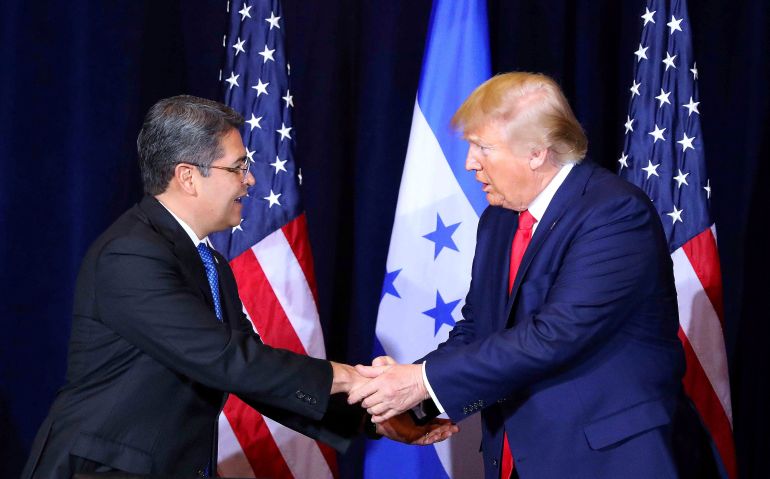
Hernandez was pardoned by Trump in December. The US president said Hernandez had not received a fair trial and had been “set up” by the Biden administration.
Trump added that Hernandez was “treated very harshly and unfairly”.
At the same time, Trump also threw his weight behind right-wing candidate Nasry “Tito” Asfura, a member of Hernandez’s party. He ran in November’s presidential election and was declared the winner a month later in the close race after delays and allegations of fraud. He took office in January.
A Pandora Papers corruption investigation also accused Hernandez of diverting nearly $11m in state funds to political campaigns from 2010 to 2013.

Why a pardon for some but jail for others?
The Trump administration has faced criticism at home for pardoning the Honduran leader while at the same time abducting former President Maduro of Venezuela and his wife, Cilia Flores, in January on similar charges.
Maduro and Flores were seized in Caracas by the US military and flown to New York, where he is facing a range of guns and drugs charges and accusations of being a “narcoterrorist”.
At the time of Maduro’s abduction and since then, the Trump administration has targeted small boats in the Caribbean and eastern Pacific that it claims, without providing evidence, are involved in drug trafficking. More than 220 people have been killed in more than 60 such strikes on small boats in what many lawyers and activists have deemed extrajudicial killings.
Since taking office for a second term in January 2025, Trump has ordered more than 1,800 acts of clemency benefitting a range of personalities, including cryptocurrency billionaires, disgraced politicians and hundreds of political allies.
Some of the most controversial beneficiaries are supporters of his Make America Great Again (MAGA) movement, including hundreds of rioters who attacked the US Capitol on January 6, 2021, in a bid to prevent the certification of Biden’s electoral victory over Trump two months earlier.
Legal experts have argued that while the president’s clemency power is broad, using it for allegedly corrupt purposes, such as to protect political allies or obstruct justice, could form the basis for impeachment proceedings.
US constitutional expert Bruce Fein told Al Jazeera that the US Constitution’s framers “understood the abuse of the pardon power to shelter political or personal friends to constitute an impeachable high crime and misdemeanour justifying the removal of the president through the impeachment process”.
“If Democrats gain control of Congress in the midterm elections, Trump will be in impeachment jeopardy for pardoning Hernandez,” Fein said, referring to elections in November.