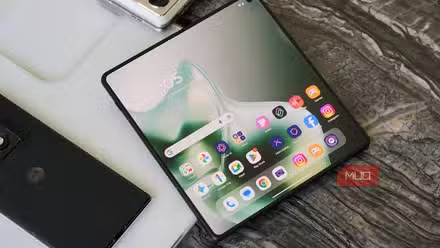
Say “Motorola” to most folks, and they picture a Razr flip phone, or the bat-wing logo on a Moto G box at Walmart. For me, I look to my Razr Fold, my favorite smartphone of 2026 so far (that I’ve tried!).
Interestingly, it’s the smaller of two companies using the Motorola name. The one you know is owned by Lenovo and deals with smartphones. The one you don’t sells communication tech to other businesses, and keeps the world moving.
Motorola split into two companies
It was never just a phone company to begin with
Motorola’s history stretches back to 1928, when it was founded as the Galvin Manufacturing Corporation in Chicago. The company adopted the Motorola name years later, combining “motor,” reflecting the growing popularity of automobiles, with “Victrola,” a well-known brand of home phonographs at the time.
Over the following decades, Motorola became one of America’s biggest technology companies. It produced car radios, televisions, semiconductors, two-way radios, pagers, and countless other electronic devices. Its communications equipment was used during NASA’s Apollo missions, carrying Neil Armstrong’s famous “One small step” words from the Moon back to Earth.
The company also helped define the mobile phone industry. Motorola engineer Martin Cooper made the world’s first public handheld mobile phone call in 1973, and the company remained a mobile giant for decades. By the early 2000s, the ultra-thin Razr V3 had become one of the best-selling phones ever made, selling well over 100 million units.
But the smartphone arm wasn’t actually hugely profitable, being propped up by the rest of the company.
Then, in 2008, investor Carl Icahn pushed Motorola to split up. It took three years to complete, but on January 4, 2011, Motorola, Inc. split into two separate public companies: Motorola Mobility, which kept the phones and set-top boxes, and Motorola Solutions, which kept the police radios and barcode scanners.
One Motorola went to Google
And then quickly onto Lenovo
Motorola Mobility didn’t stay independent for long. Google bought it in 2012 for $12.5 billion, at the time the largest acquisition in the company’s history.
The official line was smartphones; the real reason was patents — a portfolio Google wanted to defend Android against a wave of lawsuits from Apple and Microsoft. At the time, Motorola owned one of the industry’s largest collections of mobile technology patents, which gave Google valuable protection during the increasingly heated smartphone patent wars.
But 19 months later? Google was done with Motorola, and sold the phone business to Lenovo for a discounted $2.9 billion, keeping most of the patents for itself. Assumedly, the widely cited $9 billion write-off was worth the value of the patents. But in the process, Lenovo picked up Motorola’s top smartphone lines — one of the few smartphone brands with an actual foothold in the US market.
Every Moto G, Edge, Razr, and ThinkPhone sold today comes from Motorola Mobility, which operates as part of Lenovo’s global device business.
The other Motorola didn’t go anywhere
Motorola Solutions just doesn’t sell smartphones
While Motorola Mobility changed hands twice in just a few years, Motorola Solutions continued operating as an independent American company. It posted $11.7 billion in net sales in 2025 and turned $2.2 billion of that into net earnings, and it’s stock market value was sitting at around $68 billion in mid-2026, at the time of writing.
Its customers aren’t smartphone or laptop buyers, but it does still revolve around communications systems. Motorola Solutions supplies digital radio networks used by emergency services, dispatch software that coordinates responses to major incidents, body-worn cameras for police officers, command center software, video surveillance systems, and security platforms that integrate thousands of cameras and sensors across cities, airports, and industrial sites.
It’s entirely possible to spend your whole life relying on Motorola Solutions technology without ever realizing it. If emergency services respond to an incident, an airport coordinates aircraft movements, or a utility company manages its field engineers, there’s a reasonable chance Motorola Solutions technology is involved somewhere behind the scenes.
Interestingly, there is a bit of a mismatch with the total revenues from the two companies with similar names. While Motorola Solutions hit just shy of $12 billion, Lenovo’s total business revenue surpassed $80 billion in 2025/2026.
Why both companies still use the Motorola name
The Motorola you don’t see might be more important
The answer for this bit is actually simpler than you might think: as both are direct descendants of the original Motorola Inc, they are both entitled to keep using the name — but only through a little agreement in the deal. The Motorola trademark and brand name are owned by Motorola Trademark Holdings LLC, which licenses them out to the split entities.
When the company split in 2011, agreements were put in place allowing each business to continue using the Motorola brand within their respective markets. Motorola Mobility focuses on consumer electronics, while Motorola Solutions serves enterprise, industrial, and government customers.
Since there’s very little overlap between those markets, the arrangement has worked remarkably well. Most consumers never encounter Motorola Solutions, while police departments and infrastructure providers aren’t shopping for Android phones.
At the end of it all, Motorola’s legacy isn’t just the Razr line, the first mobile phone, or today’s affordable Android handsets. It’s also the radio systems that help emergency responders communicate during disasters, the dispatch platforms that coordinate ambulance services, the security systems that protect airports, and the networks that keep critical infrastructure connected.