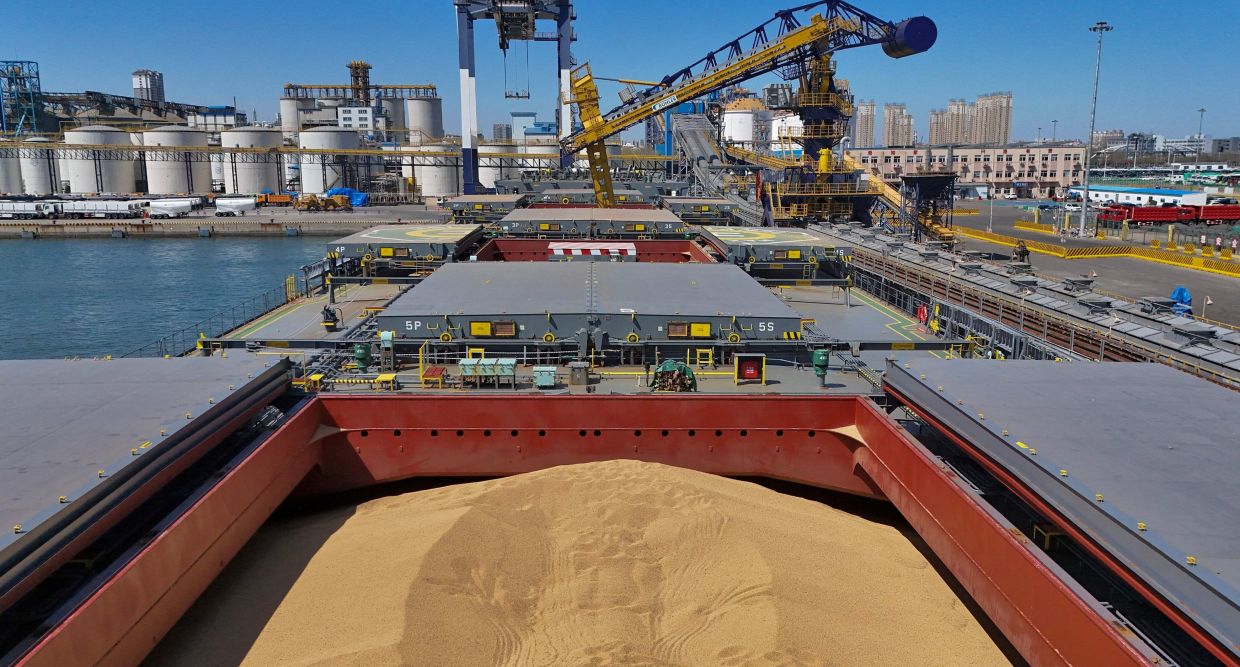
China imported 12.08 million tonnes of Brazilian soybeans in June, up 13.7 per cent from a year earlier, while volumes from the United States fell 20.6 per cent to 1.27 million tonnes, far off the pace implied by the purchasing deal agreed by Presidents Donald Trump and Xi Jinping, according to figures released on Monday by China’s General Administration of Customs.
Total arrivals of the oilseed reached 13.55 million tonnes, a record for the month, lifted by Brazilian supply and by the clearing of cargoes that had been delayed at Chinese ports.
In June of last year, Brazil sent 10.62 million tonnes, and the United States 1.6 million tonnes.
The half-year figures set the June result in a longer decline. Imports from the US fell 42.4 per cent between January and June, to 9.31 million tonnes, against a Chinese pledge to take at least 25 million tonnes a year through 2028. Brazilian volumes over the same period rose 9.1 per cent, to 34.75 million tonnes.
The commitment is annual, and June shipments reflect purchases made weeks or months earlier, which leaves room for buying to be concentrated later in the year.
The pledge has since survived a second round of leader-level diplomacy. Despite pressure from the White House, the meeting between Trump and Xi in May left the annual target untouched.
Record trade with China as the US market closes
What arrived at Chinese ports in June reflects a broader shift in where Brazil sells, and that shift is being reinforced from Washington.
Brazilian exports to China reached US$58.3 billion in the first half, a 22 per cent rise and a record for the period, according to a report published on Wednesday by the China-Brazil Business Council.
Its calculations rest on trade ministry figures compiled from the Comex Stat database between July 3 and July 10. Over the same six months, sales to the United States fell 13 per cent, to US$17.4 billion, leaving Brazil with a surplus of US$19.8 billion with China, equivalent to 47 per cent of its total trade surplus.
On the same Wednesday the report came out, the US Trade Representative confirmed a 25 per cent tariff on Brazilian goods.
The measure closes a Section 301 investigation into practices that included illegal deforestation, access to the ethanol market and disagreements over Pix, a free payment system created by Brazil’s Central Bank and widely used nationwide.
In a note, Amcham Brasil put the exposure at more than US$11 billion in industrial and agricultural exports, or 26 per cent of what Brazil sells to the United States.
Coffee, beef, orange juice, oil and gas and aerospace components were left out of the measure, which concentrates the burden on manufacturers.
China was one of the central parties in the negotiations that preceded the tariff. According to Brazil’s Development, Industry and Trade minister Marcio Elias Rosa, US officials raised critical minerals during the talks and argued that exploration should be denied to entities that do not operate on market terms, in a reference to Beijing.

Rosa said last week that his team rejected the proposal, saying rare earths and critical minerals belong to the Brazilian people.
Washington also asked for zero tariffs on industrial goods, machinery, chemicals, aerospace and automotive products, as well as ethanol, and for Brazil not to regulate digital platforms.
Soybean revenue rises, but not volume
The soybean trade that anchors the relationship with China is growing in revenue while tonnage remains flat, limiting how much more it can carry.
Brazilian soybean export revenue to China rose seven per cent in the first half, to US$20.2 billion, the council reported. That single product earned more than everything Brazil sold to the US in the same period. The increase came from prices, which rose 7.3 per cent, while the volume shipped fell 0.2 per cent.
China took 69.5 per cent of Brazil’s soybean exports, and the grain accounted for 34.7 per cent of Brazilian sales to China, a share 4.8 percentage points lower than a year earlier. What displaced it was oil.
Crude sales to China also rose 62 per cent to US$15.1 billion, a record for the period, a move the council attributed to Middle East tensions and the risk of disruption at the Strait of Hormuz, which led Chinese buyers to reduce their dependence on Gulf suppliers.
Iron ore volumes followed the same direction, reaching 135 million tonnes, a record for the first half, worth US$9.2 billion. Beef exports rose 50 per cent to US$4.8 billion as shippers filled a 1.1 million-tonne quota before a 55 per cent surcharge applies to anything above it, and that quota was nearly exhausted in June.